May 10 2010
The coffee rings phenomenon could increase the sensitivity of biosensors. This phenomenon can be noticed when coffee is spilled on a table and observing the spot where the spilled coffee has evaporated.
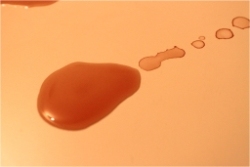 UCLA Coffee ring
At this spot a dark ring is formed around the perimeter where the particles are more concentrated as compared to the center. Many other liquids also exhibit this phenomenon.
According to scientists these rings can be utilized for analyzing blood or various fluids for disease markers through bio-sensing gadgets.
The UCLA Center for Cell Control’s Director and the UCLA Henry Samueli School of Engineering and Applied Science’s Ben Rich–Lockheed Martin Professor Chih-Ming Ho, informed that understanding the transportation of nano and micro particles in evaporating droplets of liquids offers great avenues for several applications of technology, such as biomolecule concentration and separation, nanostructure self-assembly, particle coating and lithography patterning. He emphasized the importance of determining the phenomenon’s definite limits before venturing to engineer biosensing gadgets for these applications. Ho is also a member of the National Academy of Engineering.
UCLA Engineering's department of mechanical and aerospace engineering’s postdoctoral scholar and a member of the research team Tak-Sing Wong elaborated further that the human saliva or blood has many nano and micro scale particles or molecules that carry vital information on health. He revealed that when saliva or blood is placed on a surface and let to dry, the particles concentrate within a ring surrounding the stain left behind. This will help bio-scientists to quantify such biomarkers through various sensing techniques, even when they are small with minute amount in these droplets.
Whenever water evaporates out of a droplet, suspended particles in the liquid move to the edges of the droplet. These particles concentrate in a ring format around the stain left behind, when the water has evaporated completely. The water evaporation will be faster than the particles’ movements when the droplet is very small. Now the strain will have a relatively uniform concentration instead of a ring since the particles did not have adequate time to move towards the edges while they are in the liquid.
A research team under Ho has now determined the exact minimum coffee ring formation threshold, which could help in setting up standards for biosensor gadgets for detection of multiple diseases, besides other uses. The Journal of Physical Chemistry’s present issue has featured this research with the study also available online.
A special surface coated with a checkerboard pattern was created by the research team to find out the smallest droplet size capable of depicting a coffee ring when the evaporation process is complete. The pattern featured water loving or alternating hydrophilic material and water repelling or hydrophobic material. According to Wong finding out the minimal size of this ring will guide the bio-scientists to develop the smallest possible biosensors.
Source: http://www.ucla.edu