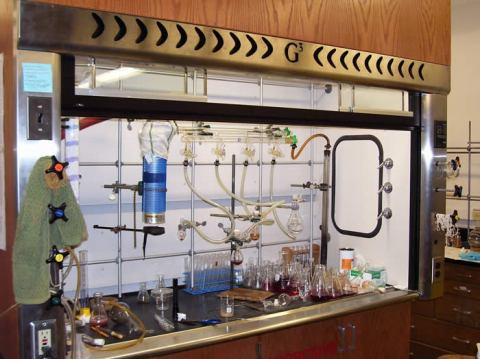
CAS DataLoggers pressure and temperature datalogging solution was recently delivered to a manufacturer utilizing a chemical fume hood for protection of workers.
 Accsense A1-01a Pressure and Temperature Data Loggers
The fume hood enables two-operator function. It consists of a fiberglas reinforced polyester liner that ensures protection from fires, chemical spills, or minor explosions. In addition, the in-built scrubber ducted hood absorbs the fumes via a plastic chamber, with subsequent water saturation.
However, in order to examine the lab room’s pressure differential, a general purpose wireless datalogging solution was the need of the hour and can function without affecting the outside space.
In order to link with commercial pressure transducers, this system entails 4-20mA input features and an ambient temperature sensor. An alarm was also needed in order to alert about differential pressure variations.
Deployment of 2 Accsense A1-01a Wireless Environmental Data Logger Pods was achieved. The pod’s data can be connected online via an Accsense B1-06 Wireless Data Logger Gateway with an incorporated 10/100BaseT Ethernet. For an effective differential pressure recording, these wireless pods were linked to pressure transducers.
By using external 4-20mA and 0-5V inputs and internal temperature sensor, the Accsense environmental sensor pods, enabled pressure and temperature monitoring respectively. The installation of Accsense was hassle-free, with its operation being consistent and simple. The system includes 2 digital inputs and a +5Vdc output to drive external sensors, enabling operation feasibility on either AC power or battery. The Accsense wireless gateway influences up to 16 sensor pods and supports DHCP and static IP addressing. A 250-sample data buffer shows dynamic function during power or internet outage.
The Accsense wireless system provided cloud-based data storage and reporting, enabling simplified alarming and archiving. The wireless gateway facilitated the pods to examine the pressure and temperature data of fume cupboard, wherein the data was transmitted to the ‘Rackspace’ cloud server or as a local ASCII stream for further use.
Accsense online account gave instant access to recent measurements from all sensor pods. Accsense system’s powerful alarm capabilities notified the staff in case the differential pressure or temperature exceeded specification. The system was successfully installed, eliminating the need for further training sessions.
Source: http://www.dataloggerinc.com/