In this article, Polytec's MSA Micro System Analyzer demonstrates how to characterize the topography of two microsystems employing substantial out-of-plane deflections as sensor elements.
The Micro System Analyzer's scanning white-light interferometer was first used to measure an integrated magneto-meter (magMEMS), whose detection principle is based on deflecting a current half-loop with a magnetic field (Lorentz force), and then to measure a flow microsensor, which uses cantilever deflection caused by incident air flows.
Assembling Microdevices
Starting with a Silicon-on-Insulator (SOI) wafer and standard CMOS technologies, surface micromachining was used to create an out-of-plane (3D) movable part by adding several CMOS-compatible steps, such as chemical release and low-temperature annealing, to achieve structures sensitive to airflow or magnetic fields.
Such mechanical structures are interfaced with electronics on the same chip and used in applications that need low power consumption, high and configurable sensitivity, and a tiny footprint.
The successful assembly of 3D CMOS-compatible MEMS sensors depends on the chemical release of microstructures and on the control of residual stresses that accumulate in multilayered structures throughout the entire heating process.
The deflection of multilayered constructions composed of both elastic and plastic thin films is caused by mismatches in thermal expansion coefficients between layers, as well as by plastic flow in a metallic layer.
Meeting the deflection requirements for multilayered micro-cantilevers is accomplished a posteriori by monitoring the process thermal budget and stack thickness.
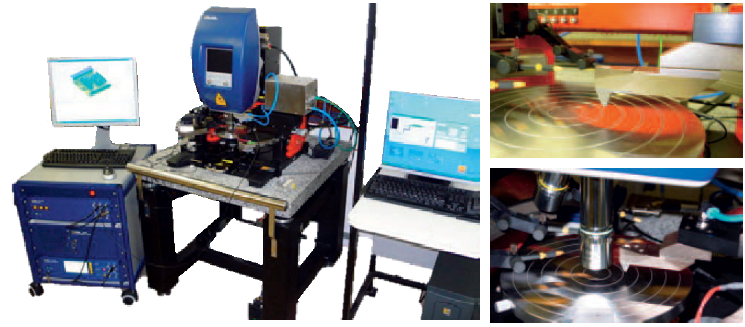
Figure 1. Measurement and test system, including the Micro System Analyzer and pressure unit (to the right, close views of the pressure nozzle). Image Credit: Polytec
Experimental Setup
To evaluate these MEMS sensors, Polytec's Micro System Analyzer was attached to a probe station on a vibration isolation table (Figure 1). The system includes two extra items: a pressure unit with a nozzle and a goniometer.
Results: 3D Half-Loop magMEMS (Integrated Magnetometer)
Figure 2 shows an SEM image of this CMOS-compatible magnetic field sensor. The Lorentz force converts an out-of-plane magnetic flux inside the device into a mechanical force on the M-shaped cantilever.
The magMEMS anchors use a Wheatstone bridge with four piezoresistors. The colored visualizations show the resulting deflection in both the off and on states of the device.
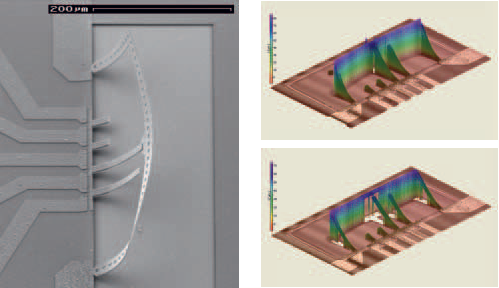
Figure 2. SEM view of a magMEMS (on the left); resulting deflections for off and on states (on the right). Image Credit: Polytec
Results: CMOS/MEMS Co-Integrated Flow Microsensor
Figure 3 shows an enlarged SEM view of the flow microsensor. Under air flow, the cantilevers bend downward, increasing their capacitance and lowering the oscillation frequency of the integrated ring oscillator.
These electrical measurements and real-time monitoring of the cantilever topography by the pressure module are being investigated. Figure 3 shows a topographic scan at the rest posture.
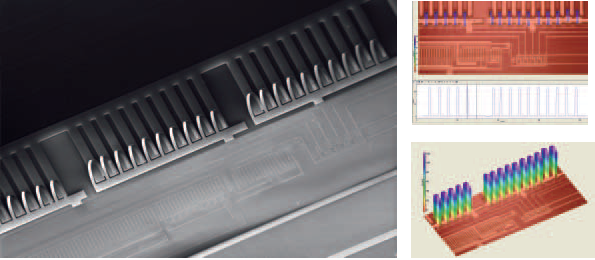
Figure 3. MEMS flow microsensors co-integrated with SOI CMOS circuits: SEM view (on the left), 2D and 3D topography profiles (on the right). Image Credit: Polytec
Conclusion/Outlook
New CMOS-compatible microsystems use Silicon-on-Insulator (SOI) technology to fabricate three-dimensional surface-micromachined sensors and actuators. Topographic examination with Polytec's MSA Micro System Analyzer is important for their development.
Flow sensors can be topographically scanned and measured using attachments that inject static pressure or constant airflow, along with a corrected objective lens. The MSA system also includes dynamic out-of-plane and in-plane vibration data, which could be useful in future investigations.
MSA: Micro System Analyzer
The MSA Micro System Analyzer is the leading measurement technology for analyzing and visualizing structural vibrations and surface topography in microstructures, such as MEMS (Micro-Electro-Mechanical Systems) devices.
The MSA-500 was created by fully integrating a microscope with Scanning Laser-Doppler Vibrometry, Stroboscopic Video Microscopy, and White Light Interferometry, resulting in an all-in-one combination of technologies that clarifies both the true microstructural response and topography.
MSA is integrated into the MEMS design and test cycle, providing precise 3D dynamic and static response data that simplifies troubleshooting, shortens and enhances design cycles, improves yield and performance, and lowers product costs. The MSA supports direct geometry scan data acquisition for vibration measurement.
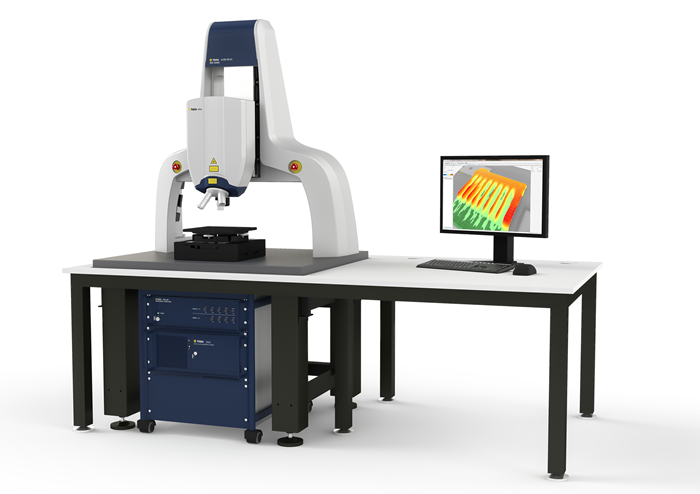
Image Credit: Polytec
Authors
- Eng. Nicolas André
- Stanislas Sobieski
- Prof. Laurent Francis
- Prof. Jean-Pierre Raskin
Electrical Department Université catholique de Louvain B-1348 Louvain-la-Neuve, Belgium

This information has been sourced, reviewed, and adapted from materials provided by Polytec.
For more information on this source, please visit Polytec.