Tunable diode laser absorption spectroscopy (TDLAS) is a laser-based technology that measures gas concentrations with high accuracy.
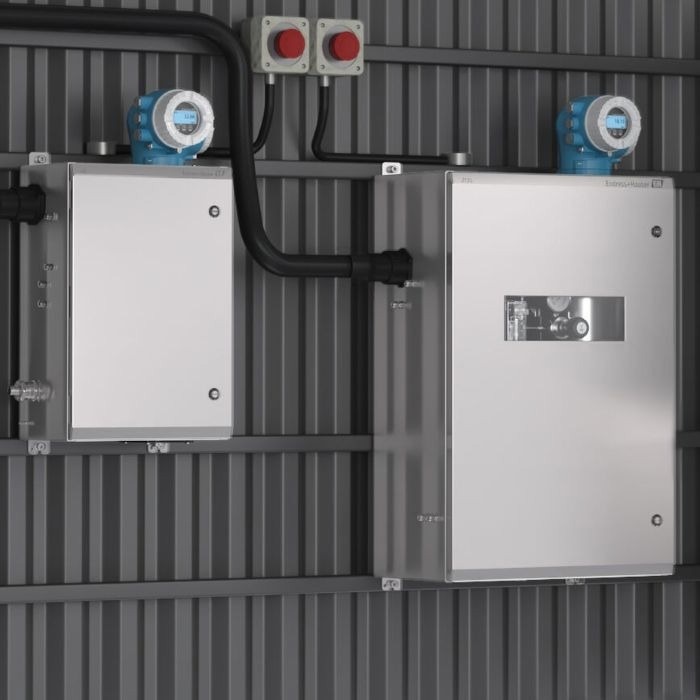
Image Credit: ©Endress+Hauser
It is used across a wide range of sectors, including natural gas, petrochemicals, refining, and environmental monitoring, where precise, real-time gas analysis is essential for safety, compliance, and process optimization.
Types of TDLAS
- In situ TDLAS detects gas concentrations directly over a chimney or duct, delivering real-time data without disrupting process flow.
- Extractive TDLAS diverts process gas through a bypass line to an analyzer, isolating the system for calibration, verification, and maintenance.
This article will take a closer look at extractive TDLAS analysis, examining its benefits in quality and process control.
How Absorption Spectroscopy Works
TDLAS works by setting a diode laser to a wavelength that corresponds to the target gas’ absorption line. As the laser travels through the gas sample, the molecules absorb light of that wavelength.
The absorption value shows the gas concentration, which can be as low as parts per billion.
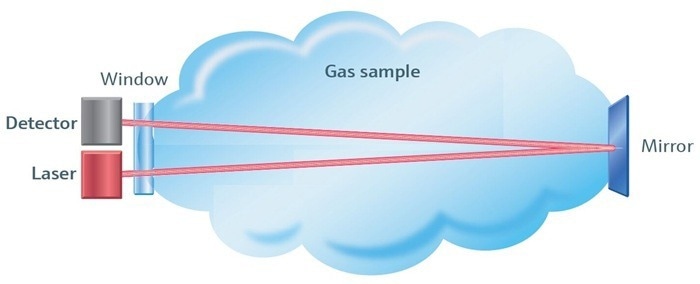
TDLAS two-pass cell arrangement. Image Credit: ©Endress+Hauser
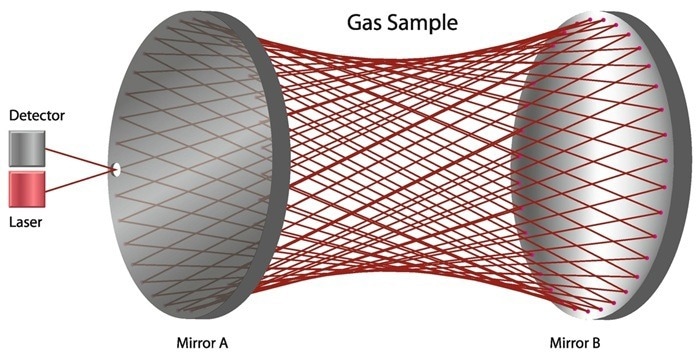
TDLAS Herriott-cell arrangement. Image Credit: ©Endress+Hauser
TDLAS is based on Beer-Lambert's Law, which describes how light is absorbed by a gas.
Eqn. 1: A = -ln(I/I0) = X • P • S • Φ • L
Where:
- A = absorbance
- I0 = incident light intensity
- I = transmitted light intensity
- X = mole fraction of the gas
- P = pressure
- S = line strength
- Φ = line shape
- L = path length
This connection enables TDLAS devices to determine gas concentrations with great accuracy, even in complicated or unpredictable settings.
Why "Tunable?"
Tunable diode lasers (TDLAS) are compact, durable devices that generate light with extremely low linewidths. These lasers may be fine-tuned to specific target gas absorption lines.
By scanning wavelengths, TDLAS devices create a spectral fingerprint that allows for accurate gas identification and quantification. This tunability is critical for minimizing cross-interference and attaining selectivity, particularly in multicomponent gas streams.
TDLAS versus Non-Dispersive Infrared (NDIR)
While both TDLAS and non-dispersive infrared (NDIR) methods are used for gas detection, their precision and performance vary greatly. TDLAS employs a narrow-linewidth laser that is tailored to the target gas's unique absorption lines, allowing for extremely selective and sensitive measurements at parts-per-billion (ppb) levels.
In contrast, NDIR uses a broadband infrared source and optical filters to segregate absorption bands, resulting in reduced resolution and more sensitivity to cross-interference from other gases.
TDLAS also provides faster response times and long-term stability without periodic calibration, making it well-suited to demanding industrial applications that require accuracy and reliability.
Components of a TDLAS Analyzer
- Detector: Measures transmitted light intensity
- Laser Source: Tunable diode laser emitting in NIR or mid-IR
- Enclosure: Heated and insulated to prevent condensation and stabilize measurements
- Modulation System: Improves signal-to-noise ratio via sine wave modulation
- Signal Processor: Uses algorithms to extract gas concentration from spectral data
- Optical Cell: 2-pass cell (simple design for short path measurements) or Herriott cell (multi-pass design for greater sensitivity up to 28 meters)
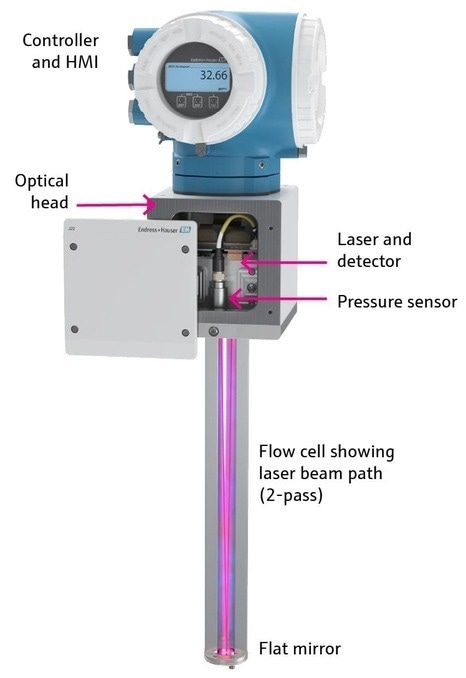
Components of a TDLAS analyzer – 2-pass cell. Image Credit: ©Endress+Hauser
TDLAS Techniques
Wavelength Modulation Spectroscopy (WMS)
To increase sensitivity, TDLAS often uses wavelength modulation spectroscopy (WMS) with second-harmonic (2f) detection. This technique:
- Uses a lock-in amplifier to detect the 2f signal
- Improves trace gas detection by reducing noise
- Modulates laser at high frequencies (e.g., 7.5 kHz)
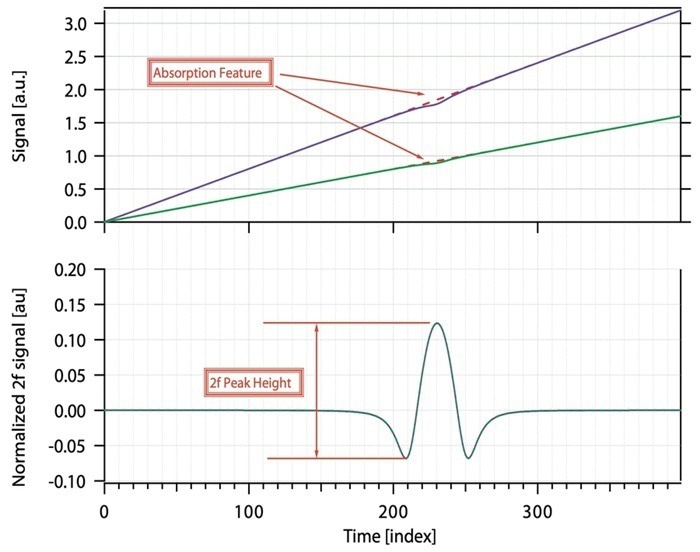
Typical transmitted laser intensity and corresponding normalized second harmonic signal. Image Credit: ©Endress+Hauser
This method permits the detection of gases at extremely low quantities, even in complicated backgrounds. It also adjusts for laser drift, mirror fouling, and intensity changes.
Differential Spectroscopy
In situations with a significant background interference, TDLAS devices employ differential spectroscopy.
- Scrubbers remove the target gas from the sample, resulting in a "dry" spectrum
- The system compares this to the "wet" spectrum, which includes the gas
- Subtracting the two yields the desired gas signal
This approach is particularly effective for detecting H2O (water/moisture), H2S (hydrogen sulfide), NH3 (ammonia), and CO2 (carbon dioxide) in hydrocarbon-rich streams, where overlapping absorption bands may otherwise conceal the signal.
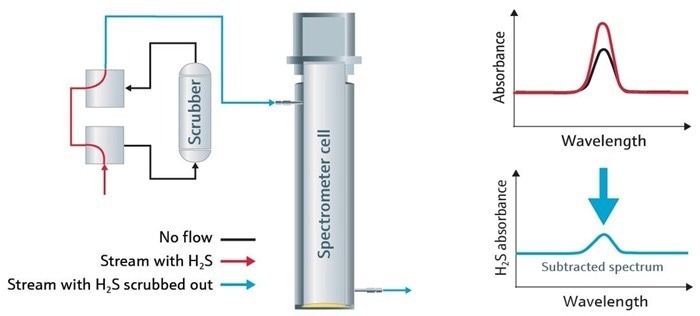
TDLAS differential scrubbing system. Image Credit: ©Endress+Hauser
Differential versus Non-Differential Measurement
Differential measurements:
- The analyte has poor absorptivity
- Analyte signals are faint compared to the background signal
- Composition and other parameters greatly affect the spectral backdrop
Non-differential measurements:
- High analyte absorption
- Changes to the spectral background are insignificant
- The signal-to-noise ratio is favorable for analyte detection
Get your PDF copy here
Multipass Herriott Cells
For the best sensitivity, TDLAS systems often include Herriott cells, which fold the laser beam several times across the sample gas.
This results in a lengthy optical route (up to tens of meters) in a small container, boosting the signal without increasing the system size. Unlike cavity-enhanced spectroscopy, Herriott cells are less susceptible to mirror fouling and have a uniform route length, making them excellent for industrial applications.
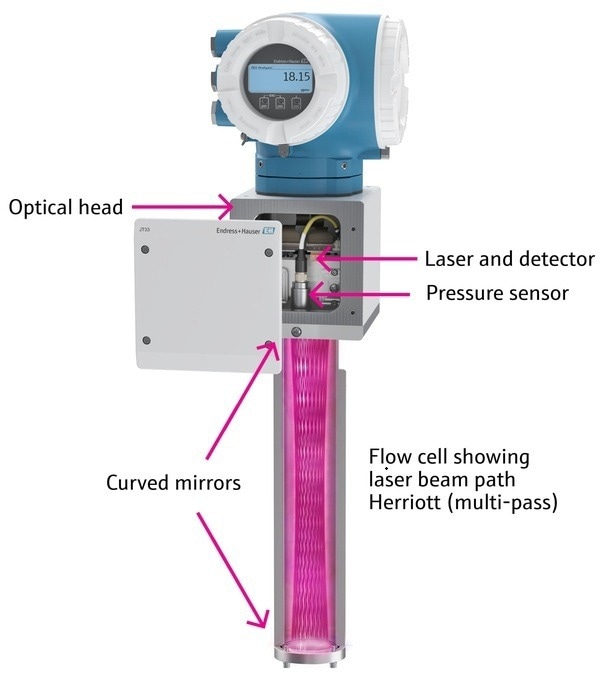
A multipass Herriott cell for a TDLAS analyzer. Image Credit: ©Endress+Hauser
Benefits of TDLAS
TDLAS provides various advantages:
- Low Detection Limits: Down to ppb levels
- High Selectivity: Targets narrow absorption lines
- Fast Response: Real-time measurements (sub-second)
- Minimal Maintenance: No moving parts or consumables
- No Wet-Up/Dry-Down Delays: Unlike surface-based sensors
- Reliable Performance: Stable over time without recalibration
TDLAS is a key technique in contemporary gas analysis, providing unparalleled sensitivity, selectivity, and stability. Whether you are optimizing a refinery process, maintaining pipeline compliance, or monitoring emissions, TDLAS delivers the information you need accurately and instantaneously.
The combination of sophisticated spectroscopy, durable architecture, and low maintenance makes TDLAS well-suited for harsh industrial environments. With its proven performance in trace and percentage-level applications, TDLAS is the go-to technology for accurate gas measurement.
Challenges and Solutions in TDLAS
Background Interference
- Challenge: Gases such as hydrocarbons can obscure target signals
- Solution: Select lines carefully using the HITRAN database and differential and multi-peak spectroscopy
Pressure and Temperature Variations
- Challenge: Pressure and temperature can impact line form and intensity
- Solution: Implement real-time compensating algorithms and temperature-controlled enclosures
Mirror Fouling
- Challenge: Mirror fouling can decrease signal intensity
- Solution: Normalize 2f signals and apply automated diagnostics for optical power loss detection
Validation and Calibration
- Challenge: Maintaining precision over time might be tough
- Solution: Use permeation devices, cylinder standards, and factory calibration with NIST-traceable gases
TDLAS Applicability Throughout Sectors
Natural Gas: Measure pollutants in natural gas streams online and in real time.
- Carbon dioxide (CO2) and methane (CH4). detection: helps monitor emissions and optimize processes
- TDLAS detects moisture (H2O) in CH4 (methane) at less than 5 ppb, even with significant methane interference
- Monitors H2S (hydrogen sulfide) levels to ensure compliance with pipeline tariffs and environmental standards, with detection limits below 1 ppm
Biogas or Biomethane
- LNG: Perform crucial measures to ensure LNG production and timely shipping
- Refinery: Monitor pollutants in refinery gas streams, including fuel gas and hydrogen recycle loops
- Syngas: Measure carbon dioxide in syngas with excellent selectivity and accuracy using laser technology
- Natural Gas Processing: Monitor pollutants during natural gas processing using selected and precise measures
Petrochemical
- Caustic wash towers monitor acid gases such as CO2 (carbon dioxide) and H2S (hydrogen sulfide) at the inlet/outlet
- Detects C2H4 (ethylene) generation, acetylene, NH3 (ammonia), and CO2 (carbon dioxide) to ensure product quality
- Provides catalyst protection by measuring trace moisture and HCl (hydrochloric acid) in high-purity ethylene and propylene streams.
Environmental
- Real-time detection of greenhouse gases, including carbon dioxide, methane, and nitrous oxide
- O2 (oxygen) in hydrocarbon streams reduces combustion hazards during storage and transportation
Performance Capabilities of TDLAS
- H2O (moisture) in N2 (nitrogen): Repeatability of ± 3 ppb
- H2S (hydrogen sulfide) in sour gas: Range up to 50 %, repeatability ± 1 %
- CO2 (carbon dioxide) in synthesis gas: Range up to 40 %, repeatability ± 0.02 %
- NH3 (ammonia) in C2H4 (ethylene): Repeatability better than ± 50 ppb, with potential < 20 ppb
- CO (carbon monoxide) in H2 (hydrogen): Detection limit < 10 ppb
- CH4 (methane) in H2 (hydrogen): Repeatability of ± 4 ppb
These capabilities vary by product, but TDLAS demonstrates high accuracy across a wide range of concentrations and gas types.
Frequently Asked Questions Regarding TDLAS
What is TDLAS, and how does it work?
TDLAS (tunable diode laser absorption spectroscopy) is a laser-based technology for measuring gas concentration. It operates by setting a diode laser to a wavelength that matches the target gas's absorption line.
As the laser travels through the gas sample, the molecules absorb light of that wavelength. The quantity of light absorbed is measured and used to compute gas concentration using the Beer-Lambert Law.
What are the key components of a TDLAS system?
TDLAS systems usually contain:
- An adjustable diode laser (light source)
- A gas cell for laser interaction with samples.
- A photodetector measures transmitted light.
- A beam modulation method improves signal-to-noise ratio.
- A data collection and processing equipment for analyzing and reporting gas concentrations.
Which gases can TDLAS detect?
TDLAS can detect a wide variety of gases. These gases are widely used in natural gas, petrochemical, refining, and environmental applications.
- Moisture (H2O)
- Carbon dioxide (CO2)
- Methane (CH4)
- Hydrogen sulfide (H2S)
- Ammonia (NH3)
- Oxygen (O2)
- Hydrogen chloride (HCl)
How does TDLAS compare with NDIR?
TDLAS has superior sensitivity and selectivity to NDIR spectroscopy. While NDIR uses broadband infrared light and filters, TDLAS employs a narrow-linewidth laser tuned to specific absorption lines, eliminating cross-interference and enabling ppb-level detection. TDLAS also reacts quickly and requires little maintenance.
What are the benefits of TDLAS?
Benefits of TDLAS include:
- High sensitivity (ppb-level detection)
- Fast response time (real-time monitoring)
- Resistant (suitable for harsh environments)
- Excellent selectivity (minimal cross-interference)
- Low maintenance (no moving parts or consumables)
What are the limits of the TDLAS?
The limitations of TDLAS are as follows:
- Limited to the gas phase, not suited for liquids or solids
- Higher initial investment compared to alternatives such as NDIR
- The laser must pass through the gas sample to ensure line-of-sight
- Spectral interference requires careful line selection in complicated mixes
What are some popular uses for TDLAS?
TDLAS is commonly used for the following applications:
- Detect dangerous gases quickly for safety and leak prevention
- Real-time monitoring of gas concentrations for industrial processes
- Monitoring the environment for trace contaminants and greenhouse gases
- Research and development: Exploring gas-phase processes and materials
- Medical and biotech applications include breath analysis and metabolic monitoring
How is the TDLAS calibrated and validated?
TDLAS systems are usually factory-calibrated using NIST-traceable gas standards. Field validation can be done with certified gas cylinders or permeation instruments.
To achieve long-term correctness, advanced systems use real-time validation features such as reference cells or spectral locking.
References
- Ji, W.; Liu, X. S.; Feitisch, A. TDL Analyzers for Measurement of PPB and Percentage Level Analytes in Process Applications, The International Society of Automation (ISA), 2010.
- Liu, X. S.; Ji, W.; Feitisch, A. Advancing Spectroscopy in Service of Process Control Objectives, ISA, 2011.
- Liu, X. S.; Ji, W.; Feitisch, A. Development of H2S, H2O, NH3, and C2H2 TDL Analyzers D-1 for Petrochemical Applications in Optically Interfering Hydrocarbon Streams, ISA, 2010.
- Liu, X. S.; Zhou, X.; Feitisch, A. Advanced NH3 and CO2 TDL Gas Analyzers for Petrochemical F-1 Process Control and Product Qualification, ISA, 2009.
- Liu, X. S.; Zhou, X.; Sanger, G.; Feitisch, A. Tunable Diode Laser Absorption Spectroscopy Based Trace J-1 Moisture Detection in Natural Gas, ISA, 2007.
- Liu, X. S.; Zhou, X.; Feitisch, A. Tunable Diode Laser Analyzers for Ethylene Production and H-1 Quality Control, ISA, 2008.
- Trygstad, M.; Jenko, B.; Liu, X. S.; Ji, W.; Feitisch, A. Advancing TDL Technology: From Applied Spectroscopy of Comprehensive Control of Measurement Integrity, ISA, 2011.
- Zhou, X.; Liu, X. S.; Ji, W.; Feitisch, A. Tunable Diode Laser-Based Gas Analyzers for Hydrogen E-1 Chloride and Hydrogen Sulfide Detection in Hydrocarbon Background Streams, ISA, 2009.
- Zhou, X.; Liu, X. S.; Feitisch, A. Advanced TDL Gas Analyzers for Petrochemical Process G-1 Industries, ISA, 2008.
- Zhou, X.; Liu, X. S.; Feitisch, A.; Sanger, G. Tunable Diode Laser Sensors for Trace Moisture Measurement I-1 in Olefin Product Streams, ISA, 2007.

This information has been sourced, reviewed, and adapted from materials provided by Endress+Hauser Ltd.
For more information on this source, please visit Endress+Hauser Ltd.