With the optoCONTROL CLS1000 and the CFS4-A11 fiber optic reflex sensor, bore depths in turned parts, for example made of copper, are detected precisely and without contact. Even deep bores up to 1200 mm can be measured reliably, while the finest depth differences down to 50 µm are captured accurately.
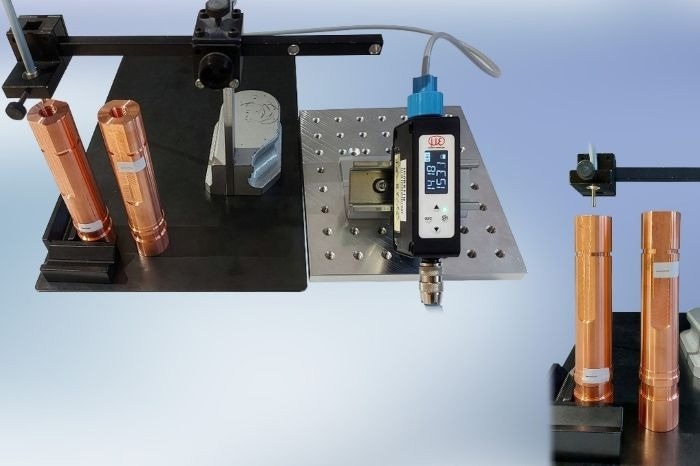 Image Credit: Micro-Epsilon
In the production of turned parts, for example made of copper, the exact bore depth is a decisive quality feature. Especially with deep or very fine bores, conventional inspection methods often reach their limits, because material properties, surface characteristics or restricted accessibility can make measurement more difficult. With the optoCONTROL CLS1000 in combination with the CFS4-A11 fiber optic reflective sensor, bore depths can be captured without contact, reliably and with high precision.
Capturing the Finest Bore Depths
To detect the depth, the reflective sensor measures into the bore from above. The deeper the bore, the less reflected light is received by the sensor and the weaker the electrical signal becomes. In this way, the finest depth differences down to 50 µm can be detected. The measured values are output directly via the display, enabling deviations to be identified quickly and the quality of the turned parts to be assessed reliably.
Precise Depth Measurement Even for Deep Bores
Thanks to the small beam angle of 22 °, the CFS4-A11 fiber optic reflex sensor is particularly suitable for measuring deep bores up to a maximum of 1,200 mm. Non-contact detection is independent of material and surface and therefore enables stable inspection even with challenging copper components. Thanks to customer-specific adaptation of the sensors, the solution can be optimally integrated into existing production and inspection processes. This ensures consistently high product quality and significantly reduces inspection effort in series production.