Precision sensor supplier Micro-Epsilon has expanded its 2D/3D range of measurement technologies with a new series of confocal-chromatic line sensors that set new standards in terms of measurement precision, compactness, dynamic range, and an exceptionally high number of measurement points per profile.
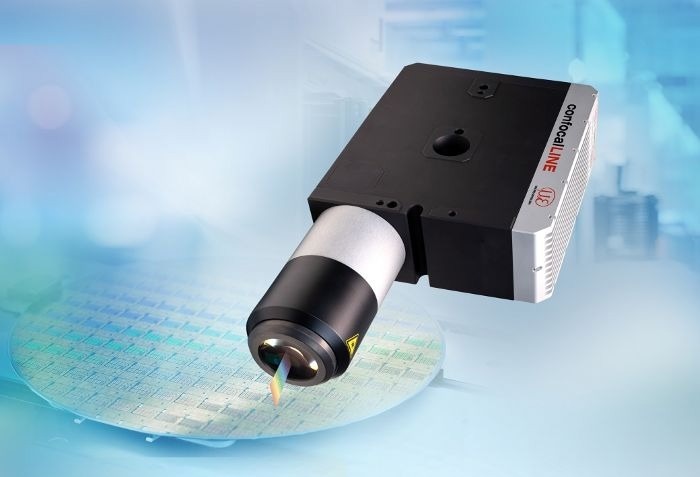 The new confocalLINE CLI8500 sets new standards in confocal-chromatic line measurement technology. Image Credit: Micro-Epsilon
The combination of very high z-axis resolution, 0.2 µm, an x-axis resolution of just 2.7 µm, together with large tilt angle and high measuring speed, the new confocalLINE CLI8500 confocal line sensor combines confocal-chromatic measurement performance with laser line profile capture speeds and opens up new possibilities in highly demanding measurement and inspection tasks – from the semiconductor industry and electronics, to battery production and mechanical engineering.
Superior Design with Integrated Signal Processing in the Sensor
As the confocalLINE CLI8500 does not require an external controller or an IPC, the sensor can be easily integrated in tight installation spaces without the need for a control cabinet. In the SMART version of the sensor, the 2D/3D measurement programs are executed directly in the sensor, with the measurement results output to a control system.
High Point Density, Wide Measuring Range and Fast Acquisition
The confocalLINE CLI8500 offers a resolution of 2,784 points with a measuring range (line width) of 7 mm per profile, making it suitable for numerous measurement tasks where the highest accuracies are required. Due to its high precision, even the smallest of objects can be reliably captured and accurately evaluated. Due to the linear measurement method, surface coverage is achieved in significantly less time compared to conventional point sensors scanning. The sensor achieves a measuring rate of up to 2 kHz over the full usable measuring range and can capture up to 10 kHz across the full width with a reduced Z range.
Measuring Principle and Advantages
In the confocal-chromatic measuring principle, white light is split into its spectral colors using a special optical system. Each wavelength has a defined focal point and corresponds to an exact distance. The sensor evaluates the wavelength reflected from the surface of the object being measured and uses this to calculate the precise distance.
The confocalLINE sensors now extend this principle to a complete measurement line. Rather than a single measurement point, a complete height profile with numerous measurement points are captured simultaneously. This allows surface profiles, edges, steps and thickness information to be recorded quickly, on a non-contact basis and with precision much greater than any laser-based system can achieve.
Stable on All Surfaces
The confocalLINE CLI8500 delivers exceptionally high signal stability on a wide variety of surfaces. A key advantage of the confocal-chromatic measurement principle is that it can measure on almost all surfaces including mirrors, transparent objects, opaque materials and even liquids. This results in stable measurement values and high process reliability in industrial quality control applications. The large tilt angle of up to ± 80 ° along the line also enables stable measurements on inclined or complex-shaped components.
Easy Installation
A centring mandrel with an adapter plate is available for easy, repeatable installation. This facilitates precise alignment of the sensor, ensuring quick, reliable mounting. The centring mandrel also allows the sensor to be mounted at a specific angle, which is particularly beneficial for demanding measurement tasks or special target geometries, as an angled sensor orientation can improve signal stability.
SMART-Generated Measurement Results or Calibrated Point Clouds
The SMART version of the sensor provides selected measurement values such as distance, angle, gap and height to be output directly via standardized communication and I/O interfaces, including EtherCAT, EtherNet/IP, PROFINET, Modbus and UDP.
For integrated 2D or 3D analysis, the measurement programs are configured on a PC using 3DInspect and saved directly to the sensor. This eliminates the need for an external control unit.
For users who wish to perform their own custom analysis, the 3D DATA models provide calibrated profile data such as 3D point clouds, which are further processed on an external computer using image processing or analysis software. Powerful SDKs help developers integrate the confocalLINE sensors into their own environments.
Compatible standard interfaces include COGNEX VisionPro, HALCON, GENiCAM and GiGE Vision, LabVIEW drivers and sample programs, Developer Tool with sample code, documentation and support (C/C++, Linux, LabVIEW, C#/.NET).
Application Examples
Precise Measurement of Wafer Topography
Measuring wafer topographies requires the precise detection of even the finest height variations. The confocalLINE CLI8500 records a detailed height profile along the measurement line, from which flatness, waviness, steps, edges, or local defects can be reliably evaluated. Due to its high precision and fine height resolution, the CLI8500 is particularly well-suited for this demanding measurement task. The non-contact measurement is an additional advantage, as it prevents mechanical stress on the wafer surfaces.
Medical Technology
The CLI8500 enables non-contact measurement of stent surface contors with high detail resolution. Due to its high precision and fine height resolution, the CLI8500 is particularly well-suited for reliably inspecting dimensional accuracy, strut widths, height differences, or potential deformations. At the same time, the non-contact measurement prevents mechanical stress on the sensitive surfaces.
PIN Measurement of Micro Connectors
The CLI8500 plays a key role in the inspection of micro-connectors. The height, position, flatness and any deformation of the pins are examined on the production line. The confocal line sensor captures a precise height profile and detects deviations such as bent pins or pins that are too high or too low. Inline measurement supports reliable quality control prior to further assembly.
Indexable Cutting Inserts
Indexable inserts are replaceable cutting inserts used in machining tools for turning, milling, or drilling. To ensure reliable machining quality, cutting edges, radii, steps, clearance surfaces, and function-critical geometries must be precisely inspected. The CLI8500 captures these contors at high resolution, enabling reliable evaluation of dimensional accuracy and edge quality.