Cairn Oil & Gas, a Vedanta Ltd. subsidiary, has invested significantly in developing oil wells in northern India. This area in the center of a desert region was entirely inaccessible just a few years ago. Because every ton of yield is important, Cairn relies on a VEGA radiometric system for multiphase measurements.
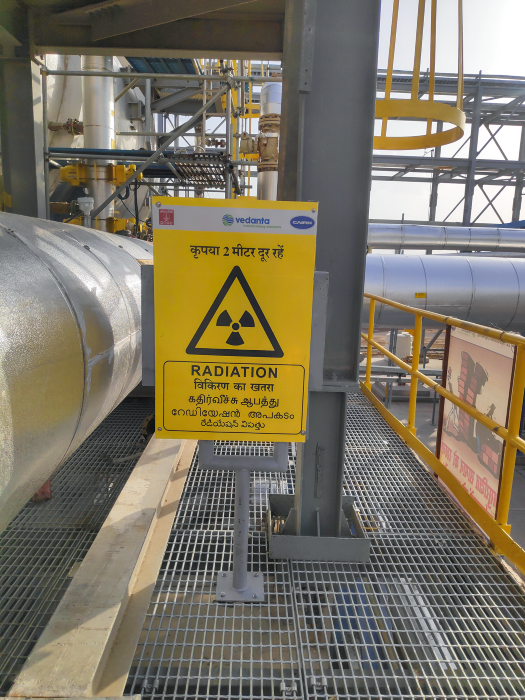
Cairn Oil & Gas uses radiometric density sensors from VEGA on the slug catcher to optimize separation performance. They’re installed in a multiple-density configuration. Image Credit: VEGA Grieshaber KG
India is a rapidly developing country with a population approaching 1.4 billion people. UN forecasts predict that India’s energy demand will double between 2020 and 2035, reaching 2040 levels, if the country’s current economic growth of 5 % to 7 % continues.
The area that the resource is sourced from has changed, however. The subcontinent is increasing domestic production, leading to more oil refineries. Companies typically face significant challenges when attempting to satisfy this demand. For example, oil extraction and refinement are often carried out in remote regions facing challenging climatic conditions. Deposits in these areas are developed at great expense over many years, occasionally even decades.
Systematically Greater Yield with EOR
It is difficult to predict which mixture will come to the surface during the extraction process, and characterizing this mix with exact data is challenging. Factors such as the density and viscosity of the extracted crude vary between drilling fields, and other wellhead conditions, such as gas content, pressure, temperature, or contamination levels, are never identical.
Increasing the yield of already developed fields is another major challenge because the cost of extraction and processing can increase depending on the crude oil’s composition.
Across the field, Enhanced Oil Recovery (EOR), also known as ‘tertiary recovery’, is increasingly helping address this challenge. This practice is virtually standard operating procedure in the industry today, typically achieving crude oil recovery yields up to 20 % higher. EOR is characterized by the use of specialist techniques, including chemical, steam, or ultrasound injection.
Optimized Separation in the Slug Catcher
Implementing this method can also improve efficiency in downstream treatment processes. For instance, crude oil is filtered at an early stage through a type of filter known as a ‘slug catcher’ to remove recurring ‘slugs’ of liquid from the process. Water, oil, and sand are separated and passed on for additional processing.
In terms of measurement technology, this crucial spot offers an excellent opportunity to improve safety and optimize operations.
Cairn Oil & Gas, Vedanta Ltd. leverage radiometric density sensors to optimize separation process efficiency in their slug catchers. These multi-density arrays (MDAs) feature a multiple-density sensor array mounted at 10 measuring points, each located one above the other.
MINITRAC 31 sensors monitor the entire density profile over the full vertical range, from 0 to 5000 mm. These devices ensure accurate, reliable measurements by utilizing highly sensitive scintillating-crystal technology installed without direct contact with the process medium.
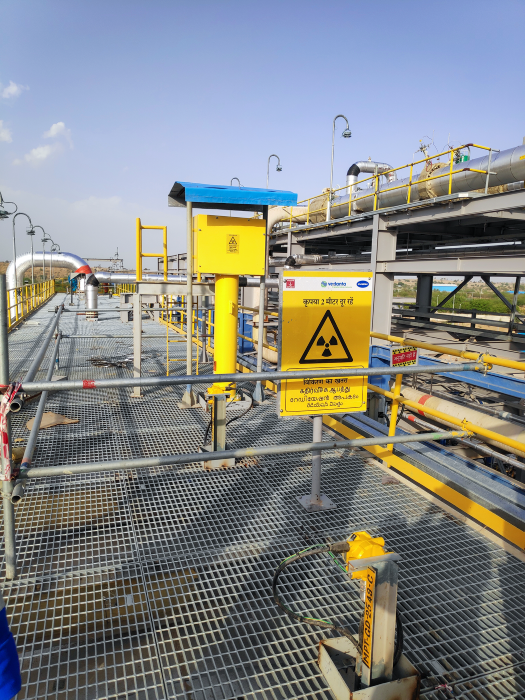
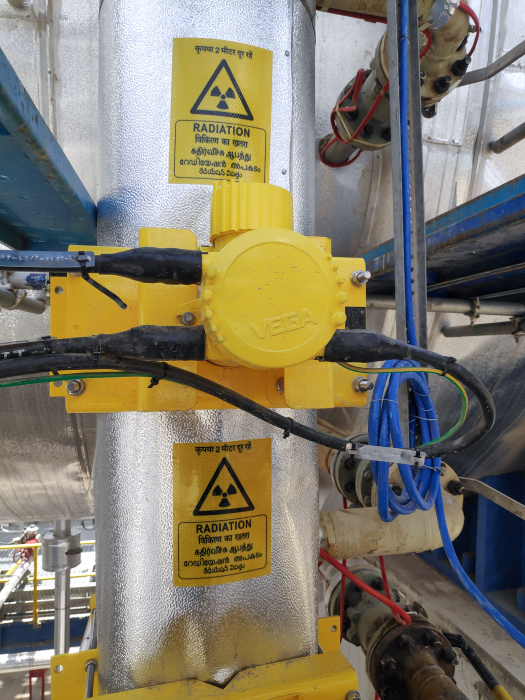
The highly sensitive, scintillating-crystal technology of the measuring instruments and their external mounting, which avoids contact with the process medium, ensure highly accurate measurements. Image Credit: VEGA Grieshaber KG
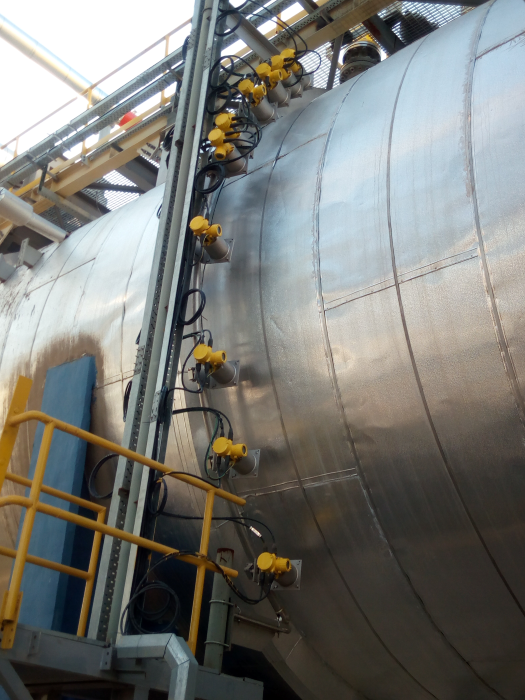
Mounted at 10 measuring points, one above the other, VEGA MINITRAC 31 sensors monitor the complete density profile over the entire vertical range from 0 to 5000 mm. Image Credit: VEGA Grieshaber KG
Operations at the Rajasthan Field run smoothly because the sensors transmit even subtle changes in the separation process to the control center in real time.
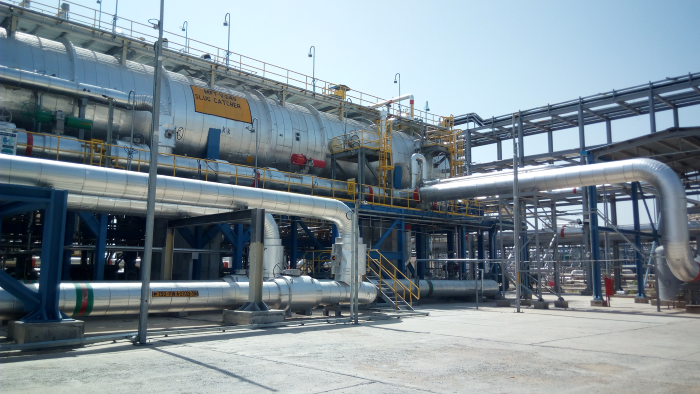
The multi-density arrays, MDAs for short, detect even the slightest change in the separation process and transmit that information to the control center in real time. This ensures that operations at the “Rajasthan Field” run smoothly. Image Credit: VEGA Grieshaber KG
Employing Patience and High-Tech Solutions
Fewer large oil reserves are being discovered, and the costs of development and production continue to rise, leading to growing interest in solutions to increase yield.
Cairn Oil & Gas, Vedanta Ltd. acquired a large tract of the Rajasthan desert in 2002. This remote location lacks access to transport links or water, but previous seismic surveys designed to determine the precise nature of the subsurface yielded promising sonic data, suggesting the presence of extensive oil deposits.
A successful result was achieved in January 2004, after drilling 15 costly exploratory holes in the North Indian desert. Cairn had drilled into the new Mangala oil field, representing the world’s largest oil discovery of the year and India’s largest onshore oil discovery in 25 years.
The first oil was extracted in 2009, and production began thereafter. The India Economic Times newspaper reported the Mangala field has produced 473 million barrels of crude oil (MMstb) to date.
Transporting this amount of oil in a freight train with standard-sized wagons would see the train’s length reach almost 40 times around the world. Cairn produces almost 25 % of India's annual crude oil output from this field alone.
Every Crude Oil has its Own Unique Characteristics
It quickly became clear that the oil extracted from the Mangala field was distinct. Its waxy nature meant that it solidified almost as soon as it reached the surface. The pipeline constructed for this oil was the longest heated crude oil pipeline in the world to date, at approximately 700 km.
The oil has already gone through the initial stages of processing before it begins its long journey to the sea and on to refineries. The oil undergoes its initial cleaning steps at the extraction site, removing impurities such as residual water and sand.
A Successful Design Must be Simulated in Advance
Knowledge of the precise nature of crude oil underpins more than just pipeline construction. It is also key to the slug catcher design.
Continuous, reliable insight into the processes within the slug catcher: With the measured values from the ten detectors, both the movement of the separation interface and the height of the emulsion layer can be precisely determined. Image Credit: VEGA Grieshaber KG
The presence of multiphase flow in the pipes often results in slug flow at the outlets. Slug catchers temporarily detain this flow to release it into the downstream processing units at a predefined rate. This allows the material to be processed in separate liquid and gas flows in a controlled fashion.
The slug catcher provides a buffer volume to better accommodate intermittent high-liquid flow. It can temporarily store liquids between the pipeline outlet and the processing facility to protect downstream pipelines and equipment.
Droplet separators are the key components of this process. These separators would quickly reach their limits if the load was uncontrolled and too high.
A slug catcher is also useful because it keeps out solid contaminants that could collect inside. This is important because extremely high loads would otherwise lead to increased amounts of solids entering the outlet stream.
The VEGA MDA profiling system helps avoid these disturbances by delivering continuous density data from each individual measuring point installed at a specific elevation in the slug catcher.
The separation layer’s movement and the emulsion layer’s height can be precisely monitored and controlled through the detailed density profile within the process, enabling optimal separator efficiency.
Reduced Maintenance Requirements
Cairn’s choice of measuring system requires little maintenance because all detectors have no direct contact with the process, as they are mounted on the outside of the vessel.
A flexible mounting system allows simple yet highly robust installation. This also means that the detectors remain easily accessible should maintenance work be required.
The multiple measuring points measure independently of one another, so any issues with an individual detector would not halt the system’s operation. The simplicity of the application begins much earlier, with the measuring system’s rapid commissioning and calibration already helping reduce start-up time and costs.
Comprehensive diagnosis via the PACTware® configuration software and its EDD and DTM description technologies provides operators with a particularly clear and simple overview of system health.
Reducing the Environmental Footprint with Measurement Technology
Yield in oil production is not solely determined by the amount of material reaching the surface. The industry is increasingly focused on optimizing the raw material before sending this on to refining. Cairn has therefore carefully examined each step of its crude oil processing operation.
Slugging (the formation of plugs that obstruct flow) was identified as one of the most prominent occurrences requiring additional attention. This very important separation process required precise monitoring of the separation layers in the slug catcher.
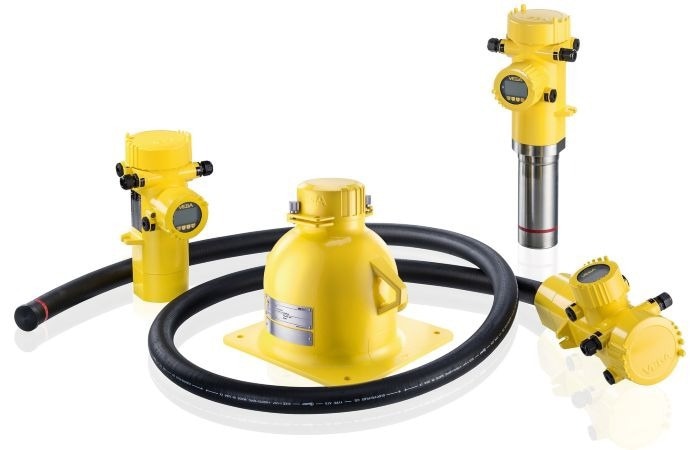
Image Credit: VEGA Grieshaber KG
The process now runs smoothly thanks to VEGA’s radiometric measuring system, which prevents particles that are too large from being dragged along and operates reliably even in extreme temperatures.
This key monitoring system also protects downstream components and processes, ensuring that oil quality is maintained as it begins its journey through the pipeline to the sea, before eventually being loaded onto ships for further transport.
Acknowledgments
Produced from materials originally authored by VEGA Grieshaber KG.

This information has been sourced, reviewed and adapted from materials provided by VEGA Grieshaber KG
For more information on this source, please visit VEGA Grieshaber KG