Hamamatsu Photonics has been at the cutting edge of optical beam shaping for more than 30 years.1 During this time, the company transformed Liquid Crystal on Silicon Spatial Light Modulators (LCOS-SLMs) into a dependable and durable beam shaping technology. These modulators, which enable dynamic digital beam shaping, open new possibilities for efficiency and effectiveness, particularly in high-power laser applications.
Applications for Laser Material Processing
LCOS-SLMs offer a versatile and dependable method for digitally shaping laser beams. With a pixelated array that allows for fine control of light dispersion, these modulators enable intricate, stable, and reproducible 3D light structuring.
The implications of this technology are considerable, especially in laser material processing, where high-power lasers can be used more efficiently and dynamically.
These LCOS-SLMs have a pixelated array (1280 x 1024) of electrodes whose drive voltage can be adjusted separately to produce a complicated distribution of light reflected off their surface. Readers are referred to the relevant sources to better understand the operating principles of LCOS-SLMs.2,3
Hamamatsu Photonics' LCOS-SLMs are widely used in many applications such as super-resolution imaging and quantum computing. Other applications include laser marking, 3D printing, laser material processing, and laser surgery.
Several properties of LCOS-SLMs cater to various user requirements. The broad wavelength support of Hamamatsu's LCOS-SLMs is well known,4 and its outstanding stability has been praised.5
Laser Material Processing
This article focuses on the high-power laser tolerance of Hamamatsu's LCOS-SLMs in the 1000-1100 nm range. Most material-processing lasers operate within this spectral range.
Laser material processing encompasses a variety of applications such as marking, surface modification, welding, cutting, soldering, and three-dimensional printing. In these applications, the typical method of operation is one spot at a time.
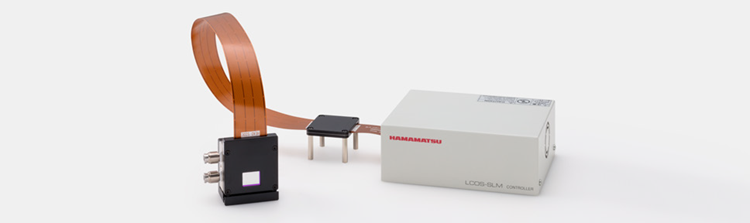
Hamamatsu's LCOS SLM X15213. Image Credit: Hamamatsu Photonics Europe
In other words, the laser is focused on a single location on the substrate being treated and moved in a pattern specified by the need. It usually involves either moving the substrate or raster scanning the laser point. This processing method has limitations.
Advantages of Digital Beam Shaping
High-power lasers have become less expensive as laser technology has advanced. Splitting excess laser power into numerous beams can improve the throughput of laser material processing.
A comparable, limited technique with static beam-shaping equipment such as diffractive optical elements (DOEs) enables a set beam form or beam distribution in space and power.
This method is appealing because, while DOEs can handle high laser strengths, their static beam-shaping nature limits their capabilities.
Digital beam shaping with LCOS-SLMs, on the other hand, has significant advantages over static beam shaping elements because it allows for dynamic manipulation of beam shapes and power distribution, the implementation of feedback control systems, and the execution of a broader range of tasks via simple programming.
Due to their low laser-power tolerance, LCOS-SLMs were limited to low-power laser material-processing applications.
Key Developments for High Laser Power Tolerance
Hamamatsu's engineers have recently improved the laser power tolerance of LCOS-SLMs, making digital beam shaping a viable alternative for high-throughput laser material processing. Liquid crystals are the key functional components of LCOS-SLMs.
High laser power can heat the liquid crystal molecules. Extremely high temperatures can permanently destroy the liquid crystal layer, while minor temperature increases change the optical characteristics (dispersion) of the liquid crystals. These, in turn, affect the beam shape.
Hamamatsu's LCOS-SLMs are designed to maximize use efficiency, reducing residual laser power that causes device heating. In addition, the system incorporates an excellent water-cooling heat sink to maintain liquid crystal temperature stability even while using pulsed lasers with average energies of up to 150 W.6
Newer innovations in thermal management of LCOS-SLMs include the use of Sapphire glass windows, which have 30 times the thermal conductivity of normal glass windows used in LCOS-SLMs.
This innovative architecture enables bidirectional heat removal from liquid crystal layers while increasing the continuous wave laser power tolerance to 750 W.7
At these power levels, it is possible to perform more demanding laser material processing applications such as laser powder bed fusion (LPBF) with multiple-point processing.8
Recent validation results show a significant improvement in laser power tolerance in the next generation of Hamamatsu's LCOS-SLM, allowing additional laser material processing applications to benefit from digital beam shaping technologies.
These developments in LCOS-SLM technology offer a robust and adaptable solution for digital beam shaping.
Enhanced laser power tolerance, novel heat management techniques, and the flexibility to dynamically alter beam forms and power distribution enable more efficient and effective processing across a wide range of applications.
As the demand for high-throughput laser processing increases, this cutting-edge technology positions itself as a key participant in satisfying those demands.
Recent enhancements, such as the ability to operate at significantly higher powers and compatibility with AI solutions, enable a broader range of complex laser material processing tasks to be completed, paving the way for new opportunities in industries such as manufacturing, healthcare, and beyond.
Hamamatsu remains committed to pushing the limits of optical beam shaping, ensuring that its clients have access to cutting-edge technology that promotes change and increases production in their respective industries.
References
- Yoshida, N.C.H.P.K.K. et al. (1992). EP0583114A2 - Optically-addressed type spatial light modulator - Google Patents. Available at: https://patents.google.com/patent/EP0583114A2.
- Hamamatsu Photonics (2026). What is LCOS-SLM? | Hamamatsu Photonics. Available at: https://lcos-slm.hamamatsu.com/eu/en/learn/about_lcos-slm.html.
- Hamamatsu Photonics (2026). What is LCOS-SLM? Principle and structure | Hamamatsu Photonics. Available at: https://lcos-slm.hamamatsu.com/eu/en/learn/about_lcos-slm/principle.html.
- Hamamatsu Photonics. LCOS-SLM X15213 series Technical Datasheet | Hamamatsu Photonics. Available at: https://www.hamamatsu.com/content/dam/hamamatsu-photonics/sites/documents/99_SALES_LIBRARY/lpd/x15213_E.pdf.
- Hamamatsu Photonics (2026). LCOS-SLM characteristics Phase fluctuations | Hamamatsu Photonics. Available at: https://lcos-slm.hamamatsu.com/eu/en/learn/technical_information/characteristics/phase-fluctuation.html.
- Fraunhofer Institute for Laser Technology ILT. (2023). New Spatial Light Modulator for dynamic beam shaping in industrial high-power USP processes - Fraunhofer ILT. Available at: https://www.ilt.fraunhofer.de/en/press/press-releases/2022/9-5-hamamatsu-slm-joint-application-lab.html.
- Hamamatsu Photonics(2023). Hamamatsu Photonics has developed an LCOS-SLM with the world’s highest power handling capability that will streamline production of laser metal machining | Hamamatsu Photonics. Available at: https://www.hamamatsu.com/eu/en/news/products-and-technologies/2023/20230620000000.html.
- Fraunhofer Institute for Laser Technology ILT. (2023). Flexible beam-shaping platform optimizes LPBF processes - Fraunhofer ILT. Available at: https://www.ilt.fraunhofer.de/en/press/press-releases/2024/11-7-beamshaping-platform-optimises-lpbf-processes.html.

This information has been sourced, reviewed and adapted from materials provided by Hamamatsu Photonics Europe.
For more information on this source, please visit Hamamatsu Photonics Europe.