Gas analyzers are central to protecting hydrocarbon processing pipelines and storage infrastructure from quality and corrosion issues. Effective gas analyzers deliver the reliable data that plant operators need to drive safety, performance, and compliance, whether they are working in oil refineries, natural gas operations, or petrochemical plants.
Image Credit: Rangsarit Chaiyakun/Shutterstock.com
Compromised readings can lead to misrouted gas, custody transfer errors, accelerated pipeline corrosion, and costly operational interruptions. These risks mean that contaminant gas analyzers should be regarded as cyber-critical devices and key to supporting safe operations, protecting data integrity, ensuring product quality, and maintaining reliable hydrocarbon processing performance.
In this light, cybersecurity has become essential to protecting devices and the operations that rely on them as digitalization accelerates across industries. However, many legacy field devices typically lack the cybersecurity capabilities built into modern equipment, creating opportunities for malicious actors to exploit vulnerabilities.
Cyberattacks are increasingly common worldwide, with critical oil and gas infrastructure experiencing a notable rise in ransomware activity. For example, the cybersecurity firm Zscaler has highlighted that ransomware attacks targeting the oil and gas industry increased 935% between April 2024 and April 2025.1
No post-April-2025 follow-up report has been published by Zscaler thus far, but subsequent research from Trellix and Waterfall indicates ongoing targeting of industrial and energy infrastructure throughout late 2025 and early 2026.
The Trellix Operational Technology Threat Report determined that operational technology (OT) and industrial control systems (ICS) “faced unprecedented threats from sophisticated adversaries” between April 1 and September 30, 2025, with the energy sector identified among the highest-risk industries.9
The report also recommends prioritizing OT security investments and stresses the need for stronger network segmentation aligned with ISA/IEC-62443 standards.
Similarly, the Waterfall Threat Report 2026 points out that “To keep cyber sabotage from reaching OT networks, organizations need to harden security at every network connection.”10
It also highlights the ongoing exposure of critical infrastructure to cyber threats, advocating for deterministic, hardware-enforced protections in order to prevent threats originating in IT environments from escalating into OT systems.
Industrial systems are becoming increasingly connected, meaning that cybersecurity vulnerabilities pose a threat to intellectual property (IP), operations, and business continuity.
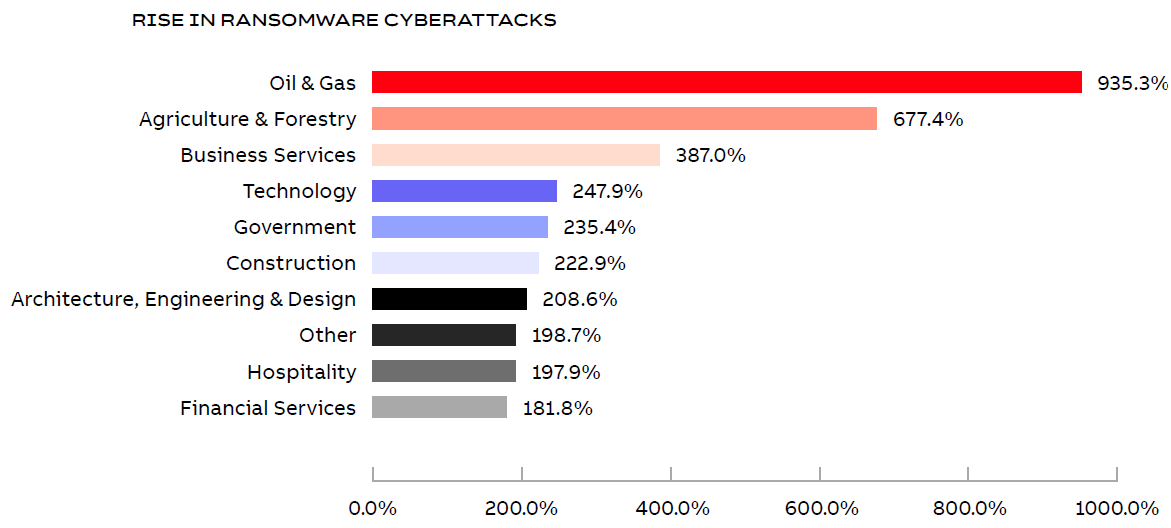
Year-over-year percentage change in ransomware extortion attacks by industry. Image Credit: Zscaler
Cyberattacks targeting oil and gas operations pose a potential fuel supply chain disruption risk, while also triggering cascading effects across utilities and customer services and compromising public safety.
The close integration of operational and IT systems makes the sector particularly vulnerable; each breach could threaten national infrastructure. Therefore, gas contaminant analyzers are attractive targets because cyberattacks can expose operational data and reveal critical details.
The American Petroleum Institute (API) stated that cyberattacks now pose enterprise-level risks with the potential to threaten operational resilience and business continuity.
Its article titled 'Defense-in-Depth: Cybersecurity in the Natural Gas and Oil Industry' highlighted that “Natural gas and oil companies recognize that their assets are the targets of a growing number of increasingly sophisticated cyberattacks perpetrated by a variety of attackers including nation-states and organized international criminals.”2
Built-in cybersecurity protections help safeguard gas analyzers as cyber risks continue to grow across critical infrastructure, supporting business continuity and reliable industrial operations.
This article outlines how built-in cybersecurity is helping industrial organizations to strengthen operational resilience while supporting compliant, secure, and straightforward deployment for plant managers, analyzer specialists, and IT decision-makers.
References and Further Reading
- Zscaler (2025). ThreatLabz 2025 Ransomware Report. Available at: https://www.zscaler.com/resources/industry-reports/threatlabz-2025-ransomware-analysis.pdf.
- Defense-in-Depth: Cybersecurity in the Natural Gas and Oil Industry
- Cybersecurity and Infrastructure Security Agency CISA. (2025). Unsophisticated Cyber Actor(s) Targeting Operational Technology | CISA. Available at: https://www.cisa.gov/news-events/alerts/2025/05/06/unsophisticated-cyber-actors-targeting-operational-technology.
- Cyber Resilience Act (2024). The Cyber Resilience Act Explained: Scope, Classes & Deadlines. Available at: https://www.cyberresilienceact.eu/explained.html.
- Geller, E. (2025). Ransomware attacks against oil and gas firms surge. Cybersecurity Dive. Available at: https://www.cybersecuritydive.com/news/zscaler-ransomware-report-manufacturing-targeted/756147/.
- Cushing, S. (2026). 2026 CIO Agenda for Oil and Gas: Technology Priorities and IT Strategy Shifts. Gartner. Available at: https://www.gartner.com/en/documents/6995166.
- Dal Cin, P., Kendzior, D. and Yusof Seedat (2025). State of Cybersecurity Resilience 2025. Accenture. Available at: https://www.accenture.com/en/insights/security/state-cybersecurity-2025.
- World Economic Forum (2022). The Global Risks Report 2022. Available at: https://www3.weforum.org/docs/WEF_The_Global_Risks_Report_2022.pdf.
- Trellix (2025). Operational Technology Threat Report. Available at: https://www.trellix.com/assets/reports/ot-threat-report-nov-2025.pdf.
- Ribeiro, A. and Ribeiro, A. (2026). Waterfall Threat Report 2026 finds ransomware slowdown masks deeper shift toward nation-state attacks on critical infrastructure - Industrial Cyber. Industrial Cyber. Available at: https://industrialcyber.co/reports/waterfall-threat-report-2026-finds-ransomware-slowdown-masks-deeper-shift-toward-nation-state-attacks-on-critical-infrastructure/.
Acknowledgments
Produced from materials originally authored by David Lincoln, Global Digital Lead at ABB Measurement & Analytics.

This information has been sourced, reviewed and adapted from materials provided by ABB Measurement and Analytics Analytical Products .
For more information on this source, please visit ABB Measurement and Analytics Analytical Products.