Sponsored by BinMasterReviewed by Ify IsiborSep 18 2026
The plastics manufacturing industry involves many moving parts. From doing more with less skilled labor to navigating volatile supply chains, producers must remain proactive with their resin inventory monitoring and replenishment strategies.

Image Credit: BinMaster
In these environments, traditional methods of tracking bulk materials–such as dropping tape measures into storage bins or manually checking hoppers–aren’t sufficient. Radar-level sensors or weight-based measurement technologies allow workers to focus on high-value tasks rather than climbing ladders and managing spreadsheets.
However, automating resin measurement is only the first step toward transforming material handling practices. Users may choose to partner measurement technologies with Industrial Inventory of Things (IIoT) tools for real-time analysis across an entire operation.
BinMaster® offers a comprehensive inventory management solution for manufacturers handling resins by integrating level sensors, load cells, and remote monitoring software.
Challenges of Monitoring Plastics Inventory
Injection molders, recyclers, extruders, and thermoforming operations use a variety of plastics in different formats, including pellets, flakes, and regrind. In addition, the usage of plasticizers, stabilizers, and other liquid components may need to be closely tracked.
Regardless of bulk materials, these manufacturing operations all face a common challenge: ensuring adequate inventory to maximize uptime and meet demand. Storage vessels, pneumatic conveyors, and hoppers must remain stocked to deliver continuous material feed and consistent product quality.
Skilled labor shortages further exacerbate this issue. Workers can choose to perform tedious monitoring tasks while strategic decisions fall by the wayside, or focus on high-value duties but rely on guesswork regarding their current material stock.
Level- and weight-measurement sensors replace uncertainty with accurate data. Workers can see what’s available in each vessel at any given time, with no sacrifices or stockouts required.
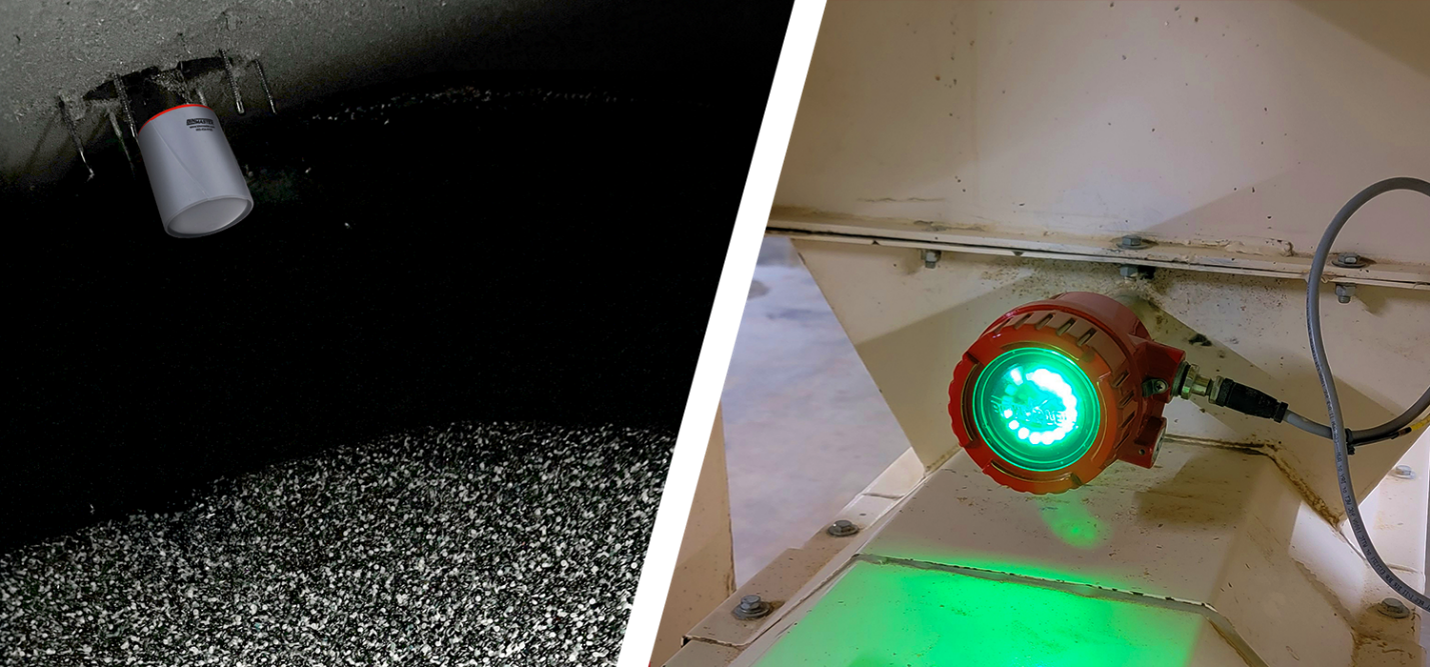
On the left, a compact non-contact radar sensor measuring resin pellets stored in a silo. On the right, a VRX vibrating rod with its bright status indicator mounted in the cone of a hopper. Image Credit: BinMaster
Level Sensors for Reliability in Resins
80 GHz radar is considered the gold standard for level indication in plastics manufacturing for several reasons:
- Non-Contact Technology: The sensor does not come in direct contact with the measured media; this is especially critical when monitoring chemicals or other harsh ingredients.
- Immunity in Rugged Environments: Sensors are unaffected by dust, vapor, steam, and changing temperature/pressure conditions.
- Superior Precision: The pinpoint beam angle is ideal for tall, narrow storage silos and provides adjustable aiming in vessels with segmentation or internal structures. The delivered accuracy is within ±0.2 inches in bulk solids.
The BinMaster CNCR-190 is a popular choice for plastics with a 98 ft. (30 m) range, simple Bluetooth configuration, and two-wire 4–20 mA or four-wire Modbus outputs for integration with existing automation systems and plant equipment.
In storage vessels where real-time visibility isn’t necessary, rotary paddle indicators, capacitance level switches, and vibrating rods are economical alternatives to non-contact radar. Point-level sensors provide high-, mid-, and low-level indications to alert operators before a costly overfill or dry run occurs, or simply to inform them to order more materials.
Each technology fits different purposes:
- Rotaries: Proven choice in pellets, regrind, and many powders; fail-safe models are available for advanced process control
- Capacitance Probes: Detect plastic materials or liquids with a consistent difference in dielectric properties
- Vibrating Rods: Ideal for lightweight powders and low-density flakes where sensitivity is important
While point-level sensors can easily be wired to a horn, light, PLC, or alarm panel for timely alerts, BMRX-300 rotaries and VRX vibrating rods provide visual alerts via a color-changing status indicator. The integrated light ring changes color from green to red depending on whether material is covering the rotating paddle or the sensor probe, allowing users to see the status from across the facility.
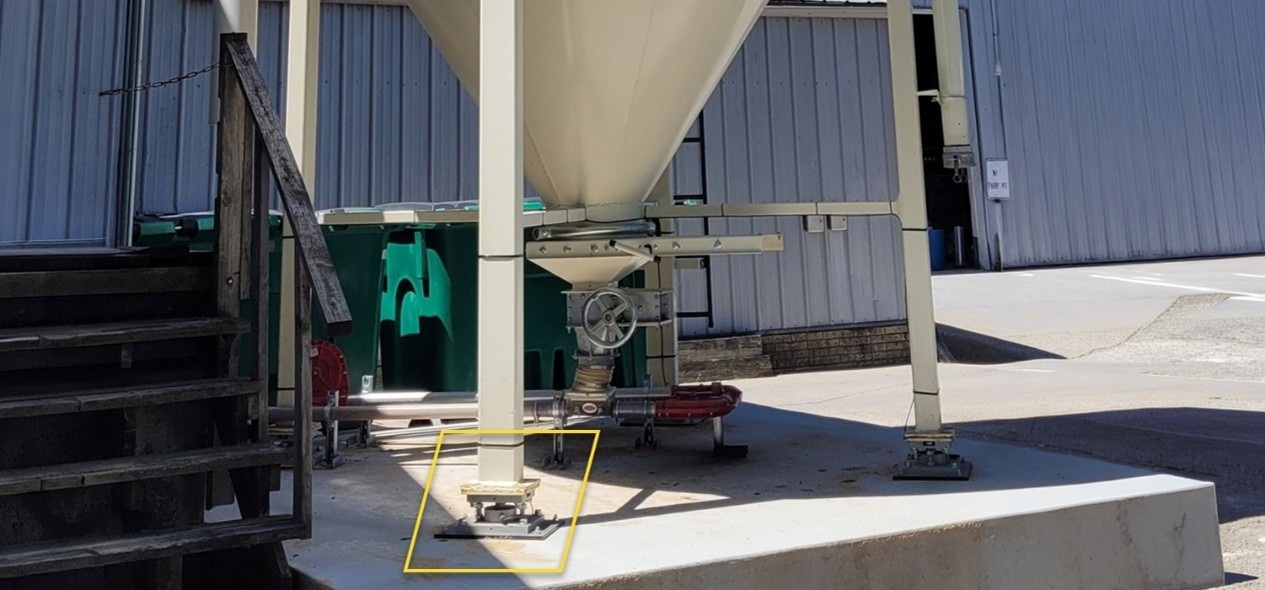
High-capacity pancake load cells installed on a storage vessel containing bulk plastic pellets. Image Credit: BinMaster
Continuous Bin Weight Monitoring
Weight-based sensors can be implemented on legged bins and silos of nearly any configuration, storing free-flowing bulk solids of many types. With repeatable system accuracy of ±1 %, plastics facilities can have the highest level of confidence and control over their inventory data.
BinTrac® by BinMaster offers patented, pre-calibrated A-Frame load cells with simple installation onto new or retrofit vessels. With a few turns of the lifting bolt, the full weight of the storage container is shifted onto load cells, which then automatically deliver inventory measurements by weight.
High-capacity pancake cells are available for heavy bins with fewer legs, but may require lifting equipment for installation in retrofitted applications.
The BinTrac system is completed with a push-button indicator that can be configured to display accurate, real-time data for up to four bins: including current levels, 24-hour usage, and the previous four fill events. These indicators can be mounted up to 250 ft. from the bin for easy walk-up or control room access.
Additionally, as opposed to a price-per-sensor structure, load cell weighing systems are priced per bin, which may offer a more cost-effective option.
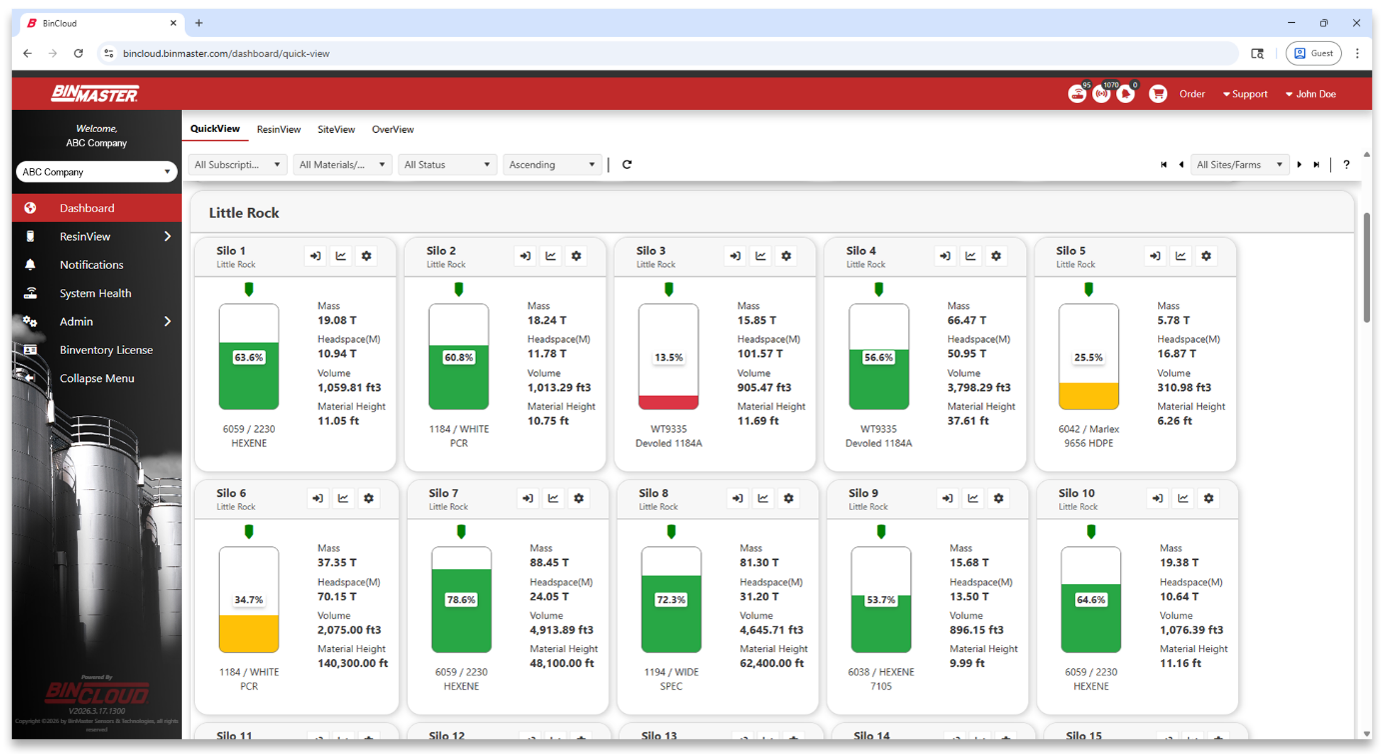
A glimpse of the ResinView® software interface, featuring real-time level monitoring with multi-bin visibility. Image Credit: BinMaster
One Remote Monitoring Platform for Any Operation
The need for continuous visibility into storage and processing vessels grows when production spans across several plants. Efficiency thrives when information is accessible across departments and kept up to date to minimize errors and miscommunication.
ResinView® remote monitoring software is a scalable, user-friendly option for monitoring silos and worksites from a mobile phone, tablet, laptop, or desktop PC at any time, anywhere with an internet connection.
Measurements collected from sensors update continuously, without manual prompting or refreshing from users. Operators can filter individual vessels or locations by status to prioritize fulfillment.
Enabling automated text and email alerts helps keep relevant staff in the loop. Paired with trend prediction and usage forecasting functionalities, this combination of historical data and real-time tracking helps inform proactive ordering practices.
Supply chain staff and suppliers can coordinate deliveries within the app when it’s time to restock. A centralized procurement department can place orders for one plant or several at a time, and reports can be scheduled or exported on demand to simplify future planning and financial audits.
See Resin Inventory Synergy with BinMaster
Whether a plastics manufacturer opts for level instruments or load cells, products from BinMaster are designed for seamless integration into one monitoring system.
A processor may choose to use load cells for large outdoor storage bins or compact, non-contact radars mounted over hoppers within the plant. Point-level indicators work in tandem with load cells or continuous sensors to deliver measurement redundancy and critical level alerts.
Regardless of instrumentation, the result is the same: workers remain safe and efficient; time-consuming measurements are eliminated; and production benefits from accurate, up-to-date data, proactive business decisions, and secure access.
Discover industry-specific solutions at BinMaster.com.

This information has been sourced, reviewed, and adapted from materials provided by BinMaster.
For more information on this source, please visit BinMaster.