From BinMasterReviewed by Ify IsiborJul 8 2026
In this interview, AZoSensors speaks with Mike Mossage at BinMaster about how IIoT solutions can be utilised to improve bulk solids monitoring.
Please tell us a little about BinMaster and the work it does around IIoT solutions.
We engineer and manufacture instrumentation for continuous inventory monitoring and process control in the bulk materials sector, including liquids, solids and slurries. While BinMaster has offered cloud-based monitoring for roughly 20 years, it has grown exponentially in the past five years.
Labor shortages, an increase in remote workers, and post-pandemic supply chain disruptions have heightened the need for accurate bulk material inventory and led to a more widespread adoption of IIoT solutions.
For companies managing bulk solids across one site or multiple locations, what are the biggest inventory-control challenges IIoT is helping to solve today?
If a company relies on manual measurements via “tape drops” or “tank sticks,” a lack of accuracy and repeatability often leads to inventory inaccuracies.
Sensors that are part of an IIoT solution eliminate human error. 24/7 connectivity provides real-time inventory levels where and when you need them; it helps operations avoid running out of raw materials or tying up cash in excess safety stock.
BinCloud® software by BinMaster centralizes data from multiple sites on a single dashboard where inventories can be totalized for a more holistic approach to inventory management. With remote software, an organization can be nimbler and even move raw materials between facilities for efficient production.
In your experience, how do inaccurate inventory readings and disconnected worksite data affect production planning, purchasing, and the risk of downtime?
Inaccurate inventory and/or the inability to access inventory data can lead to stockouts and lost production. Emergency deliveries may be required, potentially even during off-hours, increasing raw material costs. A lack of confidence in inventory levels may then lead to keeping safety stock, which further reduces efficiency and profitability.
Another issue we often hear is having more material in vessels than actual. In this case, there won’t be enough available storage capacity for incoming deliveries. This may result in additional charges if the raw material supplier cannot unload a complete train or truckload.
Manual inspections are still common in many facilities. How does IIoT-based remote monitoring improve worker safety, especially in environments where ladder climbs, dust, heat, or difficult-access vessels make routine checks risky?
The bottom line is that if you have reliable inventory sensors with IIoT connectivity, you can say goodbye to manual inspections and the associated safety risks.
Climbing ladders or walking up stairs can be very challenging in the winter due to ice, snow, and bitter windchills. Bin climbing in the summertime can also be dangerous with rain, thunderstorms, and extreme heat indices. I understand that most will make the right choice and not take the risk in these conditions, but missed measurements could ultimately lead to gaps in readings and inventory inaccuracy.
Another matter of manual inspection is data reporting. Measurements are often entered by hand into spreadsheets or other documents, increasing the chances of mistakes or errors.

BinMaster combines real-time level sensing technology with remote monitoring software to enhance inventory visibility for industrial operations of all sizes. Image Credit: BinMaster
Labor shortages continue to affect many industrial operations. How can connected sensors, automated reporting, and cloud-based visibility help teams do more with fewer people while maintaining accuracy and efficiency?
One of the biggest challenges confronting manufacturers and processors is a shortage of labor. This ultimately means that the employees at an organization need to spend their time on tasks that add as much value as possible.
It’s somewhat common for processors to take manual measurements of materials in bins, silos, and tanks. These readings are often compiled manually, which can be both error-prone and time-consuming, as I mentioned previously. Accurate inventory at your fingertips, any time you need it, delivers qualitative and quantitative benefits.
When choosing the right sensing technology, how important are factors like material density, moisture content, vessel size, silo shape, dust, and temperature in determining the best fit?
All of these environmental factors must be taken into account to select the appropriate sensing technology. I often say that BinMaster used to supply sensors, but we now supply data thanks to the growth of IIoT. That said, sensor selection is often the first decision made in the implementation process; it serves as a key building block for the inventory management system as a whole.
The site layout, whether wired or wireless, is critical to ensure reliable communication for the end user.
BinMaster offers a range of sensing technologies. How would you describe the differences among solutions such as the 3DLevelScanner, 80 GHz Wave Radar, and SmartBob, and where is each most effective for real-time monitoring?
The 3DLevelScanner is an acoustic-based technology that maps the surface of bulk material and delivers a precise volume measurement. It is a good fit for large-diameter vessels and in bulk materials with poor flow, which can create an irregular surface topography. The 3DLevelScanner’s volume accuracy is much higher than that of single-point sensors due to its multi-point measurement capabilities.
The 80 GHz radar is a continuous non-contact technology that delivers reliable single-point measurement. Radars track material movement in near real-time and often work double duty as both an inventory monitoring and process control sensor.
BinMaster’s SmartBob®–our yo-yo technology–has been on the market for many years and is recognized for its long-term performance. Some SmartBobs have been operating in the field for decades. If continuous measurement is not required, the SmartBob is a great substitute for employees climbing bins and dropping a tape measure.
All three technologies perform well in dusty environments, which is a must when monitoring bulk solids. It is important to note that the 80 GHz radar and the SmartBob are used in liquid applications as well.
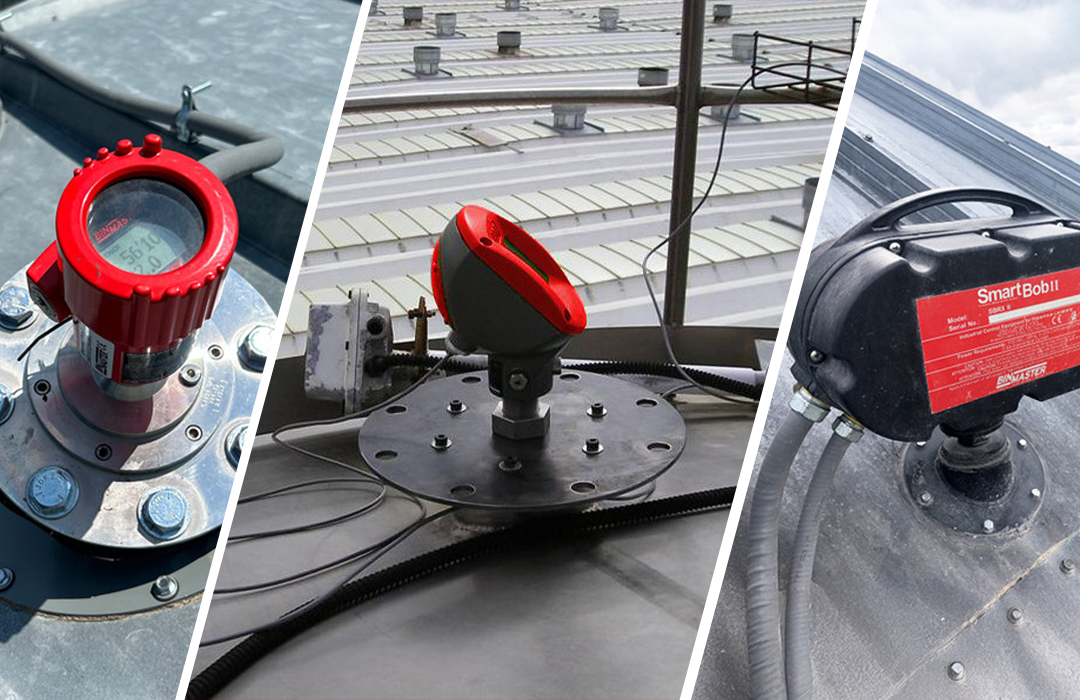
The NCR-86 non-contact radar, multi-point 3DLevelScanner, and plumb-bob SmartBob® are three of BinMaster’s continuous level measurement technologies that support IIoT systems. Image Credit: BinMaster
Bulk solids operations often face issues like bridging, rat-holing, inconsistent flow, batching errors, or conveying problems. How does access to accurate, real-time inventory data help operators respond to these challenges more effectively?
One of the most effective ways to combat bridging and flow issues is to keep material moving. Accurate, real-time data provides optimum inventory levels, which ultimately reduces the period that materials are stored.
That said, some bulk materials are challenging to measure and manage. BinMaster’s 3DLevelScanner detects irregular material topography and alerts production before problems become more significant.
BinMaster also offers a flow sensor that detects the presence or absence of material flow. While technically not an inventory sensor, it alerts workers to act when a chute or conveyor is plugged with material, which can lead to equipment damage and material spoilage.
Wireless connectivity is a major part of the IIoT conversation. How does wireless IoT help reduce installation costs, support remote real-time inventory monitoring, improve safety, and make cloud-based data more accessible across multiple sites?
Wireless sensors eliminate the need for communication cables, power wiring, and conduit, resulting in a marked reduction in installation costs. Given the labor shortage in the skilled trades, customers may experience long lead times for electrical installations. Wireless solutions can often be up and running more quickly than the hard-wired alternative.
Wireless sensors and accessories, such as network gateways and radios, are key components of connectivity for real-time, multi-site inventory monitoring. The ability to totalize inventory across multiple sites is critical to a comprehensive inventory management strategy.
The BinMaster team is seeing a number of safety initiatives that all but ban climbing ladders to check bin, tank, and silo levels. Reliable sensors comply with these directives, eliminate the need for manual inventory checks, and greatly reduce maintenance trips to the top of vessels.
How do you see IIoT solutions evolving in bulk solids management, and what should operators be thinking about now to prepare for the future?
Based on recent employment data, skilled labor shortages aren’t going to end anytime soon. Companies will continue to be forced to do more with less in terms of human capital; therefore, IIoT solutions will only grow.
I expect to see more vendor-managed inventory (VMI) practices in which fulfillment responsibilities and the maintenance of optimal inventory levels shift to the raw material supplier. IIoT will also play a key role in the AI revolution. Machine learning models will use IIoT data to further optimize inventory management through predictive analytics.
About Mike Mossage

Mike has held many positions since his start with BinMaster in 2002. He has played an instrumental role in the growth of the company, and he currently oversees the customer service and sales teams. You will often hear Mike say that it is a privilege to lead a group of dedicated professionals who put the customer at the center of everything that they do. Mike earned his BBA from the University of Iowa, and his MBA from the University of Nebraska-Omaha.

This information has been sourced, reviewed and adapted from materials provided by BinMaster.
For more information on this source, please visit BinMaster.com.
Disclaimer: The views expressed here are those of the interviewee and do not necessarily represent the views of AZoM.com Limited (T/A) AZoNetwork, the owner and operator of this website. This disclaimer forms part of the Terms and Conditions of use of this website.