To tackle the global challenge that is climate change, a worldwide reduction in greenhouse gas emissions is required across all sectors, from waste and transport to agriculture and energy.
Many greenhouse gases, such as carbon dioxide (CO2) and methane (CH4), are not visible to the naked eye, but their undetected emissions or small leaks can have a significant impact on our atmosphere. This is especially true in the case of CH4, which has over 80 times the potency of CO2 in the first twenty years after emission, before it is removed from the atmosphere.1
Monitoring these emissions at the source in real-time is crucial for the effective handling of climate change. Optical gas sensors, particularly mid-infrared (MIR) sensors, can provide great value for real-time emission monitoring.
This technology can be used in both fixed installations and mobile platforms, and can even be integrated into compact field instruments, allowing organizations to gather accurate real-time data, supporting compliance with environmental policies. This article explores how MIR non-dispersive infrared (MIR NDIR) gas sensors can accurately measure long-term greenhouse gas emissions in the field.
Monitoring Greenhouse Gases: CO2 and CH4
Methane and carbon dioxide are the greenhouse gases that most require continued monitoring, since they are both highly abundant and persist in the atmosphere, making them key contributors to climate change.
CO2 is primarily released through the burning of fossil fuels, the production of cement, and through deforestation, which also reduces the planet’s ability to absorb the gas. CH4 enters the atmosphere from a variety of sources, like landfills, wastewater, livestock, and natural gas infrastructure, meaning it accounts for the majority of radiative forcing and remains in the atmosphere for enough time to cause a lasting impact.2
Many industries could also benefit from tracking other trace gases and volatile organic compounds (VOCs). Many of these molecules absorb infrared (IR) light at specific wavelengths in the MIR range (around three to eight μm), making them suitable candidates for optical detection.3
The key advantage of MIR sensing is that it presents the spectral separation between gas absorption peaks, reducing cross-interference, a major consideration in complicated environments such as petrochemical plants and industrial emissions stacks.
How MIR NDIR Sensing Works
MIR NDIR systems measure gas concentration by shining infrared light through a sample and detecting the amount of light absorbed.
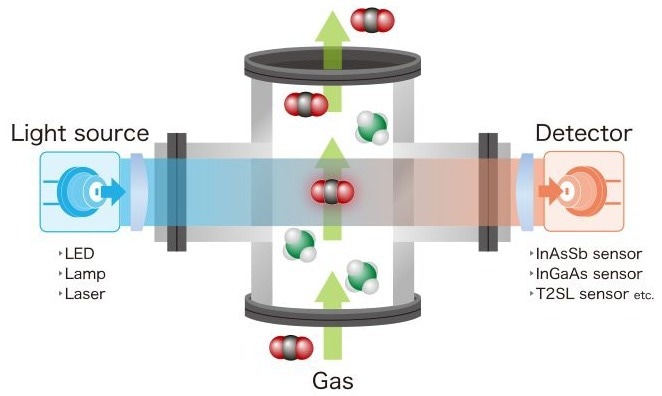
Figure 1. A schematic of a gas sensor. Image Credit: Hamamatsu Photonics Europe
Since many gases absorb IR light at unique wavelengths, this method offers a high degree of selectivity, as well as the ability to detect gases in various environments. The system typically consists of an MIR LED source, a photodetector, and a gas cell. Tuning sensors to the target gases’ specific absorption wavelengths aids the accurate measurement of concentrations, since the amount of light absorbed by a gas is directly proportional to its concentration:
A=εlc
Where ‘A’ is absorbance, ‘ε’ is the molar extinction coefficient, ‘l’ is the light’s path length, and ‘c’ is the concentration.
Combining indium arsenide antimonide (InAsSb) photodiode detectors with MIR LEDs is popular for the sensing of greenhouse gases, as this setup has a strong spectral overlap for the absorption bands of key gases, such as CH4 and CO2.3
Field Deployments: From Drones to Continuous Emissions Monitoring
Sensors based on MIR LEDs and InAsSb detectors are capable of providing high sensitivity in a small, rugged design, and, only requiring low power, are suitable for lengthy deployment in complex settings. They can be integrated into vehicles for mobile measurements, mounted on drones for aerial surveys, or installed at remote sites where regular maintenance is challenging.4,5
These abilities make them essential in strong climate strategies, as the ability to measure and corroborate greenhouse gas emissions is important for both national inventories and corporate environmental, social, and governance (ESG) reporting.
One important use is in continuous emission monitoring systems (CEMS), which are fixed installations on industrial vents or stacks that measure pollutant concentrations in real-time, ensuring regulatory compliance, process optimization, and the tracking of long-term emission trends.5 These systems are often utilized in complex environments, like petrochemical or power plants, making use of sophisticated simulation tools that help to deconvolute overlapping spectra to isolate the necessary compounds.
Similar technology is used in fence-line monitoring, where networks of sensors surrounding the perimeter of a facility detect any fugitive emissions that escape into nearby areas. This aids with leak detection, as well as providing transparency for local communities and supporting environmental reporting.
In the oil and gas industry, optical sensors are widely used for methane leak detection, with multi-sensor networks able to not only triangulate the locations of leaks but also reconstruct plume movement in 3D, creating a high-quality image of real-time emissions.4
Beyond industry, these sensors are used in climate research efforts to measure specific gases in situ, providing precise and direct emission quantification at the source to inform mitigation strategies.
Beyond MIR NDIR: QCLs, UV-Based Systems, and Hybrid Approaches
Applications that require the measurement of more complex gas mixtures generally use quantum cascade lasers (QCLs) to accurately recognize and measure specific gases within a blend. These offer a high level of spectral precision, making it easier to isolate individual gases, even if multiple compounds are present. For certain gases like ammonia (NH3), UV-based detection systems, generally using UV photodetectors and xenon lamps, are preferred to infrared methods. Although not a greenhouse gas, ammonia contributes to secondary particulate formation and is under increasing regulatory scrutiny, particularly in agricultural environments and maritime emissions, where recent European legislation may soon require its continuous monitoring in settings such as barns.4
Key Takeaways: Gas Sensing as a Cornerstone of Climate Action
Though greenhouse gases are invisible, they have a clear environmental impact. MIR NDIR gas sensors are becoming an essential part of climate action strategies, especially as expectations surrounding traceability, accountability, and climate transparency increase.
EU regulations for methane monitoring in the energy sector are already in use, and tracking measurements of ammonia and methane in agriculture may soon follow. Reliable and accurate sensing will be crucial for compliance and effective action in each of these settings.4
Advances in solid-state components like MIR LEDs and InAsSb photodiodes mean that modern gas sensors are more efficient, compact, and well-suited for long-term, decentralized deployment. This enables the taking of direct measurements at the source, providing organizations with actionable data.
Hamamatsu continues to develop high-performance, environmentally friendly sensing technologies that support accurate greenhouse gas monitoring. Their commitment to using non-toxic materials and reducing power requirements ensures that these innovations contribute to climate goals through both their applications and their designs.
To learn more, watch our webinar[4] on how MIR technologies are shaping the future of intelligent gas sensing.
References
- Mar, K.A., et al. (2022). Beyond CO2 equivalence: The impacts of methane on climate, ecosystems, and health. Environmental Science & Policy, (online) 134, pp.127–136. DOI: 10.1016/j.envsci.2022.03.027. https://www.sciencedirect.com/science/article/pii/S1462901122001204.
- World Meteorological Organization. (2023). WMO Greenhouse Gas Bulletin - No.14: The State of Greenhouse Gases in the Atmosphere Based on Global Observations through 2017. (online) Available at: https://wmo.int/publication-series/wmo-greenhouse-gas-bulletin-no14-state-of-greenhouse-gases-atmosphere-based-global-observations.
- Hamamatsu Photonics. (2025). Gas analysis using infrared (IR) light sources | Hamamatsu Photonics. (online) Available at: https://www.hamamatsu.com/eu/en/applications/measurement/gas-analysis-using-infrared-ir-light-sources.html.
- Hamamatsu Photonics. (2015). Beyond Gas Sensing Panel Discussion | Hamamatsu Photonics. (online) Available at: https://www.hamamatsu.com/eu/en/resources/webinars/infrared-products/beyond-gas-sensing-panel-discussion.html.
- Hamamatsu Photonics. Greener Industry with Advanced Gas Detection Industrialization and Its Environmental Cost. Available at: https://www.hamamatsu.com/content/dam/hamamatsu-photonics/sites/documents/21_HPE/featured-products-and-technologies/greener-industry-with-advanced-gas-detection.pdf.

This information has been sourced, reviewed, and adapted from materials provided by Hamamatsu Photonics Europe.
For more information on this source, please visit Hamamatsu Photonics Europe.