A one-year QGGPf pathfinder mission, led by NASA, JPL, and backed by $20M+ in contracted funding, will use laser-cooled rubidium atoms in microgravity to map subtle gravity changes tied to water, ice, and resource shifts. It's a step towards future high-resolution Earth monitoring.
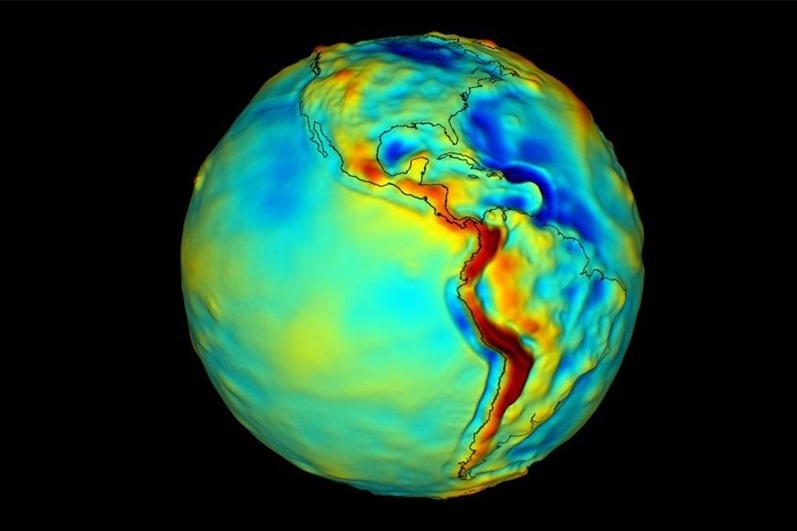
Red indicates areas of the world that exert greater gravitational pull, while blue indicates areas that exert less. A science-grade quantum gravity gradiometer could one day make maps like this with unprecedented accuracy. Image Credit: NASA.
Infleqtion and NASA are collaborating on a mission to launch a quantum gravity sensor into space.
Manufacturers of neutral-atom technology-powered quantum sensing and computing systems, Infleqtion brings its expertise to the Quantum Gravity Gradiometer Pathfinder (QGGPf) mission, led by NASA's Jet Propulsion Laboratory (JPL).
The goal is to transport the first quantum sensor aboard a purpose-built satellite in low Earth orbit (LEO) to measure the Earth’s gravitational field and its gradients/signals currently utilized for mass dynamics monitoring on the Earth’s surface.
The program comes after Infleqtion’s September 2025 announcement to go public through a merger with Churchill Capital Corp X.
Want to read this later? Click here to download a PDF.
QGGPf will rely on a single sensor using laser-cooled atoms as proof masses. Designed for quantum sensor technology demonstration, the QGGPf mission could significantly improve Earth’s gravity measurement from space.
Mass dynamics across the Earth’s surface, including land, ice, and water changes, can be monitored by a quantum sensor operating in microgravity, enabling longer interaction times and, consequently, higher measurement sensitivities. Atom interferometry will be used in the QGGPf project to measure Earth’s gravitational field nuances with high sensitivity.
By directly measuring subtle variations in Earth’s gravitational field, the mission aims to demonstrate technologies that will help reduce risk for future quantum gravity instruments. This mission is intended to lay the groundwork for future quantum sensor capabilities that could provide higher-resolution insights into underground water, ice, and natural resources shifting over time.
Importance of the Mission
The QGGPf uses rubidium atoms, cooled by lasers, to form a small cloud in a magneto-optical trap (MOT). From the source preparation region, the cold atoms are transferred to a dedicated atom interferometer region through a slight frequency shift between laser pairs. Subsequently, two clouds are created about half a meter apart.
In just a few seconds, three controlled laser pulses are applied to two prepared clouds to enable simultaneous atom interferometers. An interferogram on each cloud registers local acceleration after three interferometer pulses during the interferometer time.
From the acceleration difference, the gravity gradient is finally obtained.
Earth geodesy, a dynamic system, is shaped by hydrology, oceanography, and surface topography. QGGPf will enable researchers to investigate these targets with high sensitivity. From orbit, gravity measurements can provide consistent, global coverage over time.
QGGPf could enable researchers to track large-scale changes, such as groundwater movement, ice loss, and resource shifts, across regions that are difficult to monitor from the ground.
Funding and the Future of Quantum Environmental Monitoring
The QGGPf mission has garnered over $20 million USD in contracted mission funding to date, with key contributions from Jemba9, Monarch Quantum, Infleqtion, the University of Texas at Austin, and NASA’s Goddard Space Flight Center.
Quantum sensing is a completely new domain for the United States (US) space leadership.
Quantum sensing opens an entirely new domain for U.S. space leadership. By deploying this technology in orbit, we are demonstrating the feasibility of quantum gravity sensing in space and laying the groundwork for future capabilities that can deliver unprecedented insight into our planet.
Dana Anderson, Chief Science Officer at Infleqtion
The expected launch year of this one-year mission is 2030. The orbital deployment of this technology could serve as a demonstration of quantum gravity sensing’s feasibility in space and establish the foundation for future capabilities that could provide higher-resolution insights into Earth.
By directly measuring Earth’s subtle variations in the gravitational field, the mission aims to demonstrate technologies that reduce risks for future quantum gravity instruments.
These advanced systems provide high-resolution insights into how ice, natural resources, and underground water shift over time, crucial data for planetary health understanding, supporting long-term security and economic planning, and strengthening national resilience by helping provide consistent, global coverage.
Disclaimer: The views expressed here are those of the author expressed in their private capacity and do not necessarily represent the views of AZoM.com Limited T/A AZoNetwork the owner and operator of this website. This disclaimer forms part of the Terms and conditions of use of this website.