 Interview conducted by Frances BriggsJan 12 2026
In this interview, Vladimir Marhefka, CSO and Vice-Chairman of the Board at RVmagnetics, discusses the details behind their patented MicroWire technology - the smallest passive sensor in the world. Vladimir describes their successes to date, their outlook in 2026, and why it's the RVmagnetics sensor you should choose. As he puts it, the MicroWire allows sensing in places where traditional sensors simply cannot exist.
The MicroWire is the world's smallest passive sensor. Can you explain what that means and how its scale affects technology?
When we say that RVmagnetics develops the smallest passive sensor in the world, we are referring to our glass-coated magnetic MicroWire, which is thinner than a human hair, typically between three and 70 micrometers in diameter.
The sensor is so small that it can be embedded directly inside materials such as composites, polymers, batteries, implants, or even high-precision mechanical parts without altering their structure, mass, or mechanical performance. The importance of this small scale is tremendous. It enables “invisible” sensing, where the sensor becomes part of the material itself, eliminating design compromises because the sensor doesn’t force engineers to change the product.
By enabling passive sensing, the MicroWire allows remote readout in environments where electronics cannot survive, including high pressure, extreme temperatures, movement, or biological tissue. It extends monitoring from the surface to the core of the structure, offering deeper, more accurate insight.
Essentially, the small scale allows sensing in places where traditional sensors simply cannot exist.
Where did it all start? What sparked the beginning of RVmagnetics, and how have you come so far?
RVmagnetics was founded by Prof. Dr. Rastislav Varga, an internationally recognized physicist known for his pioneering work in magnetic amorphous materials. His vision was to take the academic concept of magnetic microwires and turn it into a practical, industrial sensing platform.
The company started as a small R&D group in Slovakia. Over time, as MicroWire proved its potential in areas like structural health monitoring and smart materials, we expanded, patented our technology and applications, built our own MicroWire quality control line, and assembled an internationally focused engineering, physics, and business team.
What has brought us so far is consistent: deep expertise, scientific curiosity, and a culture of industry collaboration. We co-develop solutions with clients, and this approach has allowed us to move from a research-driven company to a trusted industrial partner.
Can you briefly explain how the technology works and where it can be used?
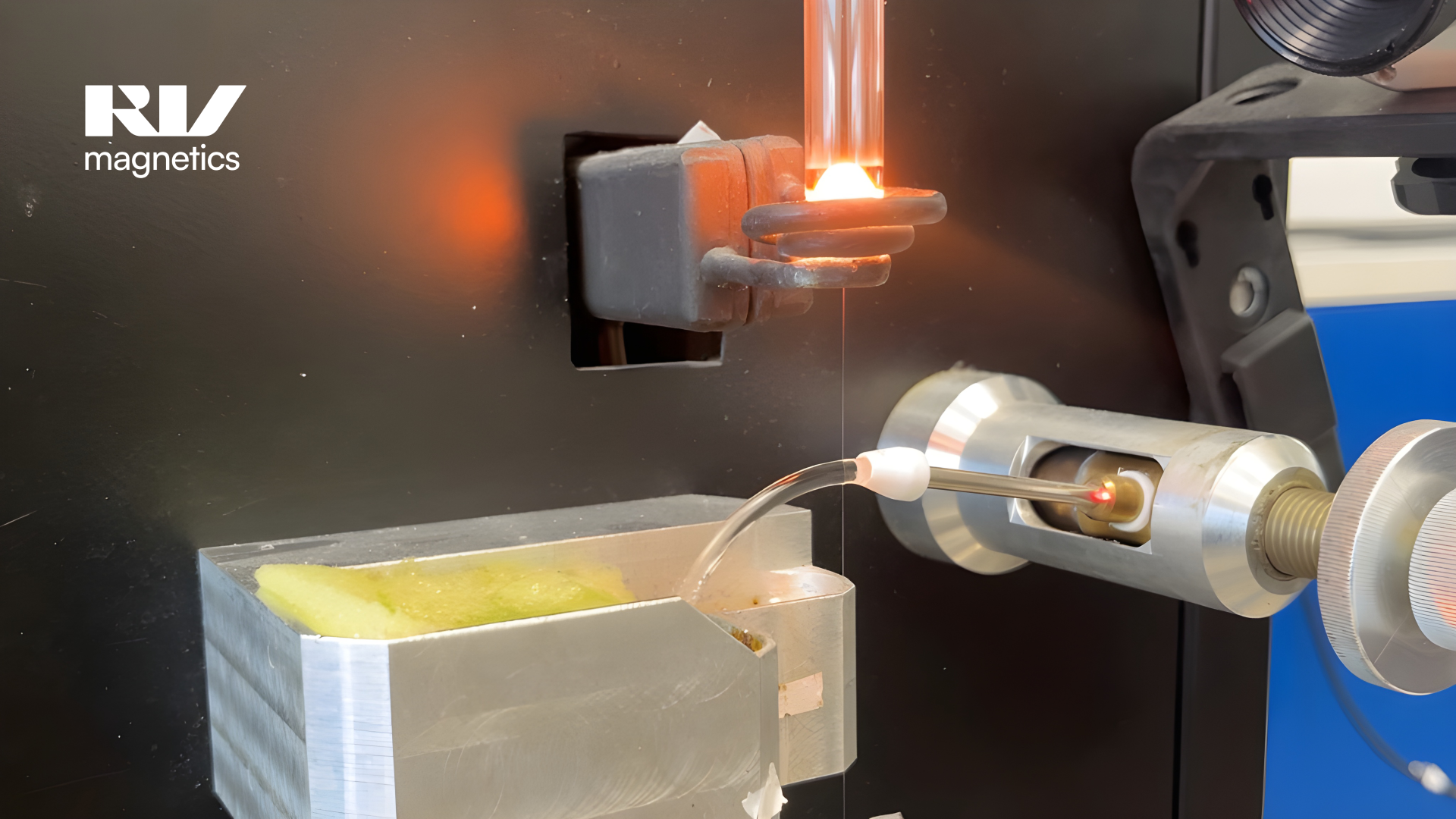 Image Credits: RVmagnetics
MicroWire is a glass-coated magnetic sensor whose magnetic properties shift in response to external physical stimuli such as stress, temperature, pressure, or vibration. Our external interrogation unit detects these changes in contactless and translates them into precise measurements.
Our sensing solution consists of four important parts: the MicroWire sensor, sensing coils, the MCU, and custom software. The sensor detects magnetic changes, the coil captures responses, and the MCU processes and transmits data wirelessly.
MicroWire Sensor can be used in composite manufacturing for monitoring curing and internal stress, electric motors for torque and vibration monitoring without slip rings, batteries & energy storage for internal temperature monitoring where thermistors cannot reach, medical implants for minimally invasive monitoring of pressure or temperature, and also in civil engineering for embedded stress and deformation sensing in concrete or geotechnical structures.
For example, a client in the aerospace sector producing high-performance carbon fiber parts needed to measure internal strain and micro-movements inside the laminate. Only external sensors are available, but our embedded sensor can measure it much faster and also in-flight/in-operation.
Our MicroWire was embedded directly during layup, remained unaffected by production, and provided real-time data throughout the manufacturing cycle - something the industry had never been able to achieve before.
Why would you encourage a manufacturer to choose your sensor technology over others?
Choose the technology that works when all others fail. MicroWire sensors are uniquely beneficial when it is not possible to place electronics at the sensing location, like when the measurement is challenged by the design of rotary equipment, for example.
Our microwire is ideal when deep, internal, or embedded sensing is required, and when sensing needs to last for decades without maintenance. Also, in cases where size constraints make conventional sensing impossible.
In other words, our MicroWire sensors are not meant to replace every conventional sensor but rather to unlock sensing in previously inaccessible environments.
What are the key benefits of using passive, contactless MicroWire sensors compared to more traditional active/contact sensors?
Their uniqueness comes from passive operation - the sensing element requires no power or wiring, extreme miniaturization - truly microscopic dimensions, and contactless readout - data can be measured through barriers.
Multi-parameter sensitivity is a big advantage: Stress, temperature, pressure, vibration, and magnetic field can all be inferred from the same MicroWire. This combination simply does not exist in any competing sensor technology today.
You were one of fifteen companies to be selected to contribute to the NATO Diana Programme. What does it mean to be involved in such a huge project that will, hopefully, have a significant impact?
Being one of only fifteen companies in the NATO DIANA Programme, selected among 2,600 companies twice for the 1st and 2nd Phases in 2025, is an enormous honor and a recognition of the years we have invested in this technology.
It validates not only our science but also the practical impact MicroWire can have in defence, security, and advanced industrial sectors.
For us, it means access to top-tier mentors, research facilities, and real-world deployment opportunities, the chance to develop high-impact sensing solutions for critical infrastructure, defence systems, and operational environments, establishing RVmagnetics on the global stage as a deep-tech innovator, and a direct pathway toward large-scale industrial deployment.
It is exciting, humbling, and energizing, and it demonstrates that our technology is not only innovative but also strategic.
Having already achieved so much success, where do you hope to see the company grow to in 2026?
Our overarching objective is to move from high-potential emerging technology to a mainstream industrial sensing platform and scale production of MicroWires to meet growing industrial demand.
By 2026, our goals include deploying installations in aerospace, defence, and automotive sectors, and accelerating OEM integration, where MicroWire becomes a built-in standard component. We also plan to deliver two to three pre-production prototypes.
Moreover, we need to expand our global partnerships, particularly in the EU and also globally. Last but not least, we would like to strengthen our R&D team with new experts in AI, materials science, and electronics.
Looking forward to the coming year more broadly, where do you see sensor technology going in R&D and industry in 2026?
There are major trends we’re already seeing intensify. The first one is embedded and invisible sensing, where sensors will no longer be mounted externally; instead, they will be built inside materials, structures, and devices. This is exactly where MicroWire excels.
The second is passive and maintenance-free intelligence because power consumption is a major bottleneck for IoT scaling, so passive sensing will be essential for long-term, reliable data.
The third is multi-parameter, multi-functional sensors. Industry will prefer a single sensing element capable of reading multiple variables, combined with AI-driven interpretation. The fourth trend is humanoid robotics requiring sensing.
MicroWire technology is perfectly aligned with all these trends, which is why we believe its adoption will accelerate rapidly.
What's something you wish more people knew about RVmagnetics?
We wish more people knew that we’re not just offering a sensor, we’re offering something completely new. We need our technology to be understood widely among engineers and innovation officers at the headquarters, because most have not yet met with it.
Our technology doesn’t compete with classic sensors; it enables applications that were previously impossible.
We thrive on co-developing solutions with partners, and many of our biggest breakthroughs came from a simple conversation that started with: "We have a problem no sensor can solve." In many cases, our MicroWire could (and can) solve it.
Saving this for later? Grab a PDF here.
About Vladimir Marhefka, CSO
Vladimir is Vice Chairman of the Board at RVmagnetics, where he leads strategy and business development. Since 2019, he has played a key role in shaping the company’s growth and commercializing its patented MicroWire technology, the world’s smallest passive sensor, across aerospace, defence, and industrial markets.
With over 18 years of experience in executive and business development roles across B2B industries and a background in finance, Vladimir brings a strong, market-driven approach to scaling deep-tech ventures.
He has led international sales teams and driven RVmagnetics’ participation in global innovation ecosystems, including NATO DIANA, BIND 4.0, and Sustainable Aero Lab. His focus lies in bridging cutting-edge R&D with real-world industrial applications in deep tech and industrial IoT.
Disclaimer: The views expressed here are those of the interviewee and do not necessarily represent the views of AZoM.com Limited (T/A) AZoNetwork, the owner and operator of this website. This disclaimer forms part of the Terms and Conditions of use of this website.