 Interview conducted by Frances BriggsMar 11 2026
From a PhD project to one of the top three players in space quantum, SBQuantum is just five years old and already on its way to orbit. CEO and founder David Roy Guay sat down with AZoSensors to discuss the company’s magnetometer technology and its jump from lab to launch.
Please can you introduce yourself and your role, and outline your spin-off journey from the Institut Quantique to SBQuantum?
I’m David, founder and CEO of SBQuantum. My background is in quantum physics, and during my PhD, I focused on diamond impurities, becoming the first to work on the topic in Canada.
Towards the end of my PhD, I filed a patent on a way to operate a sensor to very accurately measure the direction of Earth's magnetic field. And at that point, I became interested in entrepreneurship, and SBQuantum was founded.
Now we're five years in the making. One of our flagship projects is the MagQuest program to build and maintain the World’s Magnetic Model, launching the diamond magnetometer technology into space at the end of March. This sensor is the work of my PhD shrunk into something portable. And with that, we'll build future versions of the World magnetic map – the same map your phone uses for that blue arrow – so soon enough, it will be in everybody’s pocket.
Getting straight to the technical details, what are the key trade-offs you make when you're looking at the vacancy centers and balancing that with sensitivity, stability, and so on?
Okay, let's jump into it. So the NV centers in diamond are atomic impurities. These impurities result in free electrons, each with their own spin, a quantum mechanical property.
There are different grades of quantum technologies. You can utilize quantum passively, as is done in transistors or lasers. Then there’s the science that uses spin states, where we can actively control the quantum state to take ultra-precise measurements. That’s where we play.
In simple terms, spin behaves like the smallest magnet you can think of. When a magnetic field is applied, atomic energy levels split into a larger number of levels. This is the Zeeman effect. We can measure those changes in the microwave domain and read them out optically using a green laser. As the spin relaxes, it emits red light, and the intensity of that light depends on the magnetic field.
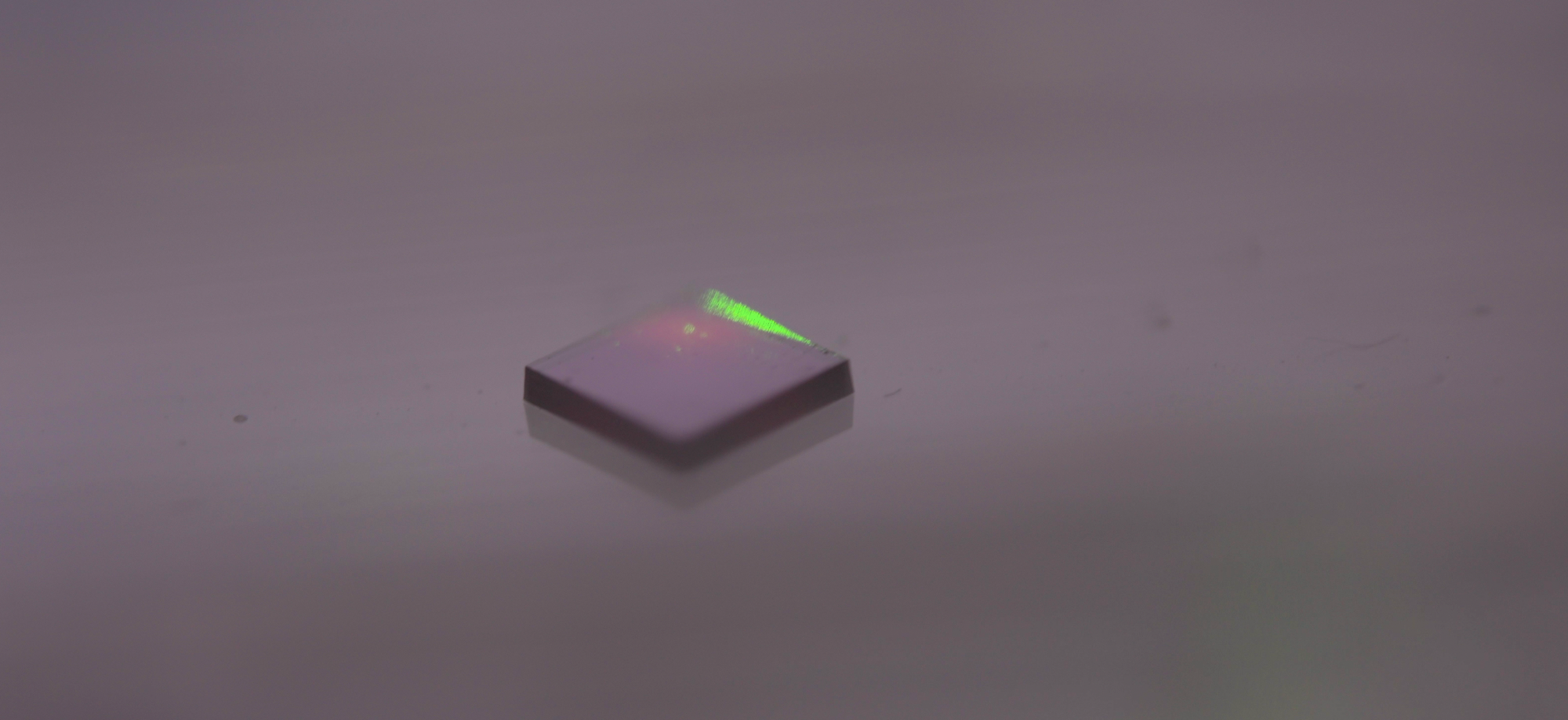
Image Credit: David Roy Guay/SB Quantum
So, this is the diamond with the green laser that's coming in. We excite the diamond using the laser, resulting in a nice optical transition that is spin preserving. As the spin deexcites, it emits red light, which gives you that red glow you see. The intensity of the red light varies depending on the value of the magnetic field.
This diamond is a synthetically grown purple diamond that features quantum-level impurities. What’s nice about these impurities is that within the tetragonal diamond lattice, you have four sensing axes resulting from just one impurity, but in a very small, micrometric volume.
So, from there, you can infer what the vector magic field is, the way the magnetic field is pointing, and this is essential to navigation.
It's essential also to build advanced interpretation algorithms. So we're building arrays of these sensors, and asking: instead of passively measuring everything that's in a sphere around us, can we be directional? If we bring back directionality to the measurement using an array, we can measure the magnetic signal and work out where it’s coming from, its size, and its speed. Using all these measurements together we can classify the signals in a way that's not been done before.
That must involve a massive amount of data processing; It’s obviously not just hardware that makes the magnetometer work so well. There must be a balance between data processing algorithms, as well as the hardware itself.
Absolutely. You can have the most sensitive magnetometer on the planet, but at the end of the day, if you put it right by the side of a metallic object, you're going to measure the metallic object.
It’s all a matter of how you understand the environment around your sensor.
Essentially, the sensor is surrounded by a sphere of signals. From there, it comes down to algorithms that can screen out the effects of the platform itself.
Take your car’s compass as an example. In modern cars, we have electronic compasses sitting very close to a large mass of metal, and in electric cars, possibly near high-current batteries as well. So to make it accurate, you need to calibrate it. You can do this by performing specific manoeuvres, like driving in a cloverleaf pattern, and then adjusting compensation coefficients to ensure the compass readings are correct.
We're doing the same with MagQuest. Our sensors will often be close to battery packs and other metallic elements. But we don't want to change the device's entire architecture. Instead, we've developed the expertise to use reference magnetometers and calibration routines to make the satellite magnetically ‘disappear’, in effect.
So that's one part, compensating for noise.
The other part is, you have the signals, what do you do with them? Let’s say you’re taking measurements and you see a car passing by, or someone walks down a hallway with their laptop. From a magnetic standpoint, or a physics standpoint, it will give the same signal. That's the dipole magnetic signal.
By building arrays of these sensors, we can null out what's happening farther away, focus on what's close, and add an extra layer of algorithms to say, okay, the object is pointing this way. It has this mass. It’s this distance away.
Your sensors work at room temperature, which is quite unusual for quantum devices. Beyond eliminating cryogenics, what properties of the diamond influence the sensor's performance, and what could be iterated further?
So, the room temperature aspect comes from the diamond's high band gap – it’s 5.5 eV. Essentially, because the diamond is transparent, very little can be absorbed; the band gap is too big. But this is nice for us, because it screens off the spin state.
Plus, the diamond is hyper rigid, so it doesn't couple that much with like-temperature and vibrations and all that just so that's a key property.
Another thing is the ruggedness of the technology. These impurities are created with mega electron volt electron beams. So if you send the technology into space, the radiation won't be much of an issue, or it could be a sensor in nuclear plants and survive the extreme environments.
So that's one point.
Another advantage comes from the electronic structure. You don’t need a very specific laser wavelength. The system can tolerate detuning in temperature and in wavelength. Actually, you could even use LED, which has a very broad emission spectrum and still have a functioning magnetometer.
The same is true with the light that is emitted. Emissions range from red to infrared light, so you don’t need particularly sophisticated optical components. That makes the platform much more practical and portable, without having to rely on highly specialized laser systems that might need millions of investment to achieve super precise wavelengths.
On top of that, since everything is based on quantum, the measurements are very accurate.
That’s a key property that we're exploiting for the MagQuest program. When you’re building a map, you need consistency and confidence, the ability to generate a single map with a stable baseline.
Sensitivity is also key. Examples in the literature show that you can reach femtotesla sensitivities. So that means we could see objects further away than current technology. These are really the main advantages.
With the right investment and the right team, this femtotesla level of performance could be achieved in a portable technology like this within the next three to five years.
However, there’s a trade-off with accompanying this high sensitivity.
You’ll almost be able to see too much and then have to calibrate much more. The algorithms are going to be even more important unless you look at very specific use cases, like you're in the middle of the ocean, there's only whales, which are non-magnetic, and maybe a submarine. Then it’ll be easier, but if you're in an urban environment, there's not actually that much gain from that level of sensitivity.
When it comes to the space project and MagQuest, the major goal is to map the Earth’s magnetic field. Why is that so important?
Well, it turns out the North magnetic pole has moved from its position of 100 years ago. It used to be much closer to Canada. Now it's moving towards Siberia, and this trend is accelerating through time.
This is a result of Earth’s geodynamo: circulating magma creates a magnetic field, which is the main contributor to the magnetosphere, which screens us from radiation, maintains our atmosphere, and provides us with navigation tools like the compass.
Birds, sharks, turtles, they all navigate using the Earth’s magnetosphere. It's essential to base navigation. GPS will tell you where you are, but it won't tell you what way you're pointing, except if you're moving.
As this pole is moving, we need to update its position on the ‘magnetic map’. Otherwise, all our navigation instruments are going to be off by a few degrees. The worst observed case of this is in Alaska, where they had to repaint the lettering on the landing strip for airplanes, because of the change in the North Pole’s position.
Previously, the position of the pole was updated every 10 years. Now it's every five. That's why we need to maintain it.
We now measure the pole’s position with ESA satellites, which are very big, the size of a bus, multi-mission, and mostly for scientific purposes. America has launched MagQuest with the hopes of a more targeted, agile, and cheaper mission approach.
But there's also growing interest in GPS-denied navigation. And for that, you could use the subtle effects of the Earth's crust. So basically, using the rock's magnetic field signal to have more resolution and perform magnetic navigation.
That's a very trendy topic, especially relevant for what's going on in Ukraine, where we see GPS constantly jacked.
When it comes to a specific area, it feels like SBQuantum’s magnetometer can do it all. You're looking at defense, space, autonomous vehicles. Is there an area that you’re particularly interested in, or anything that holds less importance?
In terms of applications, very early on, we chose not to go into health because we thought that there were too many people already looking at the same technology in the health domain. But the very first contract we got was detection and classification of objects with the Department of defense in Canada. So that has really shaped the company in terms of building the hardware and the algorithms for the special forces.
Now we're looking at usage beyond that. One aspect is working with SWAT teams in the police. We’re working with a local team here, where they have scenarios like, let’s say there’s a hostage in a house – the SWAT team wants to know if they’ve got a weapon. This is the kind of application that's especially relevant to us, including home and school safety, improved metal detectors, and even corporate security as well.
While space is a very nice application, it's very limited in terms of market size. As a startup, this is really good for us because we can validate our technology and show that it really works. With the MagQuest program, we have clear performance metrics that have really focused our development on the project, but also the performance of our sensors. It’s really shaped our company, and it's still going to play a role.
We're also working with the European Space Agency. They're funding the next version of our magnetometer, mostly for scientific purposes. For example, we’re looking at monitoring the Gulf Stream. Ions move deep beneath the ocean and create a magnetic field. Using this, we can monitor the Gulf Stream and assess whether it’s dying or its changing patterns. It’d get a bit colder in the UK if the Gulf Stream were to stop.
Tell us about the team behind you. Who’s helped you to come so far in such a short period of time?
We began with two interns, Vincent Halde and Olivier Bernard. They’re electrical engineers and built all the magnetometer electronic boards – they’re really the experts in that area. I defined the requirements, and they executed.
Since then, we’ve grown. We now have several electrical engineers, as well as a robotics engineer who works on building and integrating our sensor into different platforms. We also have data scientists, because as we develop the sensor, we’re seeing trends that don’t always align perfectly with the physics. That means we need to be creative and rigorous in interpreting the signals and understanding what’s actually happening.
Today, we’re a team of 21 people. Overall, we’re about four or five people on the business side, and the rest of the team is focused on the technical development.
Taking another step back from the technical details, if you reflect on your work and your journey to where you are today, what would your younger self be most proud of?
I feel super proud of what we've done, in part because I was the first to work on the quantum system in Canada, and it started with such a simple concept: Let’s just take whatever is commercially available, let’s build the tech, and let’s improve it.
We really embraced the user-centered discovery process, iterating and improving along the way. We’d develop and then deploy the technology, validating and asking ourselves, what we can do differently? So I'm very proud of our trajectory beyond chasing perfection and ultimate technological performance.
And with this very simple concept of just getting going and prototyping, we're now in the top three worldwide, developing this technology. We're going to space. So, if I look at my high school book, where my dream as a high schooler was to be in space, or to send something to space, we’re there. I’m super happy about that.
My final question is about inspiration. Are there any scientists, researchers, or engineers you’ve looked up to or who inspired you to set out on this journey?
I'm a big Mac fan, so Steve Jobs really inspired me in terms of simplicity and having something that just works without being complicated – I’m a big fan of his approach.
On the scientific side, there are two people. Ronald Walsworth, who was based at Harvard when he began pioneering the technology. His whole enthusiasm and drive towards applications engineering was very inspiring.
Also, Lily Childress at McGill University, who's one of the pioneers of the diamond defect field, inspired me to push towards understanding what we're seeing in terms of physics, the phenomena on the screen.
I still remember spending days during hot summers in the dark, cold physics lab, squinting to see patterns in the signals and not understanding what was going on. Lily was really inspiring in continuing to push and push the physics forward.
About David Roy Guay and SBQuantum
David Roy-Guay, CEO and Founder of SBQuantum, a pioneering spinoff from the Institut Quantique in Sherbrooke, Canada. Under David’s leadership, SBQuantum has participated in the Creative Destruction Lab Quantum Stream, which expanded the company’s focus toward algorithmic solutions and data-centric approaches.
Today, SBQuantum delivers Magnetic Intelligence solutions to clients in geophysics exploration, aerospace, and defense.
A passionate advocate of open innovation, David and SBQuantum are championing initiatives like the MagQuest Challenge, which bridge quantum science with practical end-user applications. Soon, SBQuantum’s quantum magnetometer will be deployed in space to contribute to the development of World Magnetic Models, the foundation of every compass.
Disclaimer: The views expressed here are those of the interviewee and do not necessarily represent the views of AZoM.com Limited (T/A) AZoNetwork, the owner and operator of this website. This disclaimer forms part of the Terms and Conditions of use of this website.