A slurry blending station is usually used to create set ratios and concentrations of CMP slurry, which contains an abrasive, a powerful oxidizing agent, hydrogen peroxide, and deionized water.
The concentration of hydrogen peroxide diminishes with time, so it needs to be constantly monitored to ensure the repeatability and efficiency of CMP. Product loss is minimized by checking that the CMP slurry is constantly within specification and changing the combination as required.
Tools such as the Entegris GV148 and SemiChem continually monitor H2O2 concentration. This allows for real-time monitoring of changes to the slurry blend and ensures the process remains within the set parameters. These tools can help prevent process drift and maintain maximum CMP performance.
GV148 Principle of Operation
The Entegris InVue GV148 liquid concentration sensor uses index of refraction (IoR) technology. Light from an LED is directed at an optical window in contact with the liquid. The light reflects off the liquid at an angle specified by the liquid's index of refraction.
The reflected light is then directed to a photodiode array (PDA), where its intensity is measured. A custom Entegris algorithm determines concentration by measuring small variations in light intensity that correspond to changes in the liquid's refractive index.
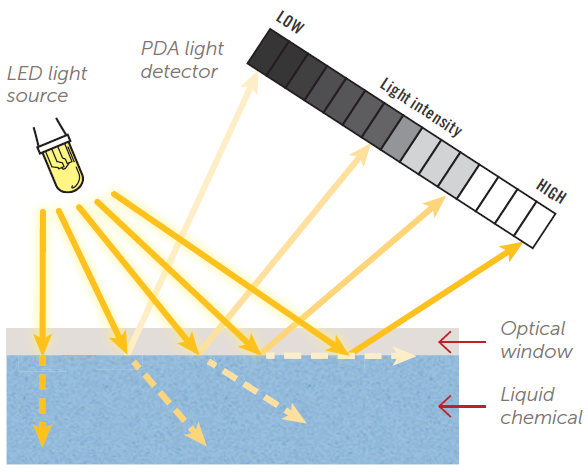
Figure 1. GV148 IoR concentration sensor. Image Credit: Entegris, Inc.
Experimental
A series of studies were carried out on the Air Water Mechatronics Slurry Delivery Systems (SDS) shown in Figure 2.
These studies aimed to see if IoR concentration monitors could accurately detect slurry/H2O2 concentrations and to understand how temperature/pressure/flow changes affect IoR measurements. The tests examined three commercially available IoR monitors: sensor A (Entegris GV148), sensor B, and sensor C.
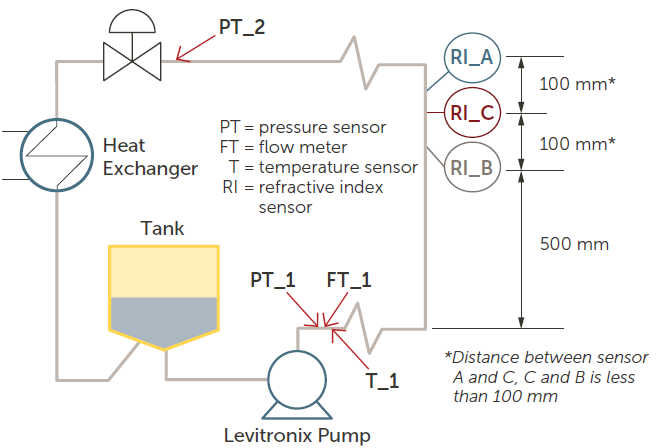
Figure 2. Test flow diagram. Image Credit: Entegris, Inc.
Figure 3 shows the circulatory conditions.
| Recirculation condition |
Basic condition |
Flow rate/pressure change test |
| Fluid volume (kg) |
|
30 |
| Fluid temperature (°C) |
25 |
20 → 30 |
| Flow rate (m/s) |
0.5 / 0.7 |
0.5-0.7 |
| Pressure (MPaG) |
0.15 |
0.05~0.17 |
Figure 3. Test conditions. Image Credit: Entegris, Inc.
Results
Test 1: Diluted H2O2
Hydrogen peroxide concentration was adjusted three times by adding H2O2 to DI water, beginning at zero weight percent. Figure 4 shows hydrogen peroxide concentration vs. time.
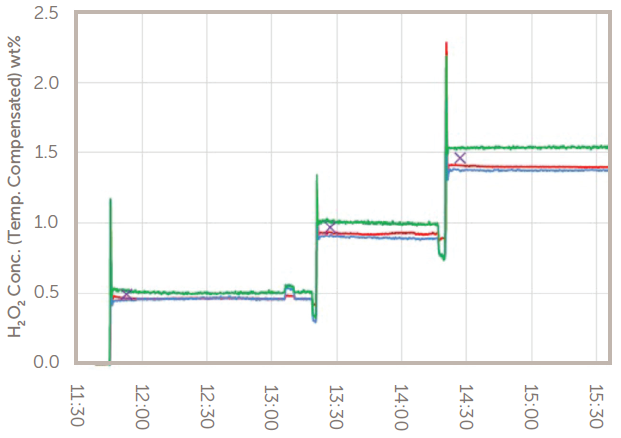
Figure 4. H2O2 concentration vs. time. Red = A, Entegris GV148, blue = sensor B, green = sensor C. X = control value by titration. Image Credit: Entegris, Inc.
Test 2: Diluted Silica Slurry
The concentration of diluted silica CMP slurry was adjusted by adding further slurry. The concentration was increased from 1.85 to 2.25 % before being reduced to 1.85 % by adding DI water.
Figures 5 and 6 show the results from all three sensors. Figure 7 is an enlargement of the first 15 minutes of Figure 5, demonstrating GV148 data accuracy and stability.
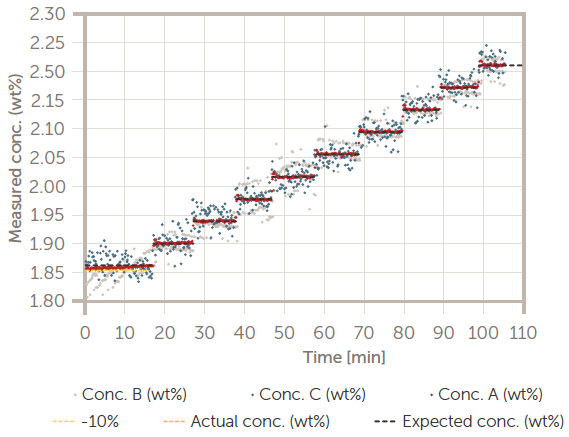
Figure 5. Increasing slurry conc. vs. time. Red = A, Entegris GV148, light gray = sensor B, blue-green = sensor C. Image Credit: Entegris, Inc.
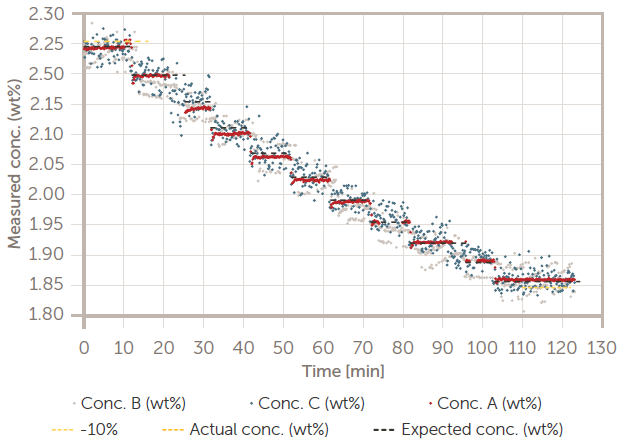
Figure 6. Decreasing slurry conc. vs. time. Red = A, Entegris GV148, light gray = sensor B, blue-green = sensor C. Image Credit: Entegris, Inc.
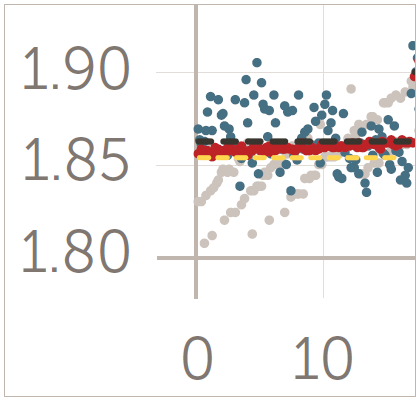
Figure 7. Entegris GV148 data in red. Image Credit: Entegris, Inc.
The Entegris GV148 data is more stable than sensors B and C. The GV148 results are also closer to the actual/expected concentration values.
Test Results Summary
The three sensors were assessed using a variety of performance parameters, and the Entegris GV148 was found to be the superior product for the following reasons:
- Easy to use: Can construct a calibration table (IoR vs. Conc.) in the field, with a smaller body and fewer components, and interact with PLC.
- Repeatable and stable measurements, with evident IoR differences as H2O2, Silica, and Ceria slurry concentrations change.

This information has been sourced, reviewed, and adapted from materials provided by Entegris, Inc.
For more information on this source, please visit Entegris, Inc.