A hatch cover may seem to be, and perhaps even prove to be, watertight, but it may still be letting the sea in. That's just how it is with one of the shipping industry's most common and expensive issues: micro leaks.

Image Credit: Sven Hansche/Shutterstock.com
Often invisible and undetectable via torch inspection, micro leaks are easy to miss in routine walk-rounds. However, these small gaps in hatch cover seals are what lie behind a considerable number of cargo damage claims each year, and they're almost completely preventable.
A Problem That Can't Be Seen
Sea water is among the main causes of cargo damage on dry bulk and general cargo ships. Steel coils rust, timber swells and stains, grain spoils, and bagged goods clump and degrade. In each case, the damage can be brought back to the same root cause: an insufficiently weathertight hatch cover, door seal, or coaming.
The problem is that conventional visual inspection techniques simply aren't enough to catch these defects. A rubber compression seal may look intact even while being unevenly compressed, perished in a single section, or displaced by a few millimeters, which is more than sufficient for water to infiltrate during heavy weather.
Chalk and hose testing have been used as workarounds for a long time; however, both are slow, weather-dependent, labor-intensive, and often too imprecise to determine exactly where a failure occurred before loading cargo.
The result is that micro leaks are typically undetected until damage has already occurred. At this point, however, vessel operators find themselves looking at costly claims, P&I club investigations, as well as reputational fallout with charterers and cargo owners.
Why Micro Leaks Are So Costly
Cargo damage claims arising from hatch cover leakage are usually costly for several reasons. Water damage to cargo is not typically limited to just one small area: when seawater enters, it often spreads through a hole and affects significantly more of the cargo than the original leak size would indicate.
Claims can also necessitate comprehensive investigations into maintenance records, which may expose the vessel to findings of negligence if leaks weren't identified and addressed proactively. Beyond direct claim costs, however, there's also operational disruption: delayed discharge, disputes with charterers, and the hefty cost of a vessel's damaged reputation and cargo.
For owners and operators alike, it is crucial to understand that the cost of prevention is significantly less than the cost of a claim. However, this is only true if leaks are found and repaired before it leaves the dock, and not after a claim has been made.
Ultrasonic Testing: Making the Invisible… Visible
This is where ultrasonic leak detection completely changes the story. Instead of depending on what is visible to an inspector or prevailing weather conditions, ultrasonic testing uses sound to locate leaks that are otherwise undetectable. It does so quickly, with precision, and regardless of sea state or sunlight.
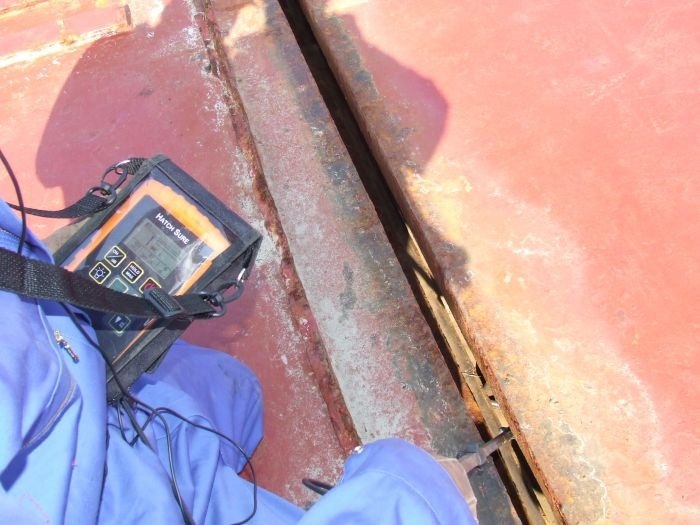
Image Credit: Cygnus Instruments Limited
Cygnus Instruments' Hatch Sure was built exactly for this challenge. The system includes a battery-powered transmitter equipped with 19 ultrasound emitters that operate at 40 kHz and are located within the closed cargo hold to produce a uniform, omnidirectional sound field throughout the space.
With the hatch closed and sealed as if for voyage, the handheld receiver is passed around the hatch cover’s perimeter coamings and door seals from the outside. Wherever ultrasound can travel through a gap, no matter how small, the receiver picks it up and displays the sound level in decibels, along with an Open Hatch (OH) value that determines exactly where the leak is.
As the test is carried out with the hatch fully sealed, it reproduces real sailing conditions with significantly more accuracy than a visual or hose test, identifying compression faults, perished seals, and hairline gaps that would otherwise only become apparent when it’s too late.
Hatch Sure is lightweight, built for one-person operation, and demands minimal training. Inspections can be conducted by crew members as part of regular pre-departure checks, not by specialist third-party surveyors.
Its six selectable power levels mean it can be used in every situation from full cargo holds to smaller access hatches and doors. Meanwhile, its ABS type is approved and broadly accepted by P&I clubs, ultimately supplying operators with a recognized, evidence-based record of weathertight integrity.
From Reactive Claims to Proactive Maintenance
When used regularly, Hatch Sure means hatch cover maintenance is no longer a reactive exercise, fixing seals after damage has already occurred. Rather, it becomes a proactive, scheduled exercise.
Creating a recorded history of hatch integrity over time makes it possible to plan and target repairs rather than guessing at them. It also provides owners with documented evidence of due diligence in the event of a dispute.
In an industry where a single cargo-damage claim can generate hundreds of thousands of dollars, the case for ultrasonic hatch testing is simple: find the leak before the sea does.

This information has been sourced, reviewed, and adapted from materials provided by Cygnus Instruments Ltd.
For more information on this source, please visit Cygnus Instruments Ltd.