With the new capaNCDT CSH/SE sensors, Micro-Epsilon is expanding its portfolio of capacitive displacement sensors with especially robust models for extreme operating conditions. New compact gap sensors also provide greater freedom of integration for high-precision gap measurements.
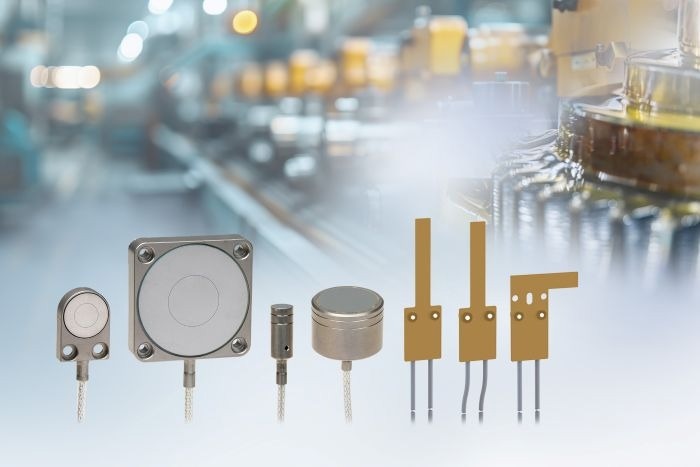 Image Credit: Micro-Epsilon
The capacitive displacement sensors in the capaNCDT series stand for maximum precision, stability and versatility. With resolutions down to 0.03 nm, compact design, multi-channel capability and OEM-ready solutions, the portfolio is suitable for a wide range of applications in industry, research and development. The globally unique product range also covers extreme temperature ranges from -270 to +800 °C and offers suitable sensors for both standard and special applications.
New Sensors for Extreme Environments
With the new CSH/SE series, Micro-Epsilon is expanding its portfolio with sensors for especially demanding operating conditions. The series comprises 5 cylindrical sensors and 7 flat-design models with measuring ranges from 0.2 to 5 mm. The sensors are based on the proven CSH standard models and offer an almost identical design as well as the same cable dimensions. At the same time, their construction is consistently designed for special operating conditions, from ultra-high vacuum and cleanroom applications to strong magnetic fields and extreme temperatures.
Designed for Extreme Conditions
The SE sensors cover a temperature range from -270 to +200 °C and impress with excellent temperature stability. Thanks to their non-magnetic titanium housing, they are particularly suitable for applications near strong magnetic fields, for example in research, cryogenics, or aerospace. The integrated cable has extremely low outgassing, is temperature-resistant and mechanically resilient.
Optimally Prepared for Vacuum and Cleanroom
For use in vacuum and cleanroom applications, the SE sensors undergo special cleaning before delivery. The selection of materials is designed for the lowest possible contamination and is optimally prepared for residual gas analysis. This makes the sensors suitable for ultra-high-vacuum applications down to 10-10 mbar, for example in particle accelerators, semiconductor systems or chemical vapor deposition processes.
New Gap Sensors for Greater Freedom of Integration
In addition to the SE sensors, Micro-Epsilon is also expanding its portfolio of capacitive gap sensors. The new CSG-0.5/CRg2.0, CSG-1/CRg2.0 and CSG-1/90/CRg2.0 models offer a significantly more compact design than previous CSG sensors. The CSG-1/90/CRg2.0 model additionally demonstrates the high adaptability of the sensors with a laterally oriented measuring surface. This enables precise gap measurements to be implemented reliably even in particularly confined installation spaces. To accompany the portfolio expansion, the completely revised capaNCDT catalog is being released with new content, illustrations and visualizations.