The Phi-TEC I and Phi-TEC II from H.E.L Group are adiabatic calorimeters designed to characterise thermal runaway hazards during process development and scale-up.
Both systems replicate industrial thermal runaway conditions on a laboratory scale, allowing exothermic reactions to be investigated safely and efficiently. Direct sample temperature measurement and rapid response to thermal changes enable the determination of key safety parameters, including onset temperature (Td), adiabatic temperature rise (ΔTad), rate of pressure change (dP/dt) and time to maximum rate (TMR).
The Phi-TEC I is designed for routine adiabatic thermal hazard characterisation, while the Phi-TEC II uses low phi-factor test cells and automatic pressure compensation to provide more representative thermal runaway data for emergency relief system design and DIERS vent sizing.
Features and Options
Phi-TEC I and Phi-TEC II comparison
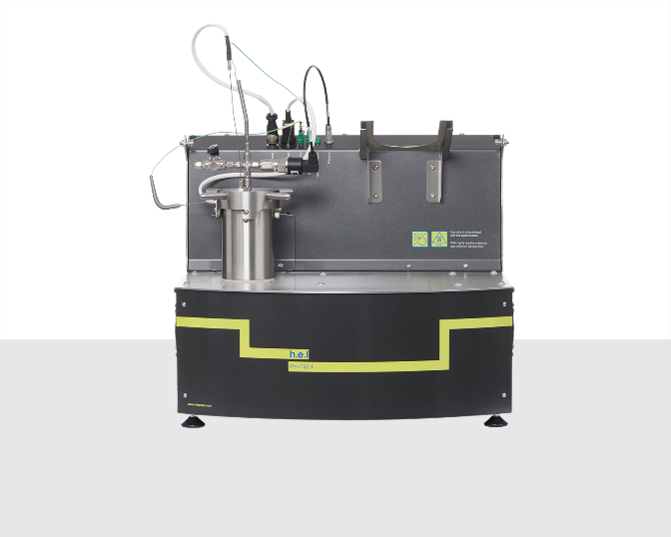 |
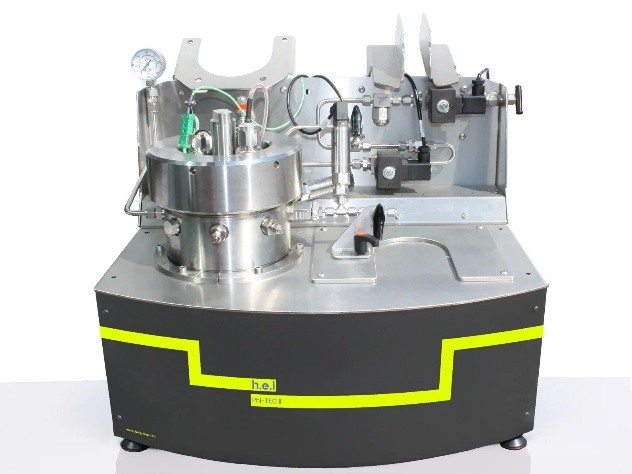 |
| Phi-TEC I |
Phi-TEC II |
|
Feature
|
Phi-TEC I
|
Phi-TEC II
|
|
Adiabatic method
|
Temperature compensation
|
Temperature and automatic pressure compensation
|
|
Test cell volume
|
Up to 10 mL
|
Up to 110 mL
|
|
Test cell type
|
Standard ARC-type and high phi-factor cells
|
Low and high phi-factor cells
|
|
Temperature range
|
−40°C to 500°C
|
Ambient to 500°C
|
|
Pressure range
|
0–200 bar
|
0–137 bar
|
|
Typical applications
|
Thermal runaway characterisation and process safety
|
Low phi-factor testing, DIERS vent sizing and emergency relief design
|
|
Reagent addition
|
Optional
|
Optional high-pressure liquid dosing and rapid injection
|
|
Stirring
|
Magnetic; stirring rate test-cell dependent.
|
Magnetic (standard, 300 rpm); optional overhead stirring for metal test cells and viscous samples.
|
The following features and options are available across the Phi-TEC range, unless otherwise specified.
Test Cells Types and Volumes
- Test cells are available in stainless steel, Hastelloy and glass.
- Closed-cell and open-cell testing configurations are available, depending on the selected system.
- Phi-TEC II supports thin-walled, low phi-factor test cells for obtaining plant-representative temperature and pressure rise rates.
Temperature Control
- Heat-Wait-Search (HWS), ramped heating and isothermal test methods.
- Automatic temperature tracking to maintain adiabatic conditions.
- Direct sample temperature measurement for monitoring exothermic reactions.
High Pressure and Vacuum Systems
- Pressure measurement enables investigation of gas generation and pressure rise during thermal runaway.
- Pressure capabilities depend on the selected calorimeter and test cell.
Reagent Addition
- Optional reagent addition systems for introducing reactants during experiments.
- Phi-TEC II supports high-pressure liquid feeding and rapid injection to replicate plant-scale operating conditions.
Stirring available
- Indirect agitation with magnetic stirrer bar as standard; fixed stirring rate of 300 rpm.
- Optional: Direct overhead stirring available for metal test cells for effective agitation of highly viscous samples.
Intelligent Software Control and Analysis
- H.E.L's WinISO software enables automated data logging, multi-step experimental procedures, parameter control and feedback loops.
- Customisable experimental plans support automated heating, gas generation detection and safety procedures.
- Optional high-speed data acquisition up to 10,000 Hz on Phi-TEC I for characterising extremely fast reactions.
- Optional bespoke testing methods.
Safety Features
- Automatic, user-configurable monitoring and shutdown procedures if safety conditions are exceeded.
- Automatic hardware and software fail-safes on both systems.
- Optional safety relief provisions, depending on system configuration.