Reviewed by Frances BriggsNov 10 2025Reviewed
A new approach to manipulating radio waves promises near-instant, high-bandwidth communication for the networks of tomorrow.
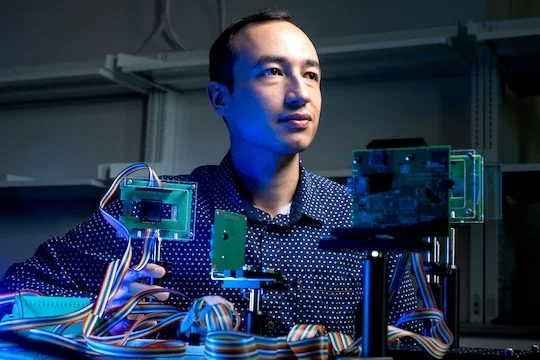 Burak Bilgin is a doctoral student at Rice University and a first author on a study published in Nature Communications Engineering. Image Credit: Jeff Fitlow/Rice University
Scientists at Rice University have developed a novel method to produce and manipulate radio wave patterns that can determine a signal's direction with an accuracy of one-tenth of a degree, approximately 10 times more accurate than previous methods. This could enable high-data-rate connections to form nearly immediately after the signal is transmitted.
The next generation of wireless communication will use signal frequencies considerably higher than those used in today's 5G systems, enabling signals to transmit far more data at significantly faster rates. These high-frequency bands, which are expected to facilitate future 6G networks, could power data-hungry devices such as untethered virtual reality headsets and real-time sensor systems.
However, these higher frequencies come with a high price: the signal fades faster as it travels through air and cannot pass through physical barriers, forcing transmitters and receivers to align directly through narrow, line-of-sight links rather than the diffuse connections used in today's Wi-Fi networks.
Rice University researchers and associates have developed a new method for establishing those links almost immediately.
The method we introduce in our paper unlocks extremely rapid angle estimation with unprecedented accuracy. This, in turn, allows for wireless links to be rapidly established or recovered with minimal latency.
This means that our method will allow wireless devices to rapidly find each other, which is essential to unlock unprecedented data rates in the next generation of wireless networks.
Burak Bilgin, Study First Author and Doctoral Student, Rice University
Bilgin compared the technique to a lighthouse "emitting multiple colors of light, where the intensity of each color traveling outward to all directions is randomized." In this comparison, the lighthouse is the wireless transmitter, the ships are the receivers, and the diffused light represents radio waves.
“The ships around the lighthouse – i.e., the wireless receivers – can determine their exact location vis-à-vis the lighthouse based on the set of colors and corresponding intensities they observe, which are unique along each direction thanks to the randomization,” Bilgin added.
To demonstrate the hypothesis, the researchers employed a thin electronic surface known as a metasurface, which was created by partners at Los Alamos and Sandia National Laboratories. When a broadband signal strikes the metasurface, it scatters in a specific pattern that is determined by both the wave's direction and frequency.
Each direction generates its unique signature, a type of electromagnetic fingerprint that receivers can compare to a preset library to determine the origin of the signal. The procedure takes only a few picoseconds (trillionths of a second).
Previous methods might alter a signal over time or across different frequencies, but not both at once. The Rice-led team discovered how to exploit the metasurface to create patterns that change both in frequency and over time.
Returning to the lighthouse analogy, our work is the first to have both multicolor and time-varying transmission. Because the random broadcast of colors is rerandomized across different time windows, the ships can make a more accurate estimation with extended observations in case the weather is foggy (noisy wireless signal) or the lighthouse is not capable of emitting many different colors (bandwidth limitations).
Burak Bilgin, Study First Author and Doctoral Student, Rice University
As wireless networks progress into the terahertz range, this level of precision will become critical.
The experiments necessitated a vast amount of data to examine how the randomized signals behaved statistically. Brown University researchers contributed to the theoretical and physical modeling of electromagnetic behavior.
“It is a study of programmed randomness. We collected a lot of data to study the average behavior. It took planning and smart scheduling, and the research had its share of unexpected setbacks, such as when the power went out during an experiment. But it was rewarding to see the results line up with our expectations,” Bilgin further stated.
According to Edward Knightly, the Sheafor-Lindsay Professor of Electrical and Computer Engineering and Professor of Computer Science at Rice, the research provides an early glimpse into how wireless networks may adapt as data demands increase.
The physics of the signal itself shape what networks can do. This study turns that challenge into an opportunity, showing that randomness, when engineered correctly, can make wireless networks faster, smarter, and more reliable.
Edward Knightly, Sheafor-Lindsay Professor, Electrical and Computer Engineering, Rice University
Journal Reference:
Bilgin, B. et.al. (2025) Programmable low-coherence wavefronts for enhanced localization. Communications Engineering. DOI:10.1038/s44172-025-00502-6.