DPDSense is an online colorimetric chlorine analyzer that measures free and total chlorine using DPD (N,N-diethyl-p-phenylenediamine). DPD is an industry standard for chlorine measurement and works in online and offline scenarios.
The DPDSense DPD colorimetric chlorine analyzer, developed by Pi, is engineered to meet or surpass leading competitors in all essential aspects while also being significantly easier to maintain, with extended maintenance intervals of six months that contribute to lower overall life cycle costs.
The free residual chlorine and total residual colorimetric chlorine analyzers assess two different forms of chlorine in water treatment: 'free' chlorine (HOCl + OCl–) and 'total' chlorine (which includes free chlorine and chloramines), both of which are utilized for disinfection.
When chlorine is introduced to water, it reacts with impurities during disinfection. Any chlorine that remains after disinfection is referred to as 'residual' chlorine. The measurement of this 'residual' chlorine, whether total or free, can assist in confirming the effectiveness of disinfection.
Process Instruments provides three solutions for measuring residual chlorine: HaloSense, which employs electrochemical technology; DPDSense, a system that utilizes online colorimetry technology; and Chloribrid®, which integrates both measurement technologies.
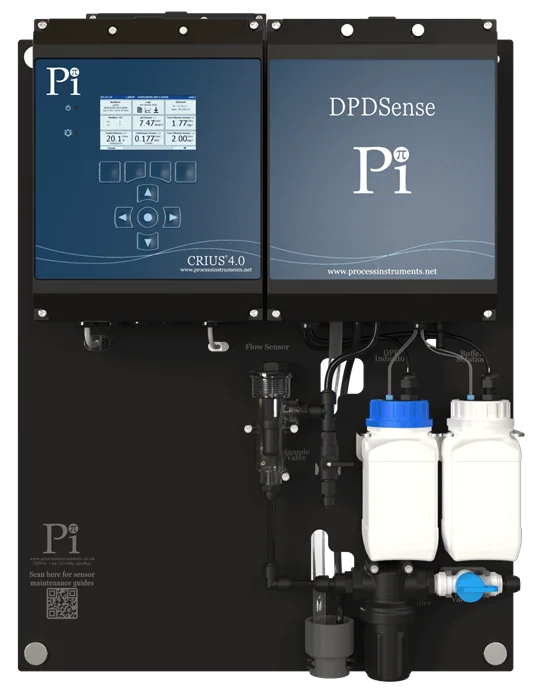
Image Credit: Process Instruments (UK)
Principle of Operation
The DPDSense colorimetric chlorine analyzer uses colorimetry to determine residual chlorine concentration. It utilizes an aliquot from a continuously flowing sample, to which a liquid buffer and liquid DPD reagent are added. DPD reacts with the chlorine in the water, producing a pink color.
The intensity of this pink hue, which is quantified by a photometer, is directly proportional to the chlorine concentration in the sample. This principle is grounded in Beer-Lambert's law, which states that absorption of light (at a specific wavelength) is linearly related to the concentration of chlorine in the absorbing solution. Consequently, absorption can be used to determine the concentration in the sample.

Image Credit: Process Instruments (UK)
Cost of Ownership
The DPDSense colorimetric chlorine analyzer is priced similarly to rival products, and the reagents needed for its operation are also comparably priced.
The DPDSense outperforms competitors because it requires less frequent, easier maintenance. While many online DPD analyzers require complex monthly upkeep, the Pi DPDSense needs only straightforward, semi-annual servicing.
Key Benefits
- Consistent and dependable – outstanding process management
- Established procedure – no calibration required during standard operation
- Multi-sensor functionality – cost reduction
- Dual and triple verification – enhanced security
- Appropriate for water, waste, and industrial uses
Applications
- Water treatment facilities
- Access to locations is available remotely
- Cooling towers
- Food and beverage sector
- Disinfection of wastewater
The DPDSense colorimetric chlorine analyzer from Pi is designed for monitoring free or total chlorine in a variety of applications. However, it is not suitable for samples with high levels of Fe, Mn, or particulate matter.
Options
The DPDSense colorimetric chlorine analyzer can measure either free or total chlorine and is compatible with the CRIUS®4.0 controller and the CRONOS® controller. This provides access to a range of control and analysis features, including:
- Multi-sensor
- Remote access
- Data logging
- PID control