Free chlorine analyzers and total chlorine analyzers quantify the ‘residual’ (leftover) chlorine in water after disinfection. This means that when chlorine is added to water for disinfection, any surplus becomes residual chlorine, which can provide further disinfection. Measuring this residual chlorine helps confirm the thoroughness of the disinfection process.
Pi offers three free and total chlorine analyzers for residual chlorine measurement: HaloSense, which uses electrochemical technology; DPDSense, which uses online DPD technology; and Chloribrid®, which combines both methods.
Free chlorine encompasses hypochlorous acid (HOCl) and hypochlorite ions (OCl–), while total chlorine includes free chlorine along with chloramines. Both forms of chlorine serve as potent disinfectants.
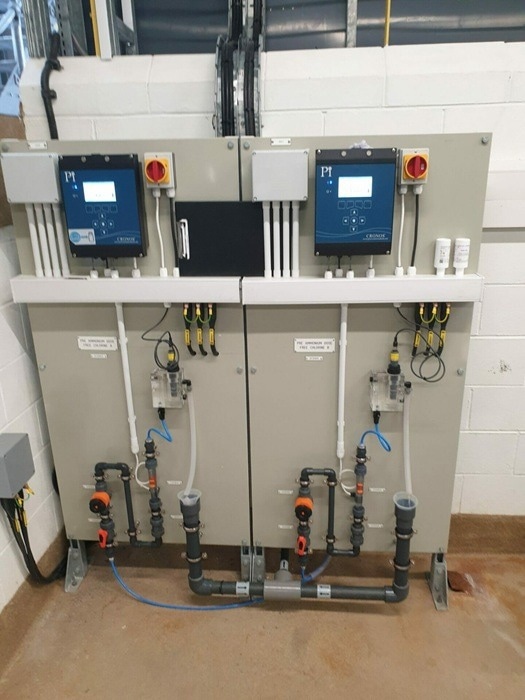
Image Credit: Process Instruments (UK)
Principle of Operation
HaloSense free and total chlorine sensors employ three-electrode amperometric sensor technology. A membrane separates the sample from two of these electrodes (the gold working electrode and the silver/halide reference electrode), which are immersed in an electrolyte. For the free chlorine sensor, this membrane allows chlorine to pass from the sample into the sensor's interior.
Here, a low pH setting converts most OCl– to HOCl. The working electrode then quantifies the HOCl, generating an electrical current directly proportional to the chlorine concentration, which is then relayed to the analyzer. Within the total chlorine sensor, both free and combined chlorine pass through the membrane. Subsequently, iodine displaces the chlorine, and this iodine is then measured at the working electrode.
Key Benefits
- Lower purchase cost
- Reduced total cost of ownership
- Diminished pH dependency (largely pH independent)
- Stable and dependable
- Buffer-free
- Reagent-free
Many water utilities seek to use a free chlorine sensor, eliminating the need for chemical buffers typically linked to these measurements. Acetate and phosphate buffers are costly and raise environmental concerns. Buffer dispensing systems require significant upkeep and involve expensive consumables; handling acids also raises health and safety concerns, and disposal costs increase if acid-treated water cannot be returned to the water supply.
Free Chlorine Sensors
Amperometric chlorine sensors and most polarographic probes detect only hypochlorous acid (HOCl). HOCl dissociates into hypochlorite (OCl–) in a pH-dependent manner. Consequently, most chlorine sensors require acid buffers for most applications.
The characteristic pH of water analyzed at a water treatment plant typically spans from 7 to 9.2. Chemical buffering lowers the pH to 5/6, ensuring that most free chlorine exists as HOCl.
The HaloSense Free Chlorine Sensor quantifies all HOCl and the predominant portion of OCl– present (indicated by the blue line on the graph). This significantly reduces pH influence, meaning most chlorine monitoring applications do not require a buffer or pH compensation.
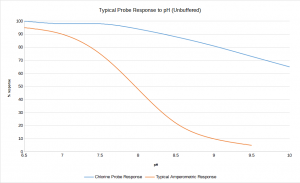
Image Credit: Process Instruments (UK)
Applications
- Real-time measurement of free chlorine in water sources
- Water treatment plant chlorine dosing control
- Regulation of free chlorine for secondary chlorination
- Distribution monitoring
- Cooling tower monitoring and management
- Pasteurization dosage regulation
- Seawater chlorination management
- Seawater bromine level tracking
- Food washing
- Chloramine regulation
The HaloSense series of chlorine sensors is especially well-suited for deployment in locations where both operational dependability and user convenience are paramount.
Small Water Treatment Plant Monitoring for Chlorine, pH, and Turbidity
Small-scale water treatment plants, along with secondary disinfection facilities, frequently encounter comparable challenges globally. The primary issue is the absence of a SCADA communication infrastructure, whose installation expenses can be prohibitive.
The secondary issue is the lack of a centralized DCS control infrastructure, where setup costs can also be excessively high. The third concern is their remote placement. These water treatment facilities are often located in distant, hard-to-access areas.
Given these three problems facing water engineers worldwide, Pi offers an economical solution that addresses all three. A CRIUS®4.0 controller integrates compact SCADA functionality and comprehensive online PID control, while its sensors (e.g., chlorine, pH, turbidity, etc.) are designed for extended operation without human oversight.
Continuous Chlorination/Bromination for Bottle Plant Pasteurization
Every Residual Chlorine Analyzer from Pi can function as a highly effective chlorine controller. These controllers may feature several control channels that can employ chemical control (typically, a relay (switch) activates dosing when chlorine is insufficient or deactivates it when excessive) or PID control.
PID signifies Proportional Integrated Derivative, representing a mathematical processing of the sensor signal to generate an output that regulates a pump and maintains a steady chlorine level in the water. All operational features are adjustable, and integrated safety mechanisms are incorporated, such as overfeed protection.
Pi’s chlorine controllers have been deployed in numerous control applications, including pasteurizers, water treatment, cooling towers, swimming pools, and so on.
Options
The following options are available in the HaloSense range
- Total chlorine sensor - 0.005–0.5 ppm, 0.005–2 ppm, 0.05–5 ppm, 0.05–10 ppm, 0.05–20 ppm
- Free chlorine sensor - 0.005–2 ppm, 0.05–5 ppm, 0.05–10 ppm, 0.05–20 ppm, 0.5–200 ppm
- Online chlorine sensor in seawater analyzers (free or total bromine) - 0.005–2 ppm, 0.05–5 ppm, 0.05–10 ppm, 0.05–20 ppm
- Online zero chlorine sensor (engineered to detect the absence of free chlorine) - 0.005–2 ppm for applications like post-activated carbon and pre-RO monitoring.
Other options include:
AutoFlush
HaloSense sensors can self-clean automatically at user-specified intervals, eliminating manual operator intervention for up to six months. The AutoFlush system proves especially beneficial in food processing, pulp and paper manufacturing, and numerous other applications prone to solid accumulation within the sample.
pH Compensation
In certain free chlorine applications with high and fluctuating pH levels, pH compensation can enhance analyzer precision. For valid pH compensation, it requires top-tier pH and chlorine sensors with lower sensitivity to pH variations, like those incorporated into the HaloSense product line.
The graph illustrates the inaccuracies observed on an actual HaloSense free chlorine sensor when a 1 ppm free chlorine sample undergoes pH shifts from 9 to over 10, then down to 7.5, and subsequently back. This chart indicates that most applications will not require pH compensation, and for those that do, this free chlorine sensor is the most suitable option for applying it.
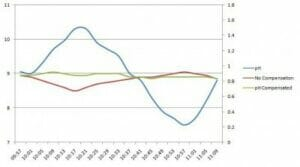
Image Credit: Process Instruments (UK)
Communications
The CRONOS® and CRIUS®4.0 controllers, designed for free and total residual dosing, can be outfitted with four PID process control features, data logging, relay outputs, analog outputs, and serial communication protocols, including Ethernet, Modbus, and Profibus.
Remote instrument monitoring (including remote access to all control functions) is accessible over the internet via GPRS and through a LAN connection. Indeed, the CRIUS®4.0 HaloSense monitor offers every desired option, whereas the CRONOS® presents a cost-effective alternative and delivers exceptional value.
How to Monitor Free & Total Chlorine using Chlorine Sensors from Process Instruments Crius HaloSense
How to monitor free & total chlorine using chlorine sensors from Process Instruments CRIUS HaloSense. Video Credit: Process Instruments (UK)