Wildfires are becoming an increasingly persistent global risk, causing significant human, financial, and environmental damage. For instance, 70,000 wildfires occur on average across the United States (US) every year, burning millions of acres of land; destroying homes, businesses, and infrastructure; and claiming innocent lives. In 2022, 7.5 million acres were adversely affected by wildfire emergencies.1-4
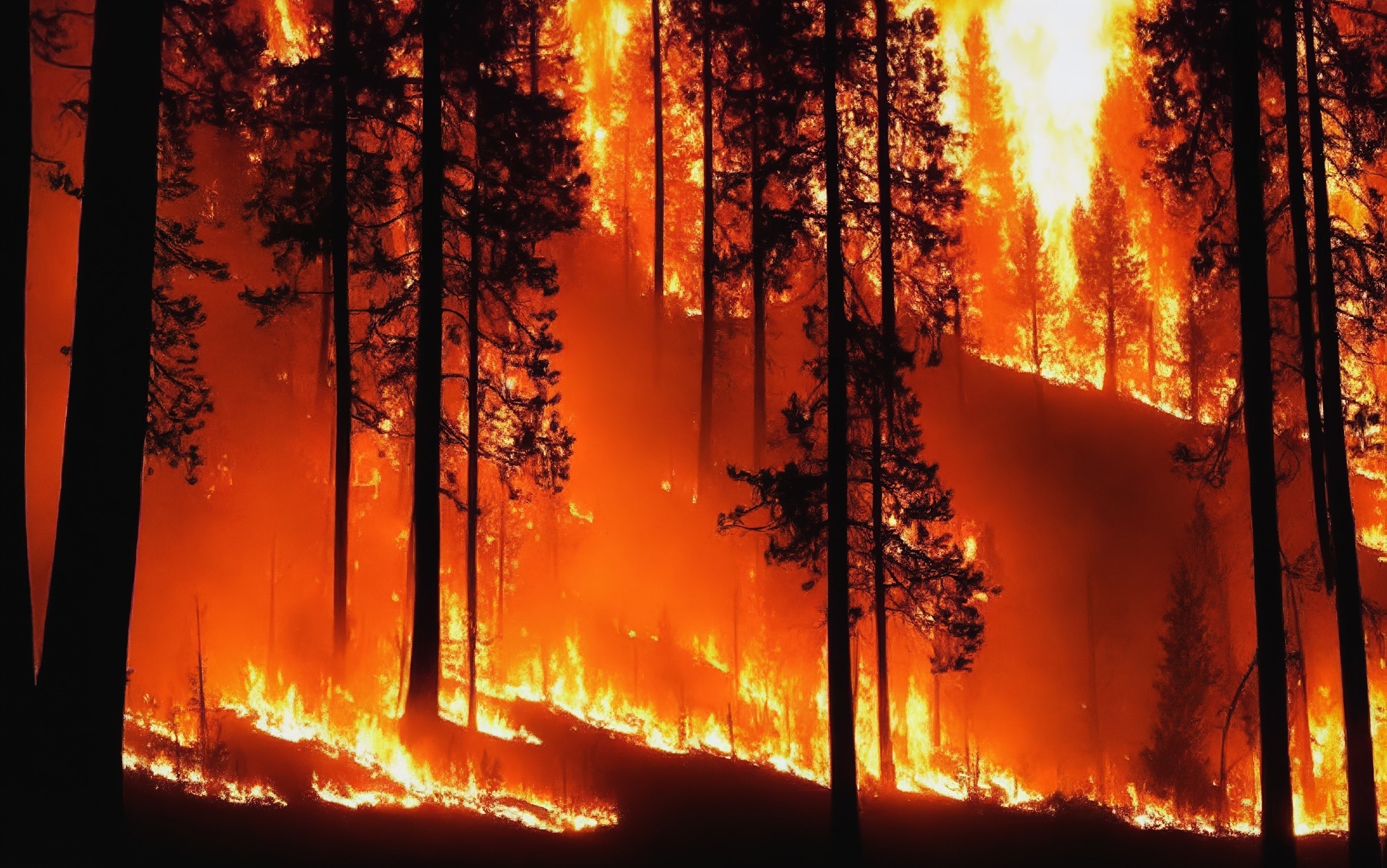 Image Credit: Pong Ch/Shutterstock
These events are expected to rise in intensity and frequency throughout the 21st century, affecting more and more communities. Thus, detecting wildfires in their nascent stages is the most efficient way to manage them. Effective early detection systems significantly mitigate their devastating effects.1-4
Terrestrial Sensor-based Systems
Wildfire sensors continuously detect elements associated with wildfire conditions, such as chemicals, volatile organic compounds, particulate matter, and gases, to locate ignition and enable geographically targeted warnings and notifications.1
Low-power sensor-based solutions that require no existing infrastructure are deployed in areas at higher risk of fires, increasing the likelihood of wildfire detection at an earlier, smaller stage than regional camera- or satellite-based solutions.2
This approach is effective because more than 90% of catastrophic fires are artificial, and firefighting resources are mindful of regions at high ignition risk across several scenarios. Thus, deploying sensors with sufficient density to cover those regions could enable early detection of wildfires.2
These sensor networks have four layers, including the physical layer, including actual sensors and surrounding electronics designed to be very low power; the network layer, including the wireless link that can be cellular or direct to satellite; the middleware layer that impacts communication architecture between physical sensors as well as cloud software; and the application layer containing artificial intelligence (AI) models to process sensor data, dashboards.2
Recent Developments
Recently, solutions incorporating gas or smoke sensors that “sniff” a wildfire have been introduced, potentially detecting a threat at an early stage. Companies like Dryad Networks and LAD Sensor have developed low-power small-form-factor solar solutions, enabling their deployment at any location.2
A potential disadvantage of gas-based “sniffing” systems is their vulnerability to wind patterns, which affect the direction of wildfire smoke. During small incipient wildfires with insufficient smoke to saturate the region, these sensors can only capture a wildfire with high deployment density, which is expensive and operationally unaffordable.2
Airborne Solutions
Airborne wildfire detection platforms use various technologies mounted on aircraft to detect smoke or heat signatures, enabling early detection of wildfires from the air with thermal cameras. These cameras operate day and night, providing crucial data for rapid response efforts.2,3
This technology is used on uncrewed aerial vehicles (UAVs) and manned aircraft to monitor large areas and isolate fire locations. While manned aircraft like helicopters and planes provide detailed imagery and cover vast areas, drones access hard-to-reach areas for close-up fire monitoring and provide exceptional maneuverability.2,3
Recent developments in UAVs have led to novel solutions to shorten wildfire response times. In 2024, Sikorsky and Rain demonstrated an autonomous Black Hawk helicopter that identifies the size and location of a small fire and then precisely drops water to extinguish the flames.2
These helicopter-based systems are costly for wildfire suppression and detection. Much cheaper drones, with costs and sizes comparable to those of regular commercial drones, can also be used to combat wildfires. Yet the low-capacity power source of these low-cost, smaller drone systems limits their ability to search for fires and their flight time.2
Drones equipped with additional devices, such as a specialized fire sensor or a water tank, are also effective. For instance, the IGNIS system combats wildfires by deploying ping-pong, small ball-sized “ignition spheres” containing a chemical payload.2
These spheres are dropped from the drone at strategic locations to create controlled fires, depriving the wildfire of fuel and preventing its spread by creating firebreaks ahead of the main blaze.2
Spaceborne Solutions
Satellite-based detection relies on specialized sensors to detect heat anomalies in the infrared spectrum, indicating the presence of fire. This enables early detection of wildfires that are obscured by smoke or located in remote areas.2
Polar-orbiting and geostationary satellites are used for wildfire detection. Polar-orbiting satellites like the National Aeronautics and Space Administration (NASA) Terra and NASA Aqua scan the entire Earth multiple times a day for fire monitoring. Yet, each consecutive scan occurs several hours apart at the same location, resulting in a low temporal sampling rate.2
Geostationary satellites, such as the NOAA Geostationary Operational Environmental Satellite, provide much higher temporal resolution for a particular area but have limited ability to monitor environmental developments worldwide. Onboard these satellites, several instruments collect different types of data, which are actively analyzed to detect wildfires, assess their climate impacts, and monitor long-term trends.2,3
The Moderate Resolution Imaging Spectroradiometer (MODIS), Visible Infrared Imaging Radiometer Suite (VIIRS), and Advanced Baseline Imager (ABI) are the imaging instruments used for wildfire detection on satellites. These instruments use specific infrared bands to maximize the possibility of fire detection.2,3
However, processing satellite data to detect small fires and wildfire anomalies is challenging due to the lower spatial resolution of satellite imagery. Additionally, smoke may appear identical to clouds, which presents another challenge.2
AI Systems
AI systems use various equipment and datasets to predict and prevent wildfires. Using machine learning, historical wildfire data is used to detect wildfire patterns in particular locations and forecast the likelihood of future fires.4
Machine learning algorithms determine whether conditions are conducive to disaster and identify potential wildfire risks with high accuracy by analyzing data such as vegetation types, weather, and previous fire incidents. This predictive power enables proactive measures, such as mobilizing resources well in advance, to improve overall resolution and response time.4
Download the PDF of this page here
Additionally, computer vision systems analyze high-resolution images captured by drones and satellites to detect wildfires. These AI-based image recognition systems excel at spotting fire hotspots and detecting smoke plumes with precision. This technology detects smoke, distinguishes among different types of smoke, and tracks the progression of a fire.4
Importance of Early Detection
The effectiveness of any wildfire detection approach relies on several parameters. Any product or technology must be evaluated based on its merits. Yet certain trade-offs exist among the different architectures. For instance, sensors could provide adequate coverage in many scenarios, since 90% of severe wildfires are human-caused. However, airborne and spaceborne solutions are essential when coverage of difficult, large terrain is required.
References and Further Reading
- Technology to Reduce the Impacts of Wildfires [Online] Available at https://www.dhs.gov/science-and-technology/technology-reduce-impacts-wildfires (Accessed on 03 June 2026)
- Honary, R., Shelton, J., & Kavehpour, P. (2025). A review of technologies for the early detection of wildfires. ASME Open Journal of Engineering, 4. DOI: 10.1115/1.4067645, https://asmedigitalcollection.asme.org/openengineering/article/doi/10.1115/1.4067645/1212421
- Khan, A. H., Bahar, A. N., & Wahid, K. (2026). A Review on Forest Fire Detection Techniques: Past, Present, and Sustainable Future. Sensors, 26(5), 1609. DOI: 10.3390/s26051609, https://www.mdpi.com/1424-8220/26/5/1609
- Using AI for Disaster Management in Wildfire Scenarios [Online] Available at https://www.captechu.edu/blog/ai-systems-for-disaster-management-in-wildfire-prevention (Accessed on 03 June 2026)
Disclaimer: The views expressed here are those of the author expressed in their private capacity and do not necessarily represent the views of AZoM.com Limited T/A AZoNetwork the owner and operator of this website. This disclaimer forms part of the Terms and conditions of use of this website.