Chicken Freshness Detection Background
Did you know that millions of tons of food are wasted each year because expiration dates do not reflect the product's quality? Traditional labeling systems cannot track spoilage in real time, especially in perishable foods like chicken.
As food safety concerns grow, demand for instant, reliable freshness data is increasing. Intelligent packaging that uses naturally occurring color-changing substances, such as anthocyanins, offers a potential solution for companies seeking to address fresh food waste. However, there has been little success in finding ways to interpret the subtle color changes observed in foods caused by environmental factors.
Advanced image recognition technologies are emerging as powerful tools to overcome these limitations. Further research is needed to enhance the accuracy, scalability, and real-world applications of this innovative technology.
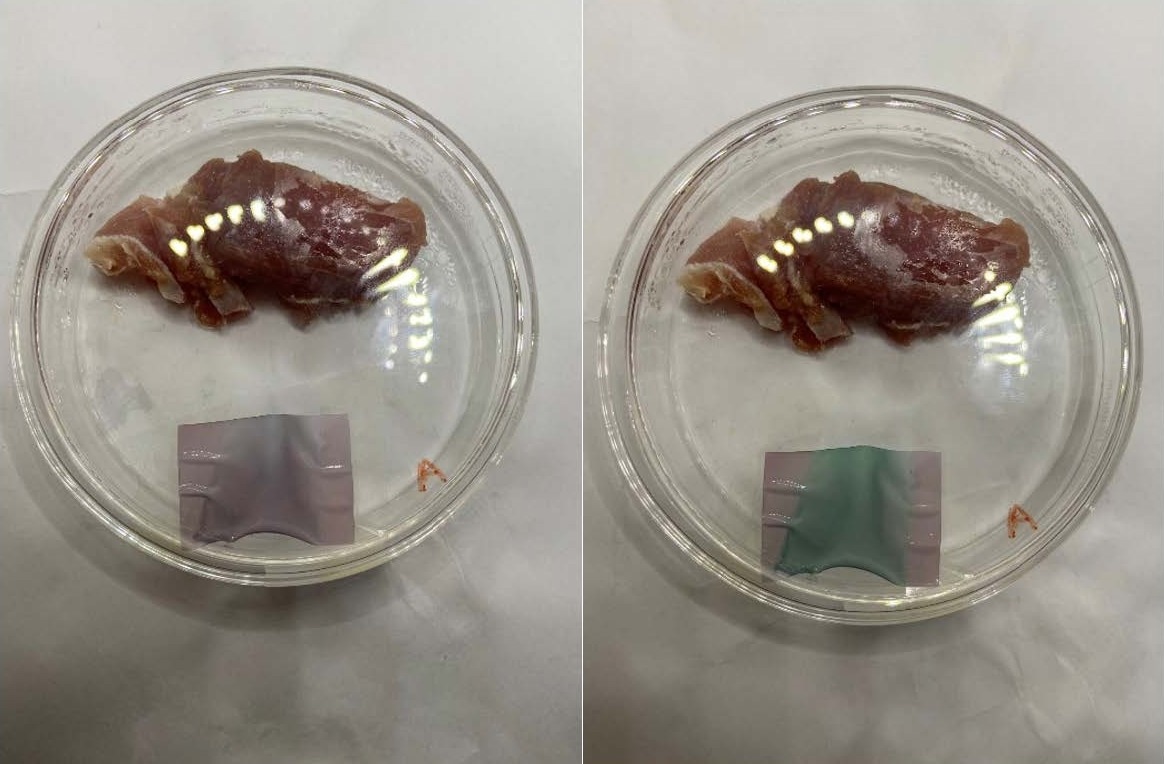
Photographs of indicator membranes of chicken meat when fresh and spoiled
Indicator Film and YOLOv8 Study Design
The study developed an integrated system combining intelligent indicator films and a deep learning-based detection model. Using anthocyanins obtained from red cabbage, an indicator film was created by adding them to a composite material composed of chitosan and polyvinyl alcohol (PVA).
The films were enhanced by the addition of UiO-66-Br metal-organic frameworks (MOFs), which improved color stability and sensitivity. The indicator films were applied to chicken samples stored under sealed conditions at 20°C, photographed under standardized imaging conditions, and the color of the indicator films was analyzed from digital images throughout the study.
The dataset contained 228 images, comprising both fresh and spoiled chicken samples. The images were divided into training and validation sets. A convolutional neural network (CNN) model based on You Only Look Once version 8 (YOLOv8) was developed and enhanced with a Residual Channel Reconstruction and Scaling (RCRS) module. In this module, residual scaling and Reparameterized Convolution (RepConv) were integrated, along with attention mechanisms such as Squeeze-and-Excitation (SE), Convolutional Block Attention Module (CBAM), Coordinate Attention (Coord), and Large Kernel Attention (LSK).
Data augmentation techniques such as mosaic stitching, MixUp blending, geometric transformations, and Hue-Saturation-Value (HSV) adjustments were applied to improve the model's accuracy. The model was trained using a stochastic gradient descent (SGD) algorithm with early stopping and dropout regularization to prevent overfitting.
Chicken Spoilage Color Detection Findings
The intelligent indicator films demonstrated clear, consistent color transitions that corresponded to the chicken's freshness. Initially, fresh chicken had a purplish-red appearance, with low levels of bacteria and acceptable quality (pH, total volatile basic nitrogen (TVB-N), and total viable count (TVC)). Later, as the chicken was stored and microbial growth increased, alkaline by-products were produced, causing a gradual color change in the film toward green. This change was visually indicative of spoilage and could support rapid interpretation, although the study validated freshness using pH, TVB-N, and TVC measurements.
The deep learning model showed strong performance in detecting and classifying these color changes. Specifically, the precision-enhanced detection network (ROL-Net) achieved a precision of 1.000 and a recall of 0.95, indicating high accuracy in distinguishing fresh and spoiled product states under the study conditions. The mean average precision (mAP) at 50% Intersection over Union (IoU) reached 98.796%, while the mAP across IoU thresholds of 50% to 95% (mAP50-95) reached 84.954%. This represents a measurable improvement over baseline detection models, including YOLOv3, YOLOv5, YOLOv6, and YOLOv10; thus, demonstrating enhanced detection accuracy and robustness.
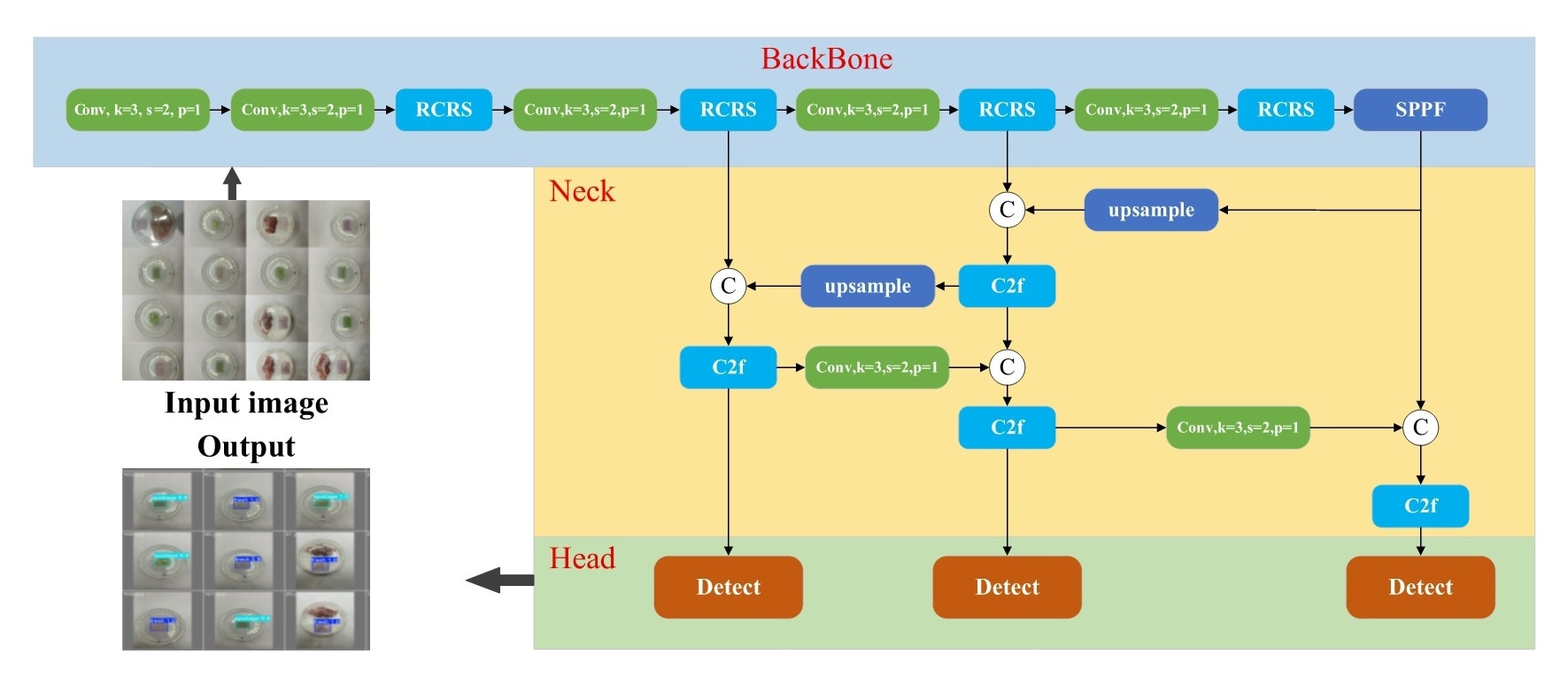
The ROL-YOLO Framework. This framework consists of three components: the backbone, the neck, and the detection head. The backbone network consists of convolutional layers and a cascaded network constructed by serially connecting RCRS modules.
Attention Mechanisms and Model Generalization
The implementation of attention mechanisms and multi-scale feature fusion improved performance. The RCRS module enabled the model to capture subtle color differences and small-scale features that are often overlooked by conventional detection systems. Additionally, the use of residual scaling stabilized training and improved convergence, reducing errors caused by lighting variations and background interference.
The results of the ablation experiments support that using a fusion strategy based on attention enhanced the model's performance. It produced an estimated increase of approximately 2.8% in mAP50 and more than 1% in mAP50-95 compared to the baseline model without fusion. The performance increase from this study demonstrates the efficacy of combining attention mechanisms with more advanced feature extraction methods, though the findings should be interpreted in light of the small image dataset.
The model also demonstrated promising generalization capabilities when tested on an unrelated industrial dataset, specifically the Northeastern University (NEU) surface defect database. While there were differences in visual appearance between objects in the two datasets, this model achieved competitive results, achieving 73.217% in mean average precision and outperforming previous models in terms of recall, demonstrating that this method may have potential relevance for other weak-feature detection applications, although broader validation would be needed before wider industrial use can be claimed.
From a real-world perspective, this technology has multiple potential advantages. Providing fast, non-destructive evaluations of freshness could reduce reliance on subjective human judgment and help limit food waste by providing accurate, timely information. Consumers, retailers, and food safety authorities could potentially benefit, as this technology may be further developed for integration into packaging systems or mobile devices.
Food Packaging AI Preprint Implications
The study demonstrates that combining intelligent indicator films with advanced deep learning models provides an effective solution for real-time detection of chicken freshness under controlled laboratory conditions.
This new system proved to be highly accurate and robust, particularly compared to several baseline detection models evaluated in the study, but these findings remain preliminary because the work was conducted on a small dataset and has not yet been peer-reviewed. It also has high adaptability across different detection scenarios and addresses key obstacles affecting food product quality.
By enabling non-destructive and visually interpretable freshness assessment, this approach has the potential to improve food safety, reduce waste, and enhance consumer confidence. Its scalability and cross-domain applicability further highlight its practical significance, although further testing under real supply-chain and retail conditions is required.
Future advancements in sensor materials and the integration of artificial intelligence could expand its use across the broader food industry and supply chain systems.
Download your PDF copy by clicking here.
*Important notice
Research Square publishes preliminary scientific reports that are not peer-reviewed and, therefore, should not be regarded as conclusive, guide clinical practice/health-related behavior, or treated as established information.
Disclaimer: The views expressed here are those of the author expressed in their private capacity and do not necessarily represent the views of AZoM.com Limited T/A AZoNetwork the owner and operator of this website. This disclaimer forms part of the Terms and conditions of use of this website.