Researchers demonstrate a new way to monitor the internal temperature of iron ore during sintering by combining advanced machine learning with physical and chemical modeling.
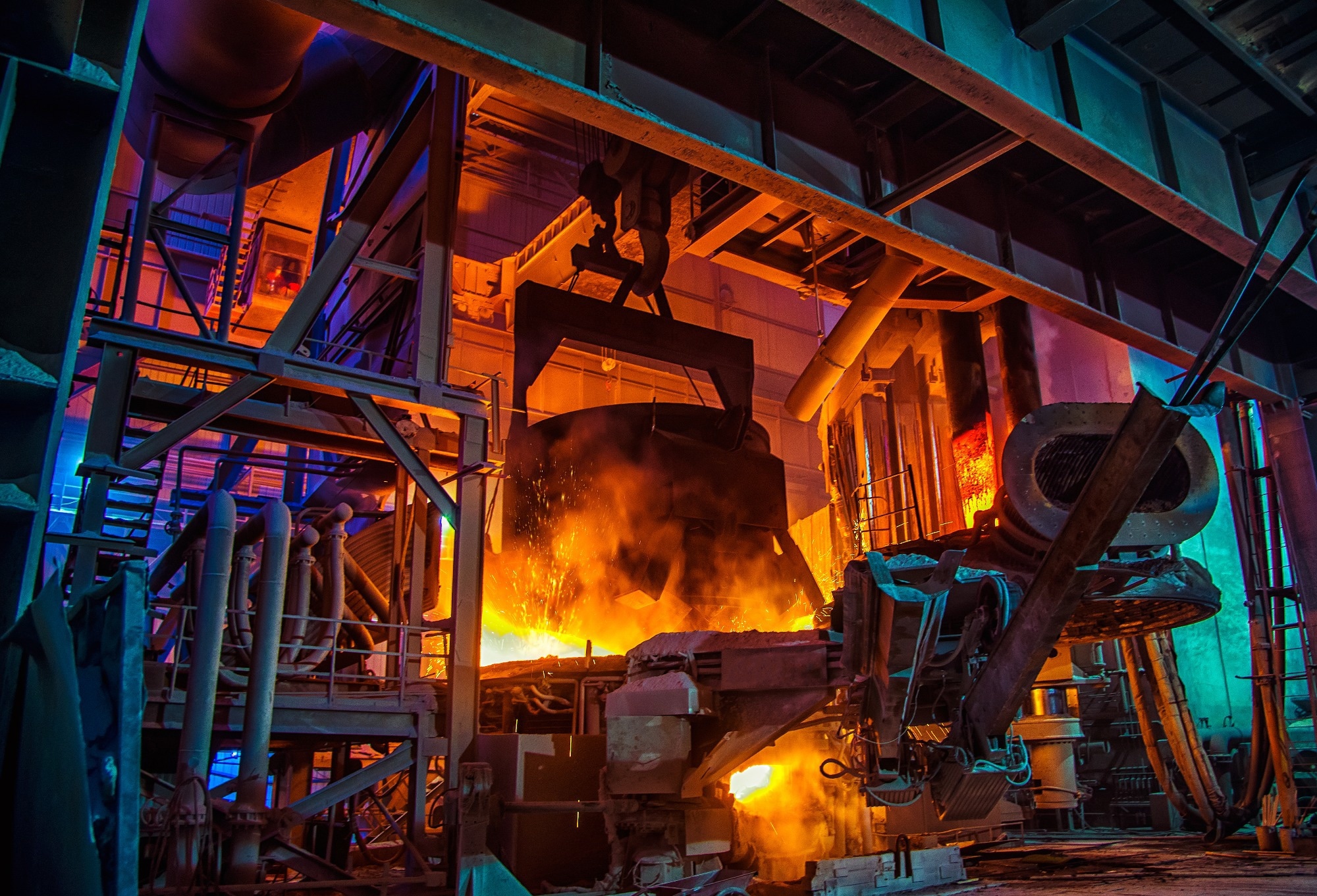
Study: Real time 3D monitoring of sintering ore temperature enabled by temporal fusion transformers. Image Credit: zhang sheng/Shutterstock.com
Writing in Scientific Reports, the team describes how a Temporal Fusion Transformer (TFT) model can generate near-real-time, three-dimensional temperature maps of sintered ore using existing plant data.
It provides a clear view into one of the most critical and energy-intensive steps in steelmaking, which has long been difficult to observe internally.
Sintering prepares iron ore for blast furnace operations, and its quality is highly sensitive to temperature. If temperatures are too low, material may remain under-sintered; too high, and excessive melting can occur.
Both lead to waste, inefficiency, and higher energy use.
In industrial settings, temperature monitoring typically relies on surface observations, such as infrared thermal imaging. While useful, these methods cannot directly capture what is happening inside the sinter bed, where key physical and chemical transformations occur.
As a result, operators must infer internal conditions indirectly, often with limited precision.
Get all the details: Grab your PDF here!
A Data Driven Framework Takes us Beyond Surface Measurements
To address this gap, the researchers developed a data-driven framework that infers internal temperature fields from external measurements.
Rather than relying on new sensors, the approach integrates historical process data, physicochemical principles, and simulation outputs to reconstruct temperature distributions throughout the sinter bed.
The system is built around a slice-based 3D representation of the sintering process. The sinter bed is divided into multiple cross-sections, allowing temperature predictions to be generated for each slice, which are then assembled into a full three-dimensional temperature field.
Two Models with Two Roles
The study combines two machine-learning models, each addressing a different challenge in the sintering process.
First, a Variational Autoencoder-Temporal Convolutional Network (VAE-TCN) model is used to infer the proportions of key chemical components in the sintering mixture.
Because detailed composition data are limited in practice, the researchers augment available measurements using Bayesian estimation and statistical assumptions, then apply a centered log-ratio transformation to handle the compositional nature of the data.
Second, the Temporal Fusion Transformer model predicts spatial temperature distributions. The TFT ingests the inferred chemical composition ratios alongside operational parameters such as ignition temperature, flue gas pressure, and windbox waste temperature, producing two-dimensional temperature matrices for each slice.
Originally designed for interpretable time-series forecasting, the TFT architecture is well-suited to industrial processes with complex dynamics. It combines gated residual networks, variable selection mechanisms, and multi-head attention to capture both short-term fluctuations and long-term trends.
But, the model does more than generate predictions. Its variable selection and attention components make it possible to identify which inputs (such as specific chemical components or operating conditions) most strongly influence temperature outcomes.
This interpretability is a key advantage in industrial environments, where understanding cause and effect is as important as prediction accuracy.
Testing TFT's Performance
Using real production data from a steel plant in China, the researchers trained and validated the model on more than 80,000 samples.
For one-step-ahead spatial temperature prediction, the TFT achieved a coefficient of determination (R2) of 0.8572 and a root mean square error of 4.76.
However, when compared with long short-term memory (LSTM) networks and standard Transformer models, the TFT consistently performed better, reducing prediction error while offering greater transparency into the driving factors behind temperature changes.
Because direct internal temperature sensors are not available in industrial sintering beds, the model was trained using temperature fields derived from physicochemical equations, simulation software, and partial real measurements.
The predicted temperature patterns were found to align closely with both simulation results and infrared thermal images, providing additional confidence in the model’s reliability.
Implications For Steelmaking
The authors emphasize that the system is designed to support monitoring and optimization, not to replace existing sensing infrastructure. By providing near-real-time insight into internal temperature evolution, the model could help operators fine-tune key parameters, improve sinter quality, and reduce energy consumption.
More broadly, the work illustrates how interpretable machine-learning models can be integrated with physical understanding to address long-standing measurement challenges in heavy industry.
The researchers suggest that similar approaches could be extended to other high-temperature processes, including cement production and ceramic sintering.
Journal Reference
Jiang, Y. et al. (2025). Real-time 3D monitoring of sintering ore temperature enabled by temporal fusion transformers. Scientific Reports, 15, 43455. DOI: 10.1038/s41598-025-27254-9
Disclaimer: The views expressed here are those of the author expressed in their private capacity and do not necessarily represent the views of AZoM.com Limited T/A AZoNetwork the owner and operator of this website. This disclaimer forms part of the Terms and conditions of use of this website.