Reviewed by Frances BriggsJan 6 2026Reviewed
Researchers at Fraunhofer are working to create a mobile gas chromatography sensor system that enables swift on-site detection of volatile organic compounds (VOCs).
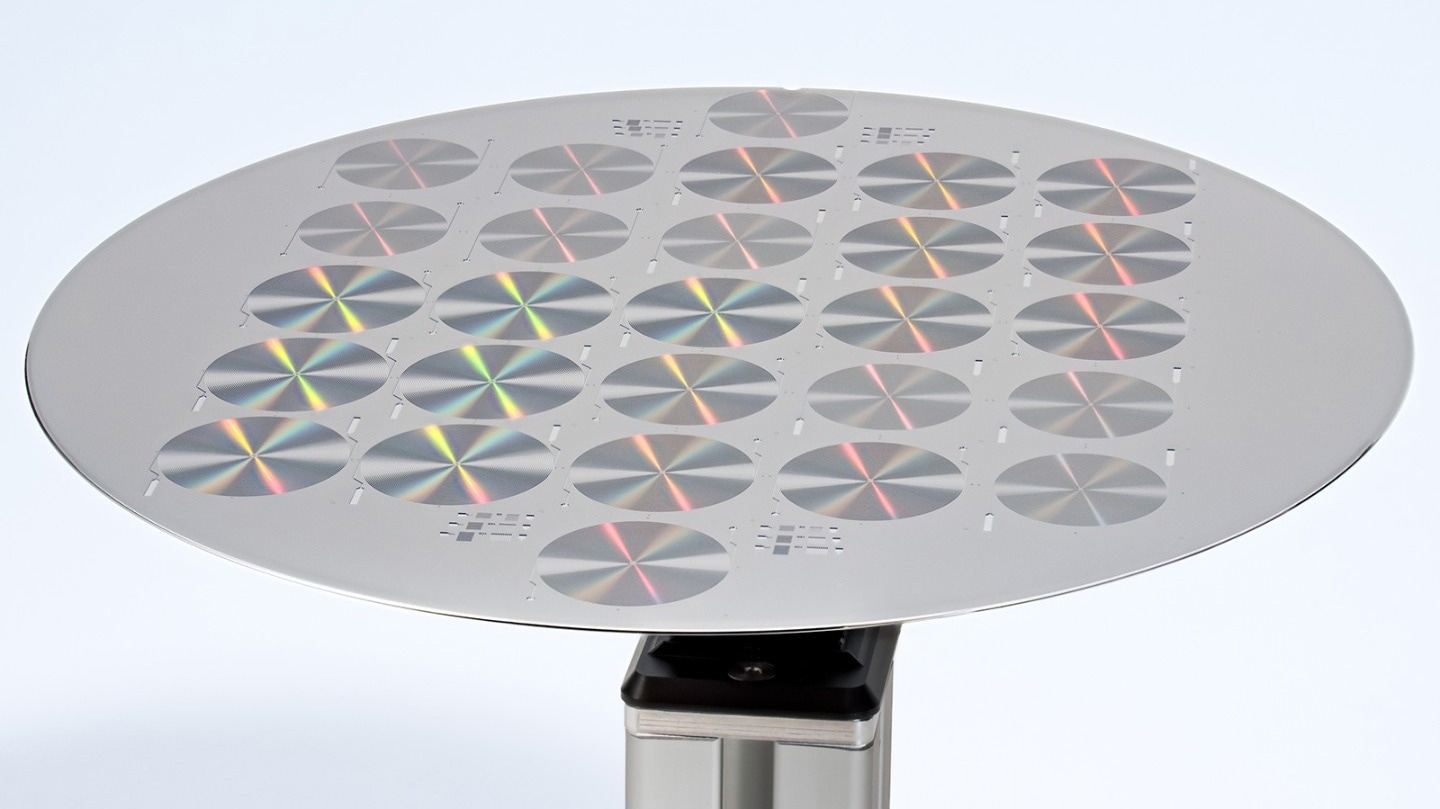 Micro-gas chromatography columns (µGC columns) etched into a 200-mm silicon wafer. The columns are sealed with a second wafer using a wafer-bonding process and then separated. They are subsequently coated with a stationary phase, similar to conventional GC columns. Image Credit: Fraunhofer IPMS
Counterfeit or substandard products are difficult, and sometimes even impossible, to recognize on sight. To tackle the challenge, three Fraunhofer institutes are collaborating on the design of a cost-effective, user-friendly device that allows even those without expertise to conduct quick, on-site evaluations.
Food fraud has been increasing for several years. High demand, fierce price competition, and intricate supply chains create the ideal conditions for mislabeling.
When harmful ingredients are involved, this form of fraud can lead to significant health risks. Correctly identifying counterfeit foods requires expensive and labor-intensive laboratory analyses. In addition, laboratory-based analysis systems require trained professionals to manage the equipment and interpret the results.
Within the Fraunhofer PREPARE project PUMMEL, research teams from the Fraunhofer Institutes for Photonic Microsystems IPMS, Molecular Biology and Applied Ecology IME, and Process Engineering and Packaging IVV are working together to design this high-tech yet intuitive sensor.
Their objective is to create a mobile gas chromatography sensor system that enables swift on-site detection of volatile organic compounds (VOCs). VOCs are chemical substances that provide insights into a material's composition or potential health risks and can indicate alterations in product characteristics.
The identification of VOCs is crucial across various sectors, including food quality and safety, healthcare, civil security, agriculture, and the chemical industry.
Two Industrially Relevant Use Cases
There’s a clear need for cost-efficient, rapid, and reliable on-site measurement technology that yields immediate results.
Olaf Hild, Head of Department, Fraunhofer IPMS
“Our system isn’t universal, but its modular design makes it suitable for a broad range of applications. In the PUMMEL project, we’re focusing on two industrially relevant use cases. First, the identification of counterfeit olive oil, which ranks among the top ten most frequently falsified food products, and second, the detection of contaminated plastic recyclates that can accumulate in packaging materials,” said Mark Bücking, Head of Department at Fraunhofer IME.
“This is particularly significant given that the recycling rate reached a record high of nearly 70 % in 2025. For this purpose, we’re developing two application-specific demonstrators for VOC detection. We’re aligning industrial interests with scientific challenges, with a focus on technological innovation that serves the German and European economy,” added Mark Bücking.
The mobile system, which will be approximately the size of a shoulder bag upon completion, will include a gas chromatography column (GC column) based on silicon chip technology, a detector or sensor, integrated sample preparation, control, and data-processing electronics, as well as a power supply.
Gas chromatography (GC) is an analytical method used to separate, identify, and quantify mixtures of substances. It’s suitable for gaseous or readily vaporizable compounds that don’t decompose on vaporization. A carrier gas first transports the sample through the GC column, which we’ve etched into a rapidly heatable and coolable silicon chip.
Olaf Hild, Head of Department, Fraunhofer IPMS
Within the column, gas molecules engage with the polymer-coated inner surfaces. The volatile organic compounds (VOCs) interact with the inner coating based on their affinity, leading to the separation of the mixture.
At the end of the chip-based gas chromatography (GC) column, a detector assesses the substances separated according to their molecular characteristics, producing a gas chromatogram with peaks that indicate the mixture's composition.
The analysis of the measurement data is conducted by Fraunhofer IME. For olive oil, the objective is to ascertain parameters such as the country of origin, age, and purity level.
Initial Tests Successfully Completed
Current experiments utilizing a standard three-meter gas chromatography (GC) column show dependable separation of volatile organic compounds (VOCs) and facilitate thorough sample analysis.
In traditional, high-performance laboratory gas chromatographs, GC columns frequently exceed 30 m in length, offering enhanced separation efficiency; however, such a degree of efficiency is unnecessary for the quality evaluation of the majority of food products.
Among various challenges, the researchers at Fraunhofer are focused on developing miniaturized GC columns that can achieve adequate separation of VOCs pertinent to various food items.
“With our system, we’re targeting non-specialists, such as bottlers and incoming-goods inspectors, who can easily operate the device after a short briefing. The components of our system can be adapted for specific applications, making it suitable for quality control in a range of different contexts, including the analysis of recycled plastics. We’re more than happy to work with industry partners to develop customized applications,” says Tilman Sauerwald, a researcher at Fraunhofer IVV, where the demonstrators are currently being developed.