Researchers have developed a thin, flexible ultrasound sensor that can estimate blood pressure continuously by tracking subtle changes in blood vessel diameter.
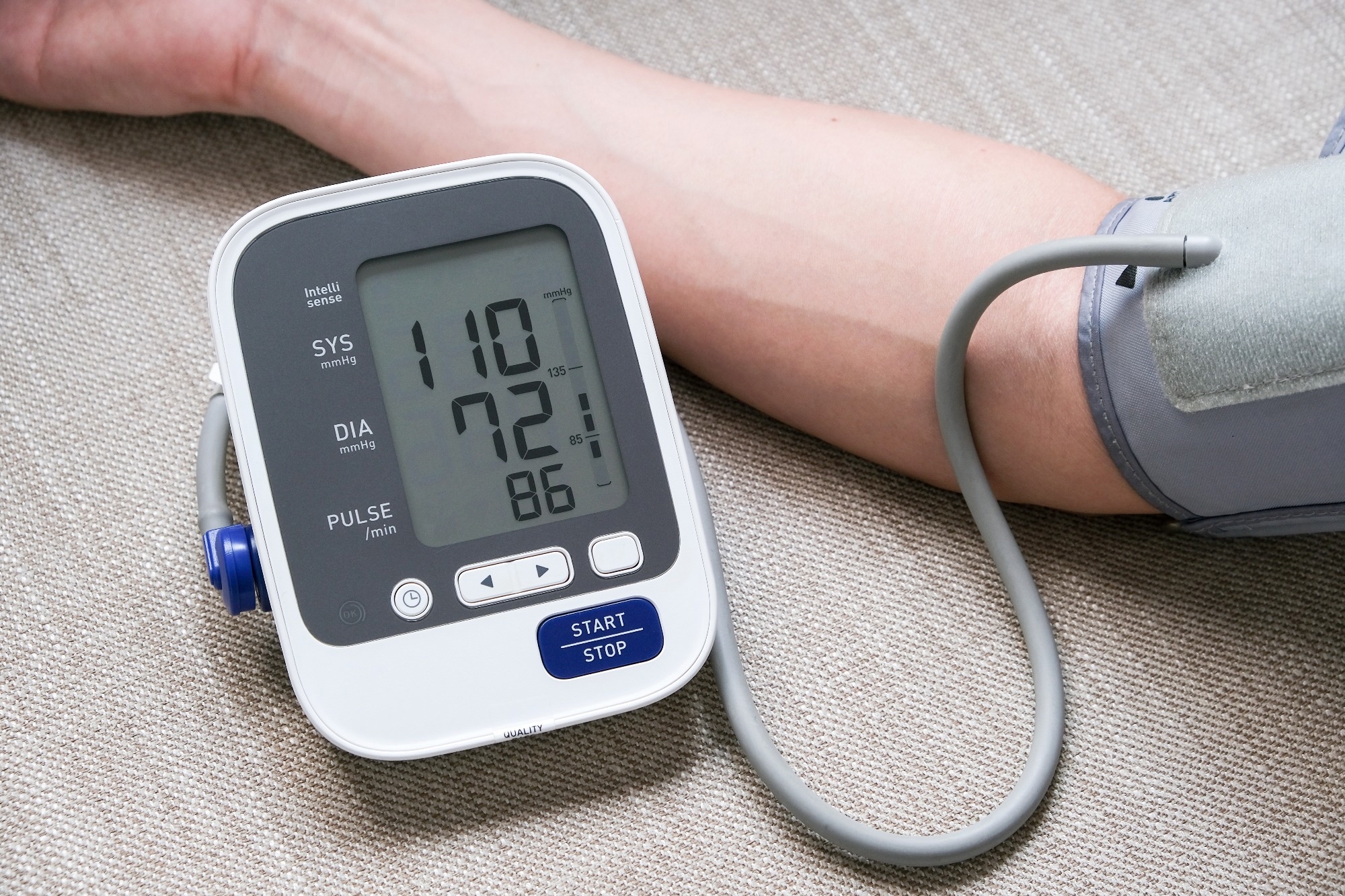 Study: Skin-conformal PMN-PT ultrasonic sensor for cuffless blood pressure sensing via eutectic solder integration. Image Credit: Me dia/Shutterstock.com
While the cuffless system has so far only been tested in labs, the work may be a significant step toward ultrasound-based cardiovascular monitoring.
The study, published in Microsystems & Nanoengineering, describes a skin-conformal ultrasonic transducer built from high-performance piezoelectric materials and assembled using a low-temperature soldering technique that preserves their sensing capability.
Get all the details: Grab your PDF here!
Why is Continuous BP Monitoring Useful?
Continuous blood pressure monitoring offers insights into cardiovascular health that on-the-spot measurements cannot capture, including beat-to-beat variability and vascular compliance.
On top of their potential for improved BP data, devices without conventional cuffs are less bulky and intermittent, making them a better choice for long-term or wearable use.
Cuffless approaches such as photoplethysmography (PPG) and tonometry have gained attention, but their accuracy can be affected by motion, lighting conditions, skin tone, and limited sensitivity to deeper blood vessels.
Ultrasound, by contrast, can probe below the skin and directly measure vessel wall motion - if it can be adapted into a flexible, wearable form.
That adaptation has proven difficult, primarily because high-performance piezoelectric materials are fragile and easily damaged during fabrication.
Flexible Ultrasound Built for the Skin
To address these challenges, the researchers designed a flexible 5×4 ultrasonic transducer array using 1-3 composite elements made from lead magnesium niobate-lead titanate (PMN-PT), a material known for its strong electromechanical response.
Central to its workings is the sensor's assembly. The team used a dual-sided eutectic solder bonding process based on a low-melting-point tin-bismuth alloy, allowing the piezoelectric elements to be electrically connected at temperatures below 150 °C.
This avoids depolarizing the PMN-PT, a common problem with conventional soldering, and enables reliable integration onto a flexible polyimide substrate.
Each transducer element is individually addressable via top electrodes, with a shared bottom ground plane that simplifies wiring while maintaining mechanical compliance.
Tracking Arteries for Blood Pressure Estimation
Rather than measuring pressure directly, the system estimates blood pressure by tracking how an artery expands and contracts during pulsatile flow.
High-frequency ultrasound pulses are transmitted into tissue-mimicking vascular phantoms, and echoes reflected from the near and far vessel walls are analyzed using a time-of-flight approach to determine vessel diameter in real time.
These diameter changes are then converted into systolic and diastolic pressure waveforms using an established exponential pressure-area relationship.
This model-based approach is well-suited to controlled phantom experiments, though its performance in living arteries remains to be tested.
Results and Performance in the Lab
Electrical and acoustic characterization showed that the array operates at a center frequency of approximately 6.0 MHz, with a −3 dB bandwidth of 38 % and a receiving acceptance angle of about 45°.
These properties allow the sensor to tolerate angular misalignment, an important consideration for wearable placement.
In pulsatile phantom experiments, the device successfully tracked dynamic vessel wall motion and reconstructed blood pressure waveforms. Estimated systolic and diastolic pressures agreed with readings from a commercial reference pressure sensor to within about 4 mmHg.
While some rigid, monolithic ultrasound devices have reported slightly lower errors, the authors note that those systems sacrifice flexibility and spatial coverage.
The reported accuracy falls within the ±5 mmHg mean error range recommended by the Advancement of Medical Instrumentation, though only under controlled phantom conditions to date.
What Needs to Happen for Ultrasound Sensors to be Commonplace?
The researchers emphasize that the work demonstrates a laboratory trial rather than a clinically validated device. No on-body or human testing has yet been performed, and factors such as motion, biological variability, and long-term wear remain unaddressed.
Future efforts will focus on refining beamforming strategies, improving acoustic coupling, and evaluating performance on superficial human arteries such as the radial or brachial artery.
If successful, these steps could help bring flexible ultrasound closer to practical, continuous blood pressure monitoring.
Journal Reference
Zaidi S.T.H. et al. (2026). Skin-conformal PMN-PT ultrasonic sensor for cuffless blood pressure sensing via eutectic solder integration. Microsystems & Nanoengineering 12, 6. DOI: 10.1038/s41378-025-01110-2,