A research team from Osaka Metropolitan University has uncovered a promising approach to designing more responsive pressure sensors by manipulating how molecules stack within a crystal, leading to dramatic changes in fluorescent color under pressure.
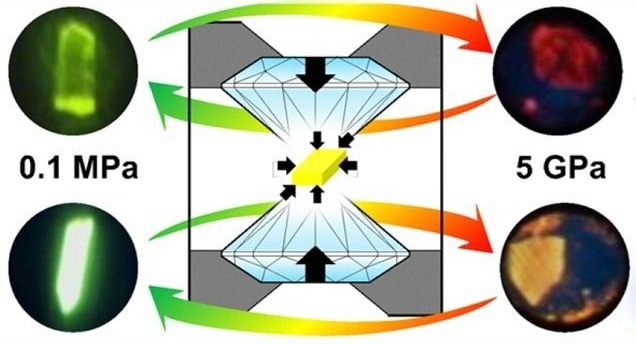
Image Credit: Osaka Metropolitan University
The discovery centers on piezofluorochromism, a property where materials reversibly change their fluorescent color when pressure is applied. This effect forms the basis for many pressure sensors used in fields like automotive diagnostics and medical monitoring. But as sensor applications become more complex, there’s a growing need for materials with heightened sensitivity and tunability.
A research team from Osaka Metropolitan University, led by Project Assistant Professor Takuya Ogaki, Associate Professor Yasunori Matsui, and Professor Hiroshi Ikeda, has uncovered a new approach to enhancing fluorescence. They found that when benzene layers (specifically cyclophane moieties) are initially stacked in a particular way, the material’s fluorescent color shift becomes significantly more pronounced under pressure.
It is difficult to rationally design organic crystals that exhibit the desired color change. Even a slight change of the structure of organic molecules yields a completely different crystal structure.
Takuya Ogaki, Project Assistant Professor, Graduate School of Engineering, Osaka Metropolitan University
To investigate further, the team studied two closely related crystalline organoboron compounds, each containing a structural unit known as [2.2]paracyclophane (pCP).
When subjected to high pressure, these materials exhibited a shift in fluorescence toward longer wavelengths, giving them a reddish glow. X-ray crystallography revealed that the underlying mechanism differed between the two compounds.
In one compound, pCP-H, molecules naturally form π-stacked dimer layers, where electron clouds pair up in stacked configurations. Pressure compresses these dimers further, intensifying the interactions between neighboring molecules and causing a strong, visible shift in fluorescence.
In contrast, the other compound, pCP-iPr, lacks this stacked structure. Here, any color change is mainly due to subtle rearrangements within individual molecules, resulting in a much weaker and less vibrant shift.
Under ultra-high-pressure conditions, we discovered that cyclophanes, such as [2.2] paracyclophane, act like springs, expanding and contracting to alter the luminescent color through changes in molecular interactions.
Yasunori Matsui, Associate Professor, Graduate School of Engineering, Osaka Metropolitan University
These findings show that both molecular stacking and internal structure play key roles in how materials respond to pressure. This insight could help researchers design more finely tuned, pressure-sensitive materials for future technologies.
As materials function not only in molecular assemblies, like crystalline states, but also in monolayers, understanding both these processes is expected to become a new molecular design strategy.
Hiroshi Ikeda, Professor, Graduate School of Engineering, Osaka Metropolitan University
The study was published in the Journal of Materials Chemistry C.
Journal Reference:
Irii, S., et al. (2026) The role of a [2.2]paracyclophane moiety in piezofluorochromism of crystalline organoboron complexes. Materials Chemistry C. DOI: 10.1039/D5TC03195H. https://pubs.rsc.org/en/content/articlelanding/2026/tc/d5tc03195h