New dual-sensor system could help prevent deadly ice-related crashes on roads and in the air.
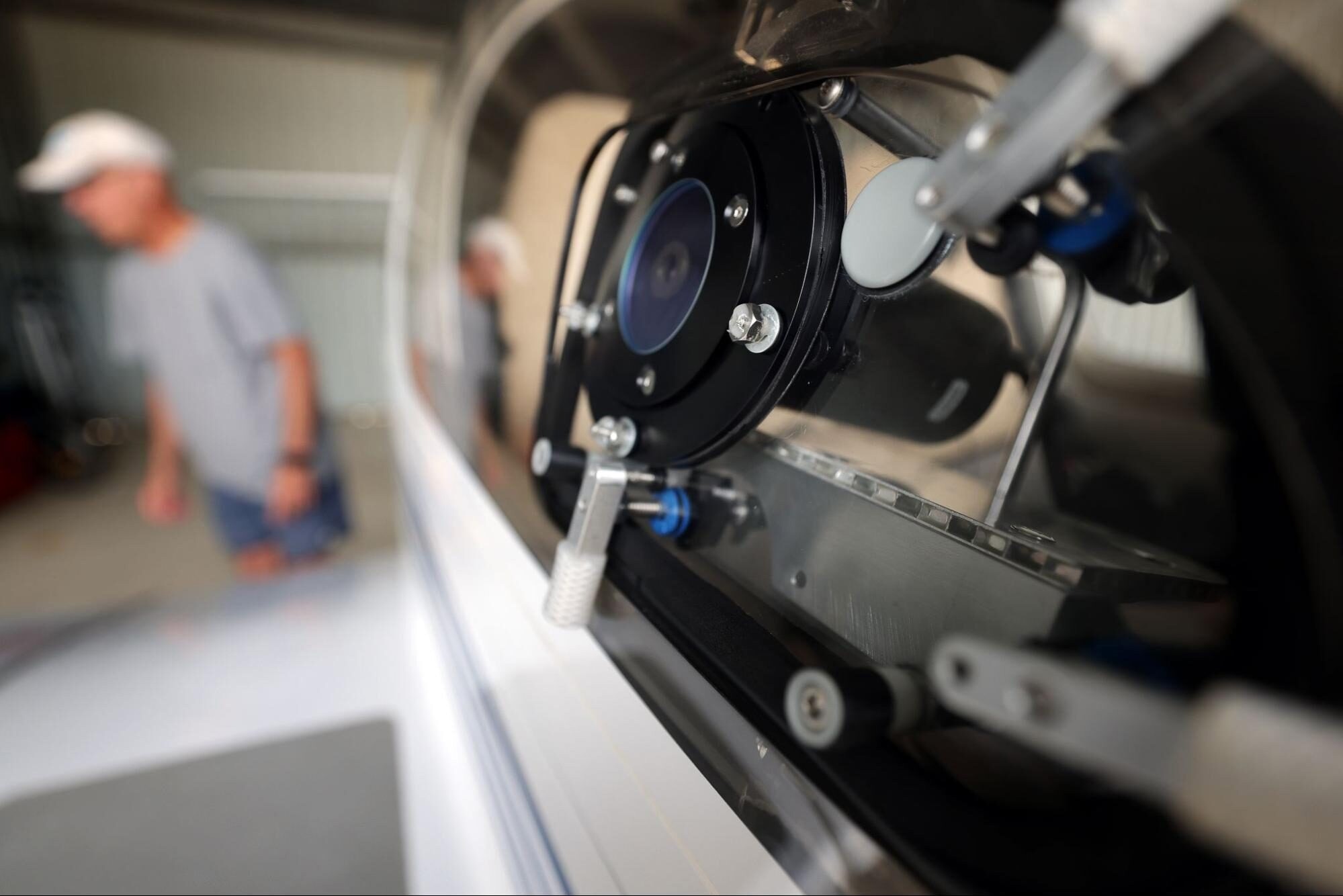 This sensor fires three infrared lasers into clouds to determine the number. Image Credit: Brenda Ahearn, Michigan Engineering, University of Michigan.
A pair of complementary sensors developed at the University of Michigan could give pilots, drivers, and automated systems crucial warnings about invisible ice hazards, potentially preventing serious accidents caused by black ice or freezing rain.
Ice is a major contributor to transportation accidents. Roughly 20 % of all weather-related car crashes each year are due to icy roads.
In aviation, ice buildup is responsible for about 10 % of fatal air carrier crashes, as it interferes with a plane’s aerodynamics and control systems.
A recent example occurred on August 9th, 2024, when a Voepass Linhas Aéreas flight crashed near São Paulo after its de-icing systems failed. Another well-known tragedy was Air France Flight 447, which crashed into the Atlantic Ocean in 2009 after ice blocked its airspeed sensors. Both crashes resulted in the deaths of everyone onboard.
More people are traveling by plane each year, and there’s more pressure to fly in all weather conditions.
Our technology can help airplanes, drones, cars, and trucks be as safe and efficient as possible.
Nilton Renno, Professor, Climate and Space Sciences and Engineering, University of Michigan
Renno’s team tested the system on both a single-engine airplane and a light business jet outfitted with scientific instruments. Their results were recently published in Nature Scientific Reports.
Renno’s team tested the dual-sensor system on both a single-engine airplane and a light business jet outfitted with scientific instruments to provide reference measurements.
Their findings demonstrate how the two sensors work together: one sits flush with the aircraft’s surface and uses microwaves to detect ice formation directly on the plane, while the other employs lasers to identify freezing rain and large water droplets in clouds, giving pilots an early warning before entering hazardous conditions.
The laser-based sensor also shows promise for use in vehicles, where it could help detect ice on roads.
The idea for the microwave sensor first came from work related to the Phoenix lander mission, which detected signs of liquid water on Mars.
Renno had been thinking about how future missions could measure moisture in Martian soils and distinguish water from ice. But one winter, a personal experience shifted his focus: as a pilot, he found his own airplane coated in ice and realized he couldn’t fly safely.
That moment sparked his interest in finding better ways to detect icing hazards, and he went home determined to explore solutions.
Icing of airplanes is a worldwide problem that can happen anytime of the year with aircraft of all sizes, depending on the flight altitude. I realized that that was a problem that I could do something about because of my background as both a pilot and an atmospheric scientist.
Nilton Renno, Professor, Climate and Space Sciences and Engineering, University of Michigan
Most airplanes today rely on two types of protruding probes to detect ice. However, because these probes extend above the aircraft’s surface, they can’t measure ice buildup directly on the plane itself.
The new microwave sensor addresses this by being embedded flush with the surface, allowing it to detect ice formation in real time. When the sensor is covered by water or ice, the frequency of its microwave signal shifts, alerting pilots to the presence of surface ice.
The second, complementary sensor uses three infrared lasers to detect freezing rain within seconds of entering a cloud. Each laser operates at a different wavelength, and the way water and ice absorb these beams varies.
By comparing the return signals, the system can identify whether a cloud contains ice particles, supercooled water droplets, or a combination. Since aircraft are most at risk when flying through supercooled droplets (which freeze on contact), this sensor gives pilots the chance to recognize and avoid dangerous clouds before icing becomes critical.
The third laser enhances the system by estimating both the size and concentration of water droplets in a cloud. It does this by comparing its return signal to those from the other two lasers. Larger droplets pose a greater threat to aircraft because they’re more likely to collide with the plane, while smaller droplets tend to follow the airflow around it.
This laser system could also have important applications on the ground.
In vehicles, it could detect black ice before a driver even feels a loss of traction - or potentially trigger automatic safety systems to respond. Research shows that even a modest reduction in speed (by just 4 to 9 miles per hour) can cut the risk of serious injury in a crash by half.
You can save a lot of lives by just slowing down when you detect a slippery road ahead.
Nilton Renno, Professor, Climate and Space Sciences and Engineering, University of Michigan
The device was partially built and developed at the University of Michigan’s Space Physics Research Laboratory. The optical sensor was created by Intelligent Vision Systems, a U-M startup that licensed the technology with support from Innovation Partnerships, which has also secured patents for the sensors. Both Renno and the university hold a financial interest in the company.
New icing detection sensors for airplanes and cars in development
Video Credit: University of Michigan
Journal Reference:
Renno, N. O., et al. (2026). A new type of aircraft icing detection system. Scientific Reports. DOI: 10.1038/s41598-025-30681-3. https://www.nature.com/articles/s41598-025-30681-3.