Why Do Scientists Care About Marsquakes?
One Lonely Seismometer on a Whole Planet
Following the Waves: P, S, and Surface Waves
Turning Wiggles into Distances and Directions
Doing Seismology and Planetary Anatomy at Once
How Accurate Are These Locations?
What Marsquakes Reveal About Mars’s Past and Future
References and Further Studies
Imagine trying to track every earthquake on Earth with a single sensor in your backyard. That’s the essence of what seismologists are doing on Mars. Despite such limited apparatus, they are still uncovering a remarkable amount about the planet’s interior.
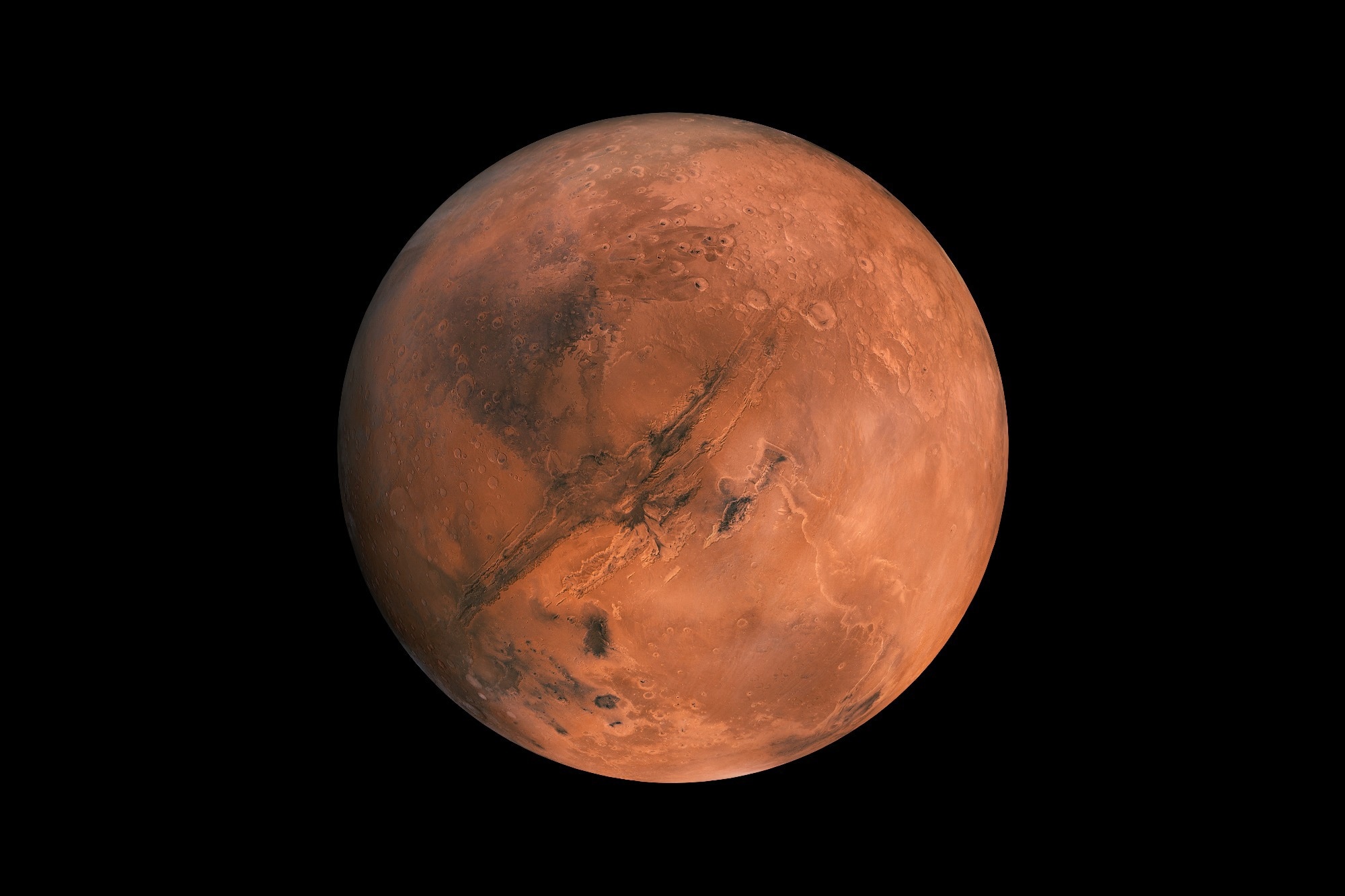 Image Credit: Alones/Shutterstock.com
Saving this article for later? Download a PDF here.
Why Do Scientists Care About Marsquakes?
Mars doesn’t have moving tectonic plates like Earth, but it does rumble. Most marsquakes are small, with magnitudes below 4, yet they still provide precise insights into what occurs within and beneath the planet’s crust.
By tracking how these shakes travel through the crust, mantle, and core, scientists can estimate the thickness of the crust, the size and state of the core, and even whether there are layers or low-velocity zones inside Mars’s mantle.
These measurements show, for example, that Mars has a single thick outer plate and a relatively large, low-density core, which informs how it cooled, lost its magnetic field, and became the dry, cold world it is today.
One Lonely Seismometer on a Whole Planet
On Earth, locating an earthquake is typically a team effort. Several seismometers record shaking while scientists triangulate the epicenter from the different arrival times. For Apollo’s seismometers on the Moon, NASA used a four-station network; for Mars, the InSight mission had to succeed with just one incredibly sensitive instrument, called seismic experiment for interior structure (SEIS), deposited in Elysium Planitia.
Unlike Apollo, SEIS cannot use the time-tested trick of finding the intersection of three circles. Instead, InSight’s team squeezes as much information as possible from a single three-component seismometer: they measure the timing, the shape, and even the direction of incoming seismic waves to reconstruct where a marsquake likely happened.
Following the Waves: P, S, and Surface Waves
When a marsquake occurs, it sends out different kinds of waves that travel at different speeds. The key wave types are:
- Primary (P) waves: Compression waves that are fastest and arrive first at SEIS.
- Secondary (S) waves: Slower shear waves that arrive later and cannot travel through liquid.
- Surface waves: Rolling waves that skim along the surface and can sometimes wrap around the planet.
Because P and S waves travel at different speeds, the time difference between their arrivals at InSight encodes the distance to the marsquake. This is similar to using the delay between lightning and thunder to estimate how far away a storm is: the bigger the gap, the farther the source.
However, the exact speeds of these waves depend on the materials they pass through, which on Mars are not perfectly known. So, scientists must solve for both the quake location and the planet’s internal structure simultaneously.
Turning Wiggles into Distances and Directions
 Image Credit: Parilov/Shutterstock.com
The first step is to detect that something is actually a marsquake and not just wind or a dust devil rattling the lander. InSight’s data are noisy, so researchers developed clever algorithms, including deep-learning systems like MarsConvNet, which scan the continuous recordings and pick out likely P- and S-wave arrivals.
Once they trust the signal, seismologists measure:
- The polarization of the waves: which direction the ground motion is strongest in, which hints at the direction to the source
- The difference between those times (the S–P time)
- The arrival times of P and S waves
From the S–P time and a candidate model of how fast waves move through Mars, they can estimate the distance to the event as a circle around the lander. Polarization analysis of the first arriving waves then narrows down which part of that circle is most consistent with the observed direction of motion, effectively pointing toward the likely epicenter.
For the cleanest events, especially low-frequency marsquakes, the team can also identify waves that have bounced off internal boundaries or that have traveled along different paths through the interior. These extra wave paths give additional timing clues that help refine both the quake’s location and the properties of the layers it passed through.
Doing Seismology and Planetary Anatomy at Once
On Earth, seismologists have a reasonably detailed map of the interior, so they mostly use it as a known background and focus on finding the quake. On Mars, the interior map is exactly what they are trying to build.
Researchers, therefore, generate families of possible 1-D models of Mars, layered structures specifying crust thickness, mantle composition, plus core size and state, and compute how waves would travel through each version. They then compare those predictions with real marsquake data, adjusting both the quake’s depth and distance and the internal model until the observed and predicted wave arrival times, amplitudes, and polarizations line up as well as possible.
This joint approach has led to major discoveries: analyses of a handful of high-quality marsquakes revealed a thick lithosphere, a relatively low-density liquid core, and, more recently, evidence for a solid inner core with a radius of about 600 km. All of that came from carefully timing waves from only a few dozen of the best events recorded at a single site.
How Accurate Are These Locations?
With just one station, marsquake locations are inevitably fuzzy: for many events, the InSight team can only determine that a quake was likely a few thousand kilometers away in a given direction and at a shallow depth, rather than pinpointing it with GPS precision.
Noise from wind and lander motions, uncertainties in how fast waves travel through Mars’s crust and mantle, and the complex ways waves can convert or scatter all blur the picture. Even so, clear patterns do emerge. Many moderate marsquakes cluster near the fractured terrain of Cerberus Fossae, while others originate from deeper beneath the crust, hinting at mantle activity.
Scientists try to overcome these uncertainties by reporting ranges rather than single best guesses, and using statistical methods to test many possible solutions, gradually tightening constraints on both quake locations and Mars’s interior structure as events accumulate.
What about moonquakes? More in this interview!
What Marsquakes Reveal About Mars’s Past and Future
Every well-recorded marsquake is both a rumble and an X-ray, revealing that Mars’s crust is thicker than expected, its lithosphere is stiff and deep, and its core is large, liquid, and probably capped by a solid inner core, clues to how the planet lost its magnetic field, thinned its atmosphere, and dried out at the surface.
Marsquakes also show where the planet is still geologically alive: activity near Cerberus Fossae and a few other zones suggests that long-term cooling stresses and perhaps lingering magma are still slowly reshaping the crust, and future explorers will need this information to choose safe landing sites, design infrastructure, and assess seismic hazards.
Though InSight has now fallen silent after recording more than a thousand events, its lone seismometer effectively founded Martian seismology, and the logical next step is to deploy more instruments so Mars can be listened to with a full global ear, allowing its interior rumbles to be located and interpreted with far greater clarity.
References and Further Studies
References and Further Studies
- Wilson, R. M., A seismometer maps Mars’s anatomy. Physics Today 2021, 74 (10), 17-19.
- Khan, A.; Ceylan, S.; van Driel, M.; Giardini, D.; Lognonné, P.; Samuel, H.; Schmerr, N. C.; Stähler, S. C.; Duran, A. C.; Huang, Q., Upper mantle structure of Mars from InSight seismic data. Science 2021, 373 (6553), 434-438. DOI:10.1126/science.abf2966, https://www.science.org/doi/10.1126/science.abf2966
- Ceylan, S.; Giardini, D.; Clinton, J. F.; Kim, D.; Khan, A.; Stähler, S. C.; Zenhäusern, G.; Lognonné, P.; Banerdt, W. B., Mapping the seismicity of Mars with InSight. Journal of Geophysical Research: Planets 2023, 128 (8), e2023JE007826. DOI:10.1029/2023JE007826, https://agupubs.onlinelibrary.wiley.com/doi/10.1029/2023JE007826
- Duran, C.; Khan, A.; Ceylan, S.; Zenhäusern, G.; Staehler, S.; Clinton, J. F.; Giardini, D., Seismology on Mars: An analysis of direct, reflected, and converted seismic body waves with implications for interior structure. Physics of the Earth and Planetary Interiors 2022, 325, 106851. DOI:10.1016/j.pepi.2022.106851, https://doi.org/10.1016/j.pepi.2022.106851
- Huang, X.; Zhang, Y.; Greenhalgh, S.; Wang, X.; Kim, D., Detection of Marsquakes on InSight data using deep learning. Geophysical Journal International 2025, 243 (1), ggaf318. DOI:10.1093/gji/ggaf318, https://academic.oup.com/doi/10.1093/gji/ggaf318
- Bi, H.; Sun, D.; Sun, N.; Mao, Z.; Dai, M.; Hemingway, D., Seismic detection of a 600-km solid inner core in Mars. Nature 2025, 645 (8079), 67-72.
- Drilleau, M.; Samuel, H.; Garcia, R. F.; Rivoldini, A.; Perrin, C.; Michaut, C.; Wieczorek, M.; Tauzin, B.; Connolly, J. A.; Meyer, P., Marsquake locations and 1-D seismic models for Mars from InSight data. Journal of Geophysical Research: Planets 2022, 127 (9), e2021JE007067. DOI:10.1029/2021JE007067, https://agupubs.onlinelibrary.wiley.com/doi/10.1029/2021JE007067
- Knapmeyer-Endrun, B.; Panning, M. P.; Bissig, F.; Joshi, R.; Khan, A.; Kim, D.; Lekic, V.; Tauzin, B.; Tharimena, S.; Plasman, M., Thickness and structure of the Martian crust from InSight seismic data. Science 2021, 373 (6553), 438-443.
Disclaimer: The views expressed here are those of the author expressed in their private capacity and do not necessarily represent the views of AZoM.com Limited T/A AZoNetwork the owner and operator of this website. This disclaimer forms part of the Terms and conditions of use of this website.