Urban flooding now ranks among the most disruptive impacts of climate change. From 1980 to 2020, floods resulted in over $1 trillion in damages, with nearly 89% of those at risk living in low- and middle-income countries. As cities grow and impervious surfaces increase, traditional flood management struggles to keep up. Smart city sensor networks are bridging this gap through real-time, distributed, and data-rich monitoring systems.1,2
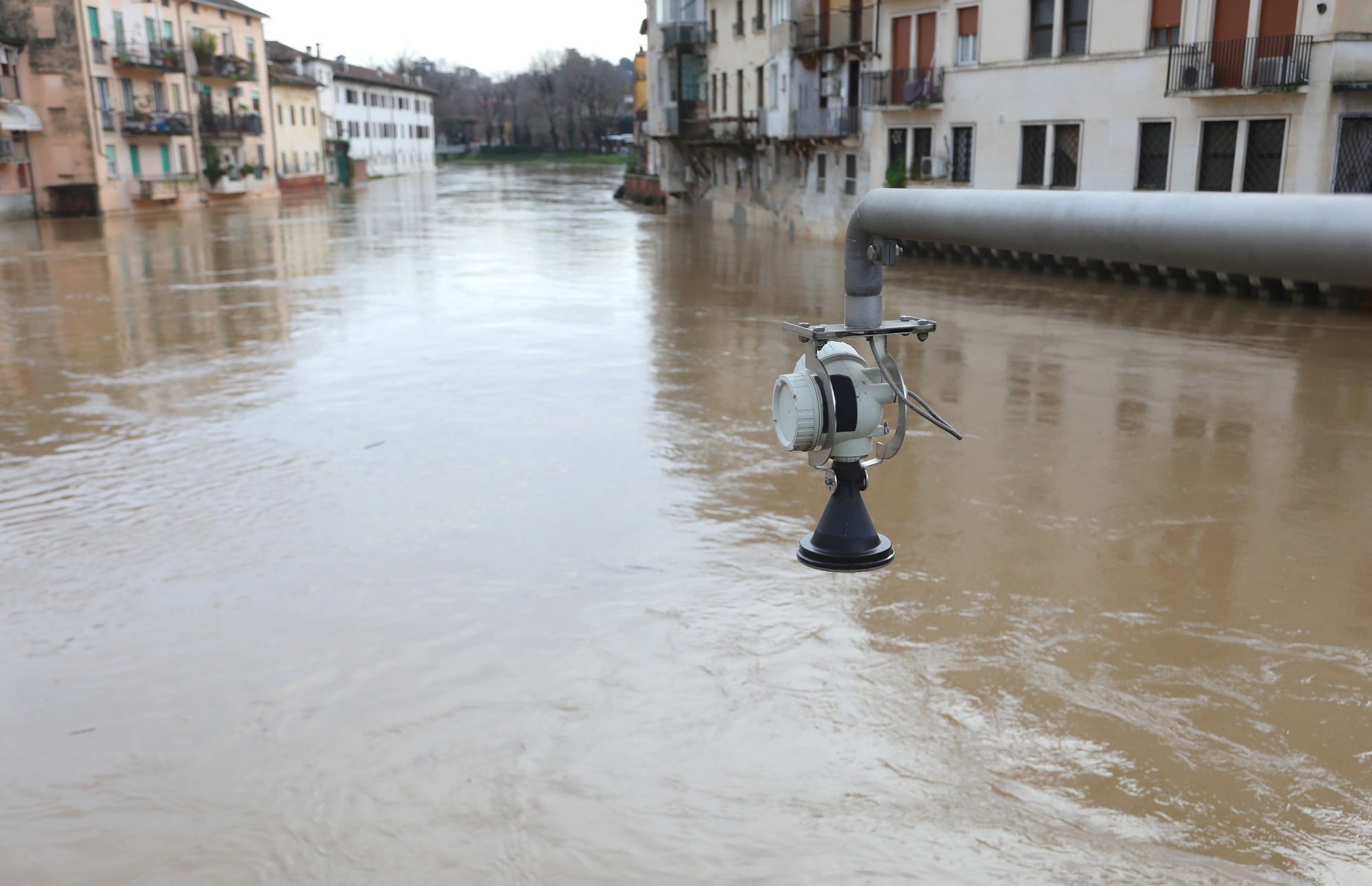 Image Credit: ChiccoDodiFC/Shutterstock
The Urban Flood Problem
Modern cities face a structural challenge in flood risk. Dense pavement prevents rainwater from percolating into soil, directing it rapidly into drainage systems designed decades ago.1
When these systems become overwhelmed, water can surge into low-lying underpasses, underground parking lots, and residential basements at alarming speeds, leaving little time for residents to evacuate. A tragic example occurred in Seoul, South Korea, in 2022, when a family lost their lives in a semi-underground housing unit due to typhoon-induced flooding.1
Traditional flood forecasting methods rely heavily on hydrodynamic models and rain-gauge data collected in river basins. These models perform adequately at the watershed scale, but they lack the spatial resolution needed to predict which specific underpass or street segment will flood within 30 minutes.
Urban environments, with their irregular terrain, buried infrastructure, and constant change, require direct, localized, real-time monitoring to generate actionable warnings at the block level.1
Types of Sensors in Flood Networks
Sensor diversity is a defining feature of modern urban flood prediction systems. Ground-based in situ sensors gather the most direct and reliable flood data. Ultrasonic sensors operate by transmitting acoustic pulses and measuring water levels based on the return time of these signals. This enables non-contact measurements with very high temporal resolution.2
On the other hand, pressure sensors analyze hydrostatic force under submerged conditions but require careful barometric compensation and regular calibration. Radar sensors, including frequency-modulated continuous wave (FMCW) radar, achieve centimeter-level flood detection accuracy without physical contact with water.2
Camera-based sensors add a visual dimension to flood monitoring. Computer vision algorithms process imagery from urban surveillance cameras to extract water-level readings at multiple points within a single field of view. Convolutional neural networks (CNNs) applied to camera images have shown remarkable accuracy with mean error rates of 0.009 meters. It outperforms traditional dictionary-learning and pixel-differencing methods in controlled tests.3
Remote sensing extends coverage beyond ground nodes. Synthetic aperture radar (SAR) satellites, including Sentinel-1A and Sentinel-1B, penetrate cloud cover during monsoon events and deliver wide-area flood mapping at sub-meter spatial resolution.2,3
UAV-mounted LiDAR and multispectral cameras bridge the gap between satellite revisit intervals and ground sensors, providing high-density elevation models and flood-extent data at the neighborhood scale.2,3
How Sensor Networks Are Structured
A functional urban flood prediction network connects sensors across three distinct layers. At the perception layer, sensors collect physical measurements including rainfall intensity, water level, soil moisture, wind speed, and flow velocity.4
At the network layer, data travels from each node to a central platform. The most widely deployed communication protocols include LoRaWAN, which supports long-range low-power transmission across several kilometers, and MQTT, a lightweight protocol suited for IoT environments with intermittent connectivity.4
Fog computing serves as an important intermediary between sensor nodes and cloud infrastructure. Instead of sending raw data streams directly to the cloud, edge devices pre-process and aggregate readings on-site. This local processing significantly reduces latency and allows for immediate alerts in response to urgent conditions.4
Meanwhile, cloud computing stores historical sensor records that feed machine learning models trained to recognize flood precursor patterns. This two-tier architecture enables the network to deliver short-term warnings in near real-time while continuously enhancing the accuracy of long-term predictions.4
Download the PDF of this page here
Sensor placement strategy directly determines prediction quality. Multi-objective optimization approaches, such as the NSGA-II algorithm, have been applied in cities like Jakarta, Indonesia, to identify sensor positions that maximize spatial coverage of flood-prone waterways. UAVs can deploy temporary sensors in areas where fixed infrastructure is unavailable or where floodwaters have severed ground access.3
Machine Learning and Data Fusion
Raw sensor data alone does not produce flood predictions. Machine learning transforms measured variables into risk classifications and water-level forecasts. Artificial neural networks (ANNs) applied to time-series data from ultrasonic, rainfall, and soil moisture sensors predict flood occurrence with measurably reduced false-alarm rates. Long short-term memory (LSTM) networks capture temporal dependencies in sensor time series, making them well-suited for predicting the rising phase of urban flood events.5
Data fusion combines inputs from multiple sensor types to compensate for individual sensor limitations. Optical satellite imagery loses effectiveness under cloud cover, while SAR penetrates those same clouds.
Ground radar sensors detect local water-flow energy that satellites cannot resolve. Integrating these sources through machine learning has demonstrated marked improvements in flood-extent delineation compared to single-sensor approaches.2
Sensor fault tolerance remains an active engineering challenge. Urban sensors are exposed to debris, submersion, and power interruptions during the very events they are meant to monitor. Systems that cross-validate readings against neighboring nodes, apply Kalman filtering for signal smoothing, or use multi-agent classification to flag invalid data have demonstrated stronger operational reliability during extreme events.3
Toward High-Precision Urban Flood Twins
Researchers at the Korea Institute of Civil Engineering and Building Technology have developed an innovative miniaturized IoT platform named WAVE-Surf. This advanced system utilizes 77 GHz FMCW radar technology, specifically designed for installation in underpasses and underground parking facilities.1
WAVE-Surf can detect pure water-flow energy with centimeter-level accuracy. It achieves this by filtering out interference from pedestrians, vehicles, and animals using range-Doppler mapping techniques. In field experiments across diverse river environments in South Korea, WAVE-Surf accurately calculated flood depth and surface flow velocity from the moment rainwater began entering monitored spaces.1
The development of systems like WAVE-Surf marks significant progress toward establishing dense, distributed flood-monitoring networks within urban settings. Flood warning systems with real-time sensor coverage have been estimated to reduce annual flood losses by up to 35%.1,6
At scale, a high-density sensor network feeding a machine-learning prediction engine lays the foundation for a digital flood twin, a dynamic computational model that replicates a city's hydrological behavior under current and forecast conditions. This integration gives city planners, emergency managers, and residents the advanced notice needed to act before floodwaters arrive.1,2
References and Further Reading
- Jang, B. J., & Jung, I. (2023). Development of High-Precision Urban Flood-Monitoring Technology for Sustainable Smart Cities. Sensors, 23(22), 9167. DOI:10.3390/s23229167. https://www.mdpi.com/1424-8220/23/22/9167
- Tao, Y. et al. (2024). A Review of Cutting-Edge Sensor Technologies for Improved Flood Monitoring and Damage Assessment. Sensors, 24(21), 7090. DOI:10.3390/s24217090. https://www.mdpi.com/1424-8220/24/21/7090
- Sengupta, S. (2024). IoT-Based Flood Detection and Management Systems in Urban Areas. Risk Assessment and Management Decisions, 1(2), 301-313. DOI:10.48314/ramd.v1i2.53. https://ramd.reapress.com/journal/article/view/53
- Zeng, F., Pang, C., & Tang, H. (2022). Sensors on the Internet of Things Systems for Urban Disaster Management: A Systematic Literature Review. Sensors, 23(17), 7475. DOI:10.3390/s23177475. https://www.mdpi.com/1424-8220/23/17/7475
- Samikwa, E. et al. (2020). Flood Prediction Using IoT and Artificial Neural Networks with Edge Computing. IEEE Xplore. DOI:10.1109/iThings-GreenCom-CPSCom-SmartData-Cybermatics50389.2020.00053. https://ieeexplore.ieee.org/document/9291641
- Esposito, M. et al. (2021). Recent Advances in Internet of Things Solutions for Early Warning Systems: A Review. Sensors, 22(6), 2124. DOI:10.3390/s22062124. https://www.mdpi.com/1424-8220/22/6/2124
Disclaimer: The views expressed here are those of the author expressed in their private capacity and do not necessarily represent the views of AZoM.com Limited T/A AZoNetwork the owner and operator of this website. This disclaimer forms part of the Terms and conditions of use of this website.