Sponsored by TOFWERKReviewed by Olivia FrostAug 19 2026
Contemporary industrial process control and semiconductor manufacturing demand real-time gas monitoring with temporal resolution that simply cannot be achieved with traditional instruments.

Image Credit: Mayy Contributor/Shutterstock.com
Quadrupole mass spectrometry-based residual gas analyzers (RGAs) scan through the mass spectrum sequentially, meaning that only a single mass-to-charge ratio is measured at any given time.
This sequential scanning architecture is blind to fast transient events because it fundamentally limits time resolution per full spectrum to the order of seconds.
TOFWERK, A Bruker Company - Process Solutions
Time-of-flight mass spectrometry (TOFMS) relies upon a distinctly different principle, with ions across the entire mass range simultaneously detected with every extraction pulse.
These extraction pulses are repeated thousands of times per second, delivering a complete mass spectrum at a time resolution of milliseconds or even sub-millisecond. TOFMS does not sacrifice mass range for speed.
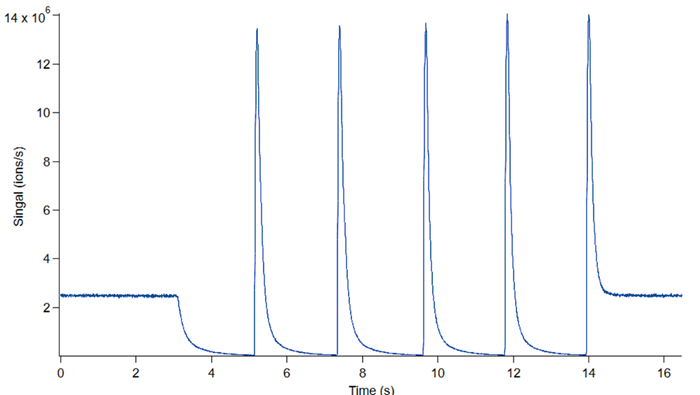
Figure 1. Full 17-second acquisition sequence with five discrete Ar injection pulses, each separated by baseline periods. The instrument resolves each pulse onset, plateau, and decay with high fidelity, capturing dynamic process events as they unfold in real time. Image Credit: TOFWERK
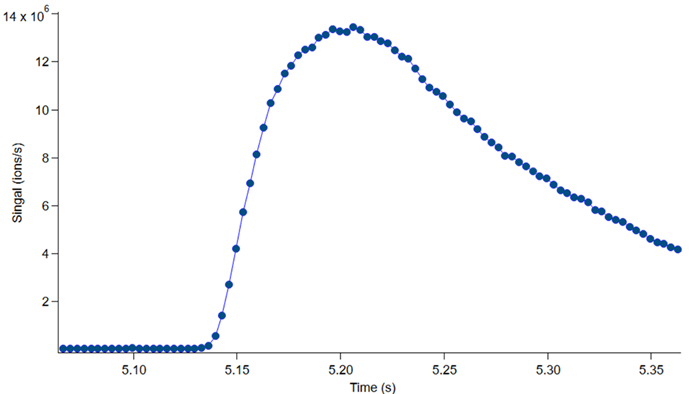
Figure 2. Zoom of a single Ar pulse between ∼5.05 and ∼5.38 seconds. Individual data points are spaced only a few milliseconds apart, revealing the sharp rising edge (∼50 ms rise time), the signal peak at ~13.5 × 10⁶ ions/s, and the asymmetric exponential decay. Image Credit: TOFWERK
TOFMS vs. RGA: Key Differences. Source: TOFWERK
| Feature |
TOFWERK TOFMS |
Quadrupole RGA |
| Detection Mode |
Simultaneous, all masses |
Sequential scanning |
| Time Resolution |
Milliseconds |
Seconds (full scan) |
| Mass Range per Acquisition |
Full spectrum every pulse |
One m/Q at a time |
| Transient Event Capture |
Yes |
No |
| Dynamic Range |
High |
Moderate |
| Sensitivity for Trace Species |
High |
Moderate |
The Importance of Time Resolution for Process Analysis
TOFMS’ millisecond time resolution enables previously inaccessible measurements of rapidly changing processes in real-world conditions.
Pulse and Valve Characterization
Valve switching, gas injection events, and pressure transients take place on timescales of tens to hundreds of milliseconds.
Only TOFMS can resolve the actual pulse profile, rise time, and tail (Figure 2) of these events, making it a key technology for qualifying gas delivery systems in semiconductor fabs.
Plasma Process Monitoring
Plasma ignition, stabilization, and extinction events in etch chambers or CVD occur within a matter of milliseconds. TOFMS can capture the entire chemistry evolution during these transients, allowing root cause analysis of yield excursions or process drift.
Leak and Contamination Event Detection
Sudden or unexpected contamination spikes (for example, from an outgassing event or valve leak) can be entirely missed by RGAs if these events take place between scan cycles. TOFMS is able to flag these spikes with precise timestamps.
Gas Switching and Purge Qualification
Time-resolved data is required to confirm that a gas line has been completely purged following a changeover. Figure 1 shows an exponential decay profile that is exactly the type of signature that TOFMS can track quantitatively.
Reaction Kinetics in Flow Systems
Capturing intermediate species and product formation rates requires millisecond sampling. This distinct advantage of TOFMS makes it ideally suited to thermal desorption, catalyst testing, or reactive gas studies.
The TOFWERK Advantage
TOFWERK Process Solutions and process-optimized TOFMS platforms offer a powerful combination of unparalleled time resolution, a robust vacuum interface, and a compact, fieldable form factor.
These instruments have been specifically designed for in-line and at-line process monitoring in demanding industrial and fab environments.
While RGAs must manage the difficult balance between mass range and speed, instruments from TOFWERK deliver both, allowing the full chemical picture to be captured every millisecond.

This information has been sourced, reviewed, and adapted from materials provided by TOFWERK.
For more information on this source, please visit TOFWERK.