*Important notice: This news reports on an unedited version of an accepted paper and is awaiting final editing. Therefore, the paper should not be regarded as conclusive or treated as established information.
Large quantities of prescription medications are discarded every year because healthcare providers cannot confirm that they remained within safe storage conditions after being dispensed. To address this challenge, researchers developed the Smart Packaging and Returns Assessment System (SPaRAS) and published their findings in Scientific Reports.
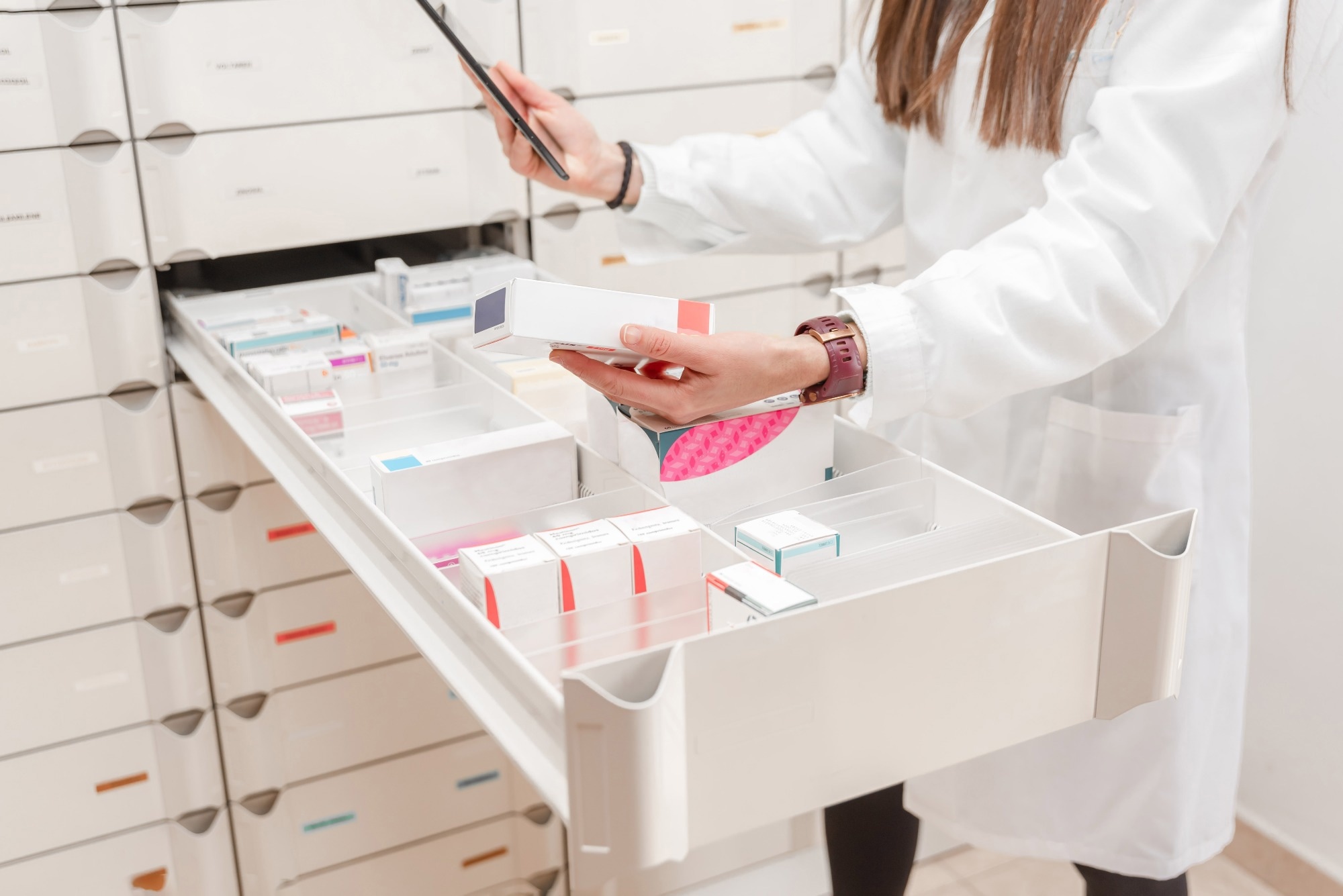 Study: A customisable environmental sensor proof-of-concept to enable prescription medicine reuse. Image Credit: Renata Photography/Shutterstock.com
This system combines customizable sensors with near-field communication (NFC) technology to monitor temperature, humidity, and other parameters while medicines remain in patient care.
By creating a secure record of environmental exposure, SPaRAS provides a verifiable history of each medication's handling conditions. This environmental record could help determine whether returned, unexpired medicines remained within defined storage criteria, potentially supporting future systems for safer medicine reuse while reducing pharmaceutical waste.
Environmental Challenges in Pharmaceutical Storage
Traditional healthcare supply chains often destroy returned prescription medications because their storage history cannot be verified. Exposure to unsuitable conditions, including high temperatures and humidity fluctuations, can degrade active pharmaceutical ingredients and compromise drug safety. This is particularly critical for biological products, vaccines, and other temperature-sensitive medicines.
Existing quality assurance techniques, such as visual inspections and conventional environmental data loggers, provide limited solutions. Industrial data loggers are often too bulky and power-intensive for individual medicine packages, while passive indicators cannot provide a continuous record of storage conditions.
Embedding low-power sensor nodes directly into pharmaceutical packaging enables continuous monitoring of environmental conditions, potentially supporting quality verification and facilitating a shift toward circular pharmaceutical supply chains.
Design and Functionality of SPaRAS
Researchers developed SPaRAS as a low-cost platform for continuous environmental monitoring of dispensed medicines. The system is built around a low-power microcontroller integrated with digital temperature, relative humidity, and ambient light sensors.
Sensor measurements are recorded at pre-programmed intervals and stored with timestamps in non-volatile memory, creating a comprehensive history of the environmental conditions experienced by each medicine package.
The platform incorporates NFC technology, allowing pharmacy staff to retrieve recorded data quickly when unused medicines are returned. Environmental thresholds can be customized for different pharmaceutical products, including, for example, refrigerated medicines requiring storage between 2 °C and 8 °C and room-temperature formulations stored below 25 °C.
To maximize battery life, the microcontroller remains in a low-power sleep mode between sampling events.
Download a free copy of this page for later.
Performance: Battery Life and Data Management
Experimental testing demonstrated that sampling frequency directly influences battery life, memory usage, and data transfer performance. When configured with the same sampling interval used by standard NHS environmental monitors, the SPaRAS prototype operated continuously for 17 days on a standard battery.
Memory analysis showed that storage capacity could support continuous monitoring for up to 337 days with a custom application-specific printed circuit board (PCB) designed to reduce power consumption. Full environmental records were transferred via the NFC interface within seconds, enabling pharmacists to quickly verify returned medicines.
During the nine-day functionality test, simultaneous readings from the two devices differed by an average of 0.24 °C for temperature and 0.28% for relative humidity, indicating close agreement between the prototypes.
The device maintained stable data logging without memory corruption or false trigger events, providing pharmacists with reliable records to assess whether returned medicines remain suitable for safe re-dispensing.
Enabling Circular Pharmaceutical Supply Chains
The SPaRAS framework has significant potential for enabling circular pharmaceutical supply chains by verifying the storage history of returned medicines before they are re-dispensed. With further development, the system could allow pharmacists to quickly retrieve environmental records through NFC, supporting immediate quality assessment while reducing unnecessary medicine disposal.
The platform could also support cold-chain logistics for temperature-sensitive products such as vaccines and biologics. Additionally, it can monitor clinical trial medicines and emergency medical stockpiles, providing environmental traceability throughout the supply chain. These capabilities help protect medicine quality and improve inventory management.
Future Directions for Sustainable Healthcare Solutions
The SPaRAS platform demonstrates that low-power, customizable environmental sensors could be used to reliably verify the storage history of returned medicines, addressing barriers to safe pharmaceutical re-dispensing.
By combining continuous environmental monitoring with rapid wireless data retrieval, the system provides a foundation for reducing pharmaceutical waste and supporting circular medicine supply chains.
Future work should focus on transitioning from prototype hardware to miniaturized application-specific PCBs, followed by large-scale clinical trials. These studies should evaluate long-term device durability and performance under real-world conditions.
As flexible electronics and low-power sensor technologies advance, smart pharmaceutical packaging could become a scalable solution for sustainable medicine distribution.
Journal Reference
Gerrans, J., Dey, N., and Sherratt, R.S. (2026). A customisable environmental sensor proof-of-concept to enable prescription medicine reuse. Scientific Reports. DOI: 10.1038/s41598-026-63372-8. https://www.nature.com/articles/s41598-026-63372-8.
Disclaimer: The views expressed here are those of the author expressed in their private capacity and do not necessarily represent the views of AZoM.com Limited T/A AZoNetwork the owner and operator of this website. This disclaimer forms part of the Terms and conditions of use of this website.