Reviewed by Frances BriggsDec 17 2025Reviewed
Researchers at Nanjing University have developed a novel helium-detecting device, drawing inspiration from the traditional Japanese bamboo weaving technique, "Kagome-biki." Their findings were recently published in Applied Physics Letters.
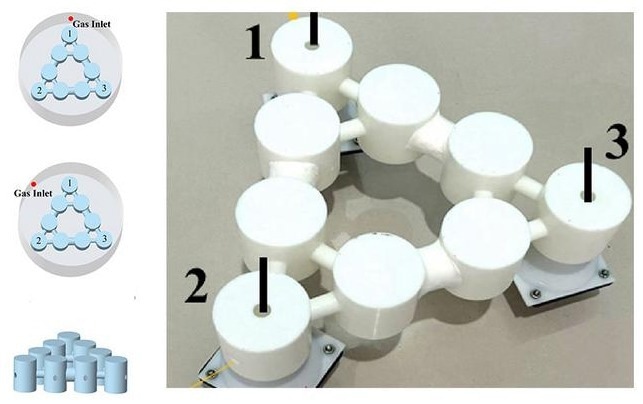 Right: Helium detection device inspired by Kagome-biki. Left: The device's triangular structure helps determine the location of helium leaks in a 2D space. Image Credit: Wang et al.
Detecting helium leaks presents a challenge. Helium is an inert gas, lacking color, odor, and taste. Its inert nature also means it does not readily interact with other chemicals. Consequently, it is invisible and undetectable by smell.
Standard gas sensors, which depend on chemical reactions, struggle to detect it. But finding helium leaks is vital, as excessive helium can replace oxygen in enclosed areas, reducing breathable oxygen levels.
The Kagome structure is triangular, composed of nine cylinders in three apex-sharing sub-triangles. Microphones in the corner cylinders capture sound, while small tubes between cylinders permit air to enter.
Sound waves originate from speakers positioned beneath the corner cylinders, focusing on the structure's corners. Sound waves, carrying energy, are vibrations traveling through a medium like air or water.
A sound wave's form dictates its pitch, volume, and speed, also known as frequency, amplitude, and velocity. The scientists used velocity variations across different substances in their helium-detecting apparatus.
The speed of sound waves depends on the density of the medium: solids transmit them fastest, air transmits them slower, and a vacuum blocks them. Every object has a resonant frequency, its inherent vibration rate. Supplying energy at this frequency significantly boosts the vibration's amplitude.
As helium enters the apparatus, the density of the gas within it is altered. Sound waves traversing the device then experience a speed alteration, ceasing to resonate with the cylinders at their specific frequency. This results in a significant amplitude variation detected by the microphones, and the frequency shift indicates the presence of helium.
Because the relative sensitivity of our sensor remains constant and is not related to working conditions, such as temperature and humidity, the sensor can be applied at an extremely low temperature, which remains challenging for traditional gas sensors working with sensitive materials.
Li Fan, Institute of Acoustics, Nanjing University
Using the triangular instrument, the scientists can pinpoint helium leaks within a 2D area by identifying the corner that registers a frequency change initially.
The group plans to enhance the device to pinpoint leak locations within a 3D environment and transform the system into a portable unit.
Journal Reference:
Wang, Z., et al. (2025). A sensor for helium leakage detection and orientation based on a two-dimensional acoustic topological material. Applied Physics Letters. DOI:10.1063/5.0288849.