Reviewed by Frances BriggsJan 23 2026Reviewed
Researchers at the University of Surrey have shown how battery-free, wireless nanosensors can significantly enhance the possibility and comfort of remote sleep and healthcare monitoring.
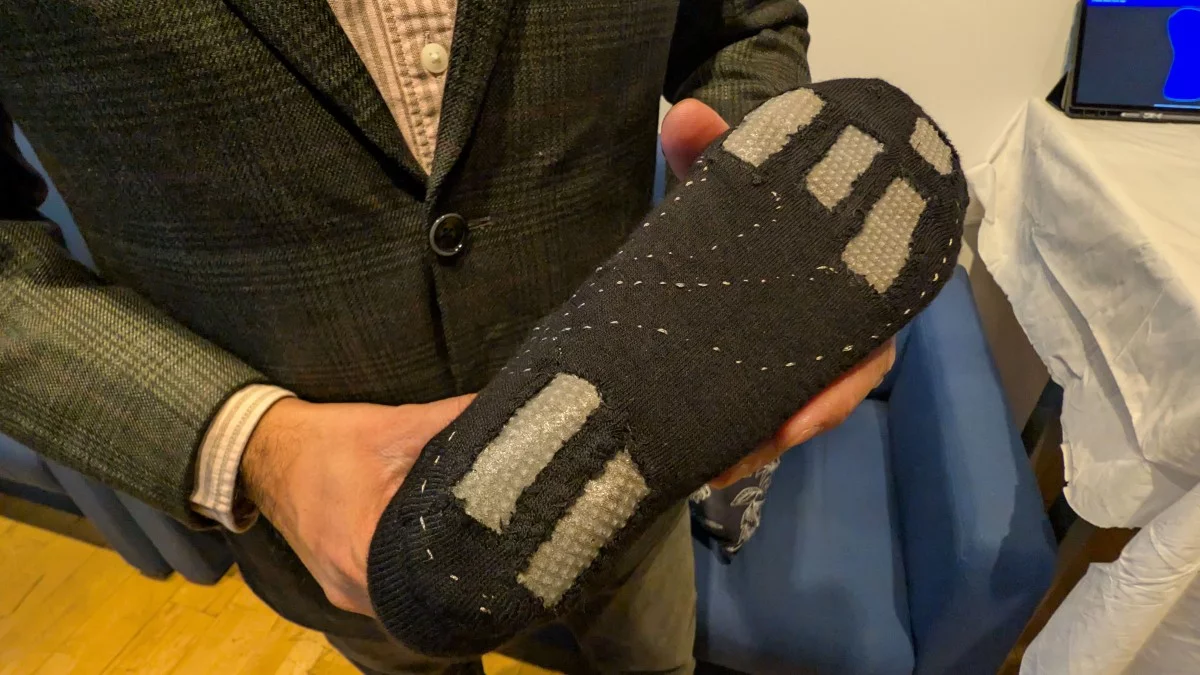 Image Credit: University of Surrey
In contrast to traditional systems used in smartwatches and other wearable devices, which rely on batteries and frequent recharging, this technology is engineered as a soft sensor that can be incorporated into garments or next-generation wearables.
Instead of a battery, it generates its own energy from subtle movements such as breathing, walking, or shifting during sleep.
Created at Surrey’s Advanced Technology Institute (ATI), researchers evaluated a collection of 16 sensors capable of monitoring various sleep patterns and body movements, emphasizing possible uses in the monitoring of sleep disorders and dementia care, where comfort, dependability, and ongoing data collection are essential.
The key achievement of the work is that the sensor is extremely sensitive to very small movements while powering itself at the same time. The device can detect very subtle human motions while simultaneously generating enough power to operate low-power electronics, even from gentle movement, enabling truly continuous, maintenance-free sensing.
Sajib Roy, Postgraduate Research Student, University of Surrey
The study showcases one of the most sensitive self-powered pressure sensors documented to date for detecting low-frequency human motion. It was published in Advanced Materials.
This device uses an ultra-thin nanofiber structure, which is created by incorporating a boron-based two-dimensional nanomaterial – referred to as borophene – into a flexible polymer through an electrospinning technique.
When pressure on the device or movement occurs, the material generates an electrical signal, eliminating the need for batteries.
The generated signals are sufficiently strong to power low-power electronics, creating a route to long-term, maintenance-free monitoring in healthcare, wearable technology, and smart environments.
We have shown how advances in materials science can be translated into practical and impactful healthcare technologies. Battery-free and unobtrusive monitoring systems like this have significant potential to support continuous health monitoring and the next generation of digital healthcare solutions, particularly for home-based care. This is exactly the type of development needed for enabling SDG-3 for good health and wellbeing in society.
Ravi Silva, Distinguished Professor, Interim Director, Institute for Sustainability (IfS)
Ravi Silva is the Director of the Advanced Technology Institute (ATI) and Head of the NanoElectronics Centre.
The study supports the vision of Z-PULSE, a spin-out company from Surrey, which aims to convert advanced materials research into practical, zero-burden healthcare monitoring technologies.
This work shows the promise of nanofiber-based, self-powered sensors for unobtrusive sleep assessment. For dementia care in particular, the ability to monitor movement comfortably and continuously – without wearables or batteries – could make a real difference, and we are excited to progress toward real-time clinical studies.
Dr. Bhaskar Dudem, CTO and Co-founder, Z-PULSE Ltd
Journal Reference:
Roy, S., et al. (2025) Ultra-Sensitive Nanofiber-Based Triboelectric Nanogenerator for Energy Harvesting and Self-Powered Sensing. DOI: 10.1002/adma.202521626.