Microscopic sensors that are as thin as a strand of hair but capable of taking multiple measurements simultaneously could revolutionize the diagnosis and monitoring of diseases like cancer.
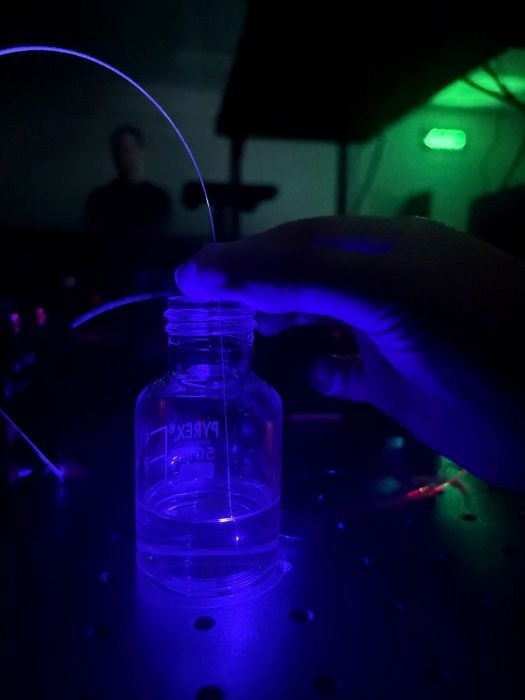 A fiber-optic probe with 3D micro-printed sensing structures is immersed in a liquid sample, where light-induced emission reveals changes in the chemical environment in real time. Image Credit: Adelaide University
Researchers from Adelaide University’s Institute for Photonics and Advanced Sensing and the University of Stuttgart in Germany worked together to develop the tiny sensors using state of the art, ultrafast 3D micro-printing technology.
The unique sensors target specific biomarkers and are printed directly onto the tip of optical fibers. They’re able to monitor several signals at the same time, including temperature and chemical changes.
“This breakthrough could lead to next-generation medical tools that track disease, guide treatment and monitor the body in real time,” said Associate Professor Shahraam Afshar, the project’s lead researcher from Adelaide University’s Institute for Photonics and Advanced Sensing.
“The sensors are able to provide reliable and clear information about the presence of disease in a minimally invasive way. This opens the pathway for smarter tools in healthcare, environmental monitoring and wearable technology.”
The researchers have spent several years developing this new technology, which works by detecting changes in the body brought on by cancer at a molecular level through light.
“Molecules emit light when they come into contact with a by-product of cancer. The amount of light they emit depends on the concentration of the cancer cells. By inserting the sensors into tissue and measuring the amount of light emitted, we believe we can determine the presence of cancer,” he said.
This is a significant development which builds upon existing methods that are only able to measure one biomarker at a time.
“It’s very difficult to measure or detect different signals coming from a living environment such as the human body simultaneously,” said Associate Professor Afshar.
“When you can only measure one biomarker at a time, it’s hard to determine if the cause of the change is cancer or another issue.
“This is why our method is so revolutionary, as it enables us to provide precise information immediately to medical professionals.”
The research has been published in the journal Advanced Optical Materials and will benefit from a recent $1.32 million Australian Research Council Linkage Infrastructure, Equipment and Facilities grant, which will help to establish a world-class, high-precision micro and nano printing facility at Adelaide University.
“Having access to the latest laser printing technology will allow us to continue our research and hopefully detect even more biomarkers, such as changes to pH or oxidation-reduction,” said Associate Professor Afshar.
“We will be able to create prototypes faster, build more complex structures and apply what we learn to the broader biomedical field.
"In the future, we would like to collaborate with hospitals to refine the technology, which we believe could be ready for use within the next decade.”