*Important notice: This news reports on a paper which has been accepted and is awaiting peer review. Scientific Reports sometimes publishes preliminary scientific reports that are not peer-reviewed and, therefore, should not be regarded as conclusive or treated as established information.
A soft add-on optical sensor was able to detect bleeding behind the tip of a colonoscope in a small live-animal study, researchers report in Scientific Reports, with no significant overall effect on procedure time or operator workload.
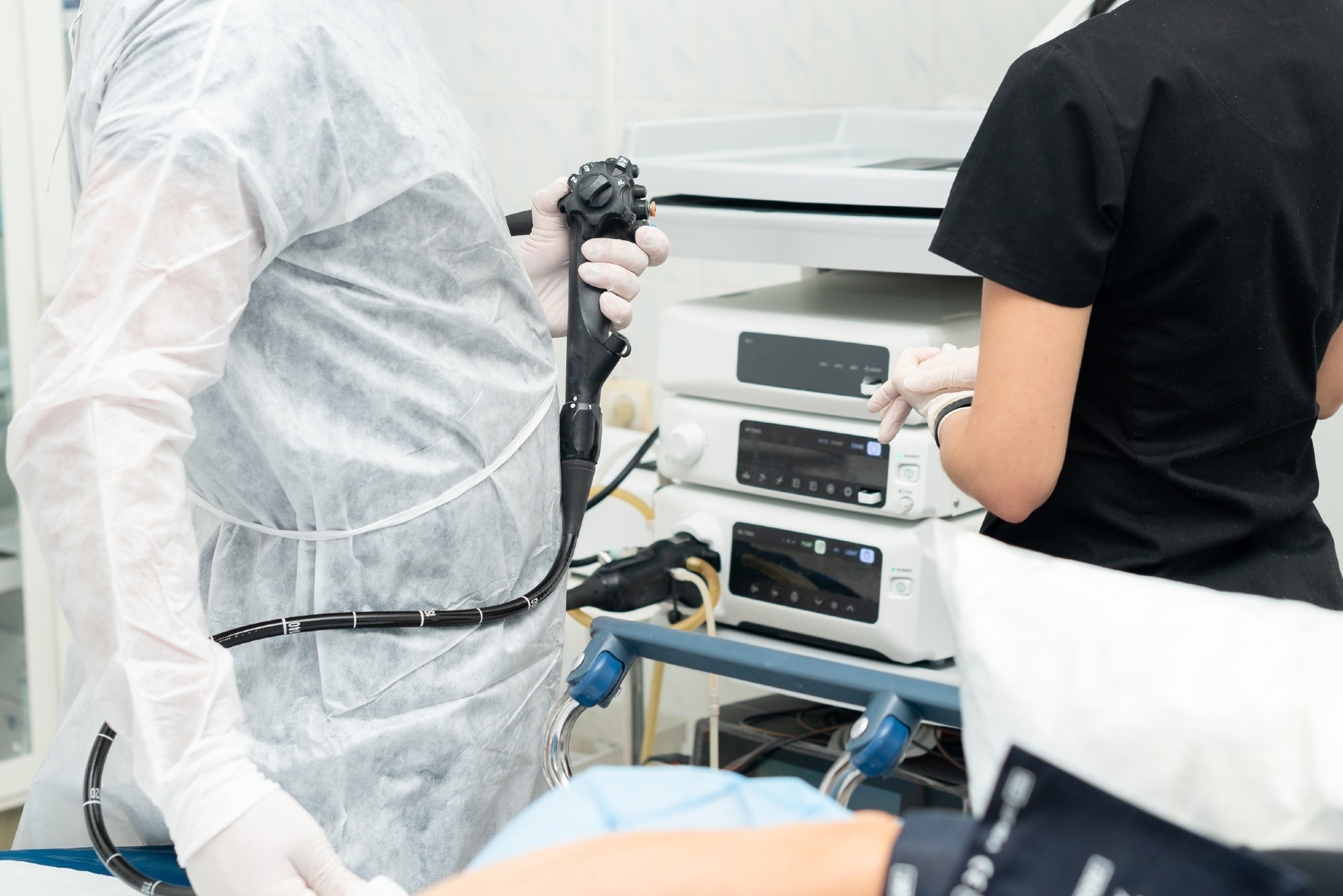 Study: In vivo evaluation of a soft optical sensor for bleeding detection in colonoscopy. Image Credit: ShvedKris/Shutterstock.com
Saving this for later? Download a PDF here.
Colonoscopy is widely used to investigate suspected colorectal cancer and other lower gastrointestinal conditions, including large bowel obstruction, infectious colitis, and inflammatory bowel disease.
However, the procedure carries risks, notably bleeding and perforation, which may go unnoticed in real time if they occur outside the camera's view at the colonoscope’s tip.
Bleeding in the lower gastrointestinal tract can arise both from existing disease, such as colorectal polyps, and from procedure-related injury during colonoscope navigation. Patients with inflammatory bowel disease, polyps, diverticula, and haemorrhoids may also face a higher risk of bleeding during colonoscopy.
Wireless capsule endoscopy has improved the detection of upper gastrointestinal bleeding, but it is not routinely used for lower gastrointestinal bleeding and cannot be incorporated into standard endoscopes.
A Device For What The Camera Cannot See
To address this, the researchers developed a soft sensor that can be attached along the colonoscope and continuously sample colonic fluid through a microfluidic channel.
The device uses infrared and green light to monitor transmission through that channel. In earlier ex vivo tests using a blood analogue, reduced green-light transmission indicated blood at concentrations above about 35%.
In the new study, the authors said that with actual porcine blood, the in vivo detection threshold corresponded to about 20% blood concentration, suggesting better detectability than in the earlier blood-analogue work. The sensor had previously been tested in an ex vivo bovine colon model using a colonoscopy simulator, but the team said those conditions could not fully reflect real procedures, including the effects of bowel preparation.
An In Vivo Study on Porcine Models
Experimental Setup
The in vivo evaluation involved two 30 kg Yorkshire pigs, two testing sessions, and two expert endoscopists. The researchers assessed bleeding-detection accuracy, navigation time, safety, durability, and operator workload using the National Aeronautics and Space Administration Task Load Index, or NASA-TLX.
The sensor itself measured 10mm in width, 25mm in length, and 1mm in thickness. It consisted of a polydimethylsiloxane cladding produced using soft lithography, with four optical waveguides connected to a central microfluidic channel.
The channel had a cross-section of 100µm × 200µm, while the waveguides measured 200µm × 200µm. Three sensors were mounted on a flexible resin sleeve and attached just behind the colonoscope tip, allowing detection at three circumferential positions spaced 120 ° apart.
Before each session, the pigs underwent bowel preparation and received intramuscular buprenorphine, followed by vascular access and xylazine. After endotracheal intubation, general anaesthesia was maintained with isoflurane while vital signs, reflexes, and jaw tone were monitored.
Conducting the Trial
Each endoscopist completed 15 tests in total, although the trial mix differed between sessions: in the first, both users carried out control and device-control trials, but only one performed bleeding trials; in the second, the other completed all trial types. The pigs were euthanised with intravenous Euthasol after testing.
In each trial, the endoscopist advanced from the rectum to about 60cm into the distal colon, stopping before the helicoidal section. Navigation times were recorded in both colonoscope-only and device-assisted trials.
In bleeding trials, the scope was advanced beyond the biopsy site, then retracted while the sensor was monitored for signs of bleeding. After each trial, the microfluidic channel was flushed with deionised water, and baseline voltages were recalibrated.
The researchers also noted that when sustained natural bleeding became difficult to maintain, some positive trials used intravenous blood delivered through the colonoscope channel to create pooling at the biopsy site.
What The Researchers Found
The sensor achieved 92 % accuracy, 83 % precision, 100 % sensitivity, and 87 % specificity in a porcine model.
Median navigation time was 16.41 seconds with the sensor, compared with 17.47 seconds without it, suggesting no significant overall effect on insertion time. Median NASA-TLX scores were 51.7 in device-control trials and 54 in colonoscope-only control trials, indicating that the added device did not significantly increase cumulative workload.
There were, however, false positives in some no-bleeding trials. The authors attributed these to faecal matter and mucus, suggesting that bowel preparation remains important for reliable performance. They also reported that mucus sometimes caused the tubing and sensor to slide, briefly affecting insertion pace in some trials.
Regarding safety, the paper reported no unintended perforations or bleeding caused by the sensor. One pig showed internal bruising, but the authors said this was linked to the duration of testing and repeated colonoscopies rather than to the device itself.
Potential for Safer Colonoscopy
The findings suggest that a soft optical sensor could be added to a conventional colonoscope to help detect bleeding occurring behind the distal tip, beyond the camera’s direct view.
But the authors were cautious about the implications. This was a small preclinical animal study, the navigation assessment was limited to the distal colon, and larger user cohorts and further testing will be needed before the approach can move towards clinical use.
Journal Reference
Gerald, A., et al. (2026). In vivo evaluation of a soft optical sensor for bleeding detection in colonoscopy. Scientific Reports. DOI: 10.1038/s41598-026-43768-2
Disclaimer: The views expressed here are those of the author expressed in their private capacity and do not necessarily represent the views of AZoM.com Limited T/A AZoNetwork the owner and operator of this website. This disclaimer forms part of the Terms and conditions of use of this website.