Carbon dioxide (CO2) is widely used across sectors such as beverage dispensing, food and beverage processing, indoor agriculture, research laboratories, cold storage, welding, and industrial gas distribution.
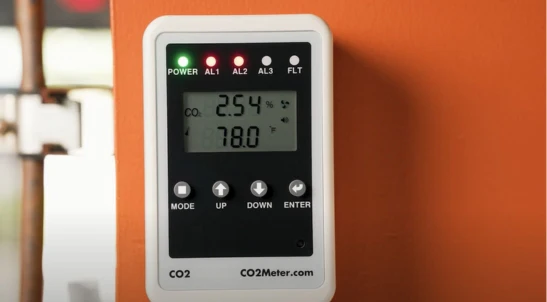
Image Credit: CO2Meter, Inc.
Although CO2 is non-flammable and odorless, high concentrations can rapidly become dangerous, making carbon dioxide safety monitoring and using reliable CO2 safety monitors critical for well-being, staff safety, maintaining code compliance, and lowering workplace risks.
This guide will discuss how to choose the right CO2 safety monitor, the most important features, and how to ensure your CO2 safety system meets both safety and regulatory code requirements.
The Importance of CO2 Monitoring
CO2 is denser than air and can gather in low-lying or enclosed spaces, such as walk-in coolers, storage rooms, and confined spaces.
Inadequate CO2 safety monitoring can result in leaks from cylinders, bulk tanks, or piping systems, leading to oxygen displacement, resulting in dizziness, loss of consciousness, or even fatalities.
A well-installed CO2 safety monitor ensures early detection, audible and visual alarms, and real-time alerts, giving personnel time to evacuate or respond before concentrations become hazardous.
In several jurisdictions, CO2 monitoring is also required by fire code for facilities that use or store compressed carbon dioxide.
Understanding CO2 Safety Standards and Code Compliance
Before choosing a CO2 safety monitor, it is critical to understand the regulations that drive CO2 safety monitoring requirements:
- OSHA Permissible Exposure Limits (PEL): 5,000 ppm as an 8-hour time-weighted average
- NIOSH & ACGIH recommendations: Short-term exposure limits at higher concentrations
- International Fire Code (IFC) & NFPA 55: CO2 safety monitoring is required in rooms where compressed CO2 exceeds threshold quantities
A compliant CO2 safety monitoring system should be developed to meet or exceed these standards and feature alarm setpoints that comply with the required safety guidelines.
Key Factors when Choosing a CO2 Safety Monitor
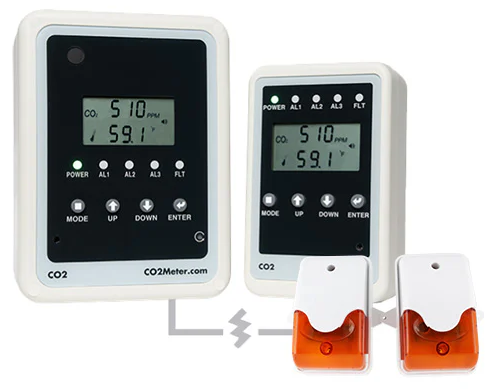
RAD-0102-6-HS2. Image Credit: CO2Meter, Inc.
1. Application and Environment
Different applications require varying CO2 safety monitoring solutions. It is important to consider the following areas:
- Beverage dispensing areas and walk-in coolers
- Bulk CO2 storage and fill rooms
- Indoor grow facilities with CO2 enrichment
- Laboratories and research facilities
- Cryogenic and cold storage areas
- Welding and industrial gas environments
The correct CO2 safety monitor should be rated for the environmental conditions in which it will be used, including temperature, humidity, and potential wash-down requirements.
2. Fixed vs. Portable CO2 Monitoring
Facilities with constant CO2 sources generally require fixed CO2 safety monitoring systems, while portable CO2 safety units provide an additional layer of staff protection.
Fixed CO2 Safety Monitors
- Installed permanently
- Continuous monitoring of CO2 levels
- Required for code compliance in the majority of facilities
- Integrated alarms, relays, and remote notifications
Portable CO2 Monitors
- Can be used as personal safety devices
- Suitable for spot checks or mobile personnel
- Supplemental protection is not a substitute for fixed systems
3. Sensor Technology & Accuracy
The sensor is the core component of any CO2 safety monitor. It's essential to look for devices equipped with NDIR (Non-Dispersive Infrared) sensors in their internals for accuracy and long-term stability.
These sensors typically offer:
- Minimal drift and long calibration intervals
- Rapid response time for leak detection
High-quality sensors ensure dependable CO2 monitoring and lower maintenance costs over time.
4. Alarm Levels & Alerts
Reliable CO2 safety monitors should also have multiple alarm thresholds, including:
- Low-level warning (e.g., 5000 ppm TWA)
- High-level alarm (e.g., 5000 ppm)
- Critical alarm (e.g., 30,000 ppm)
Audible and Visual alerts connected to a building maintenance system (BMS integration) ensure alarms are noticed immediately, even in noisy or unattended conditions.
5. Power Backup & Reliability
Power outages should never disrupt or disable CO2 safety monitoring.
It's critical to look for gas safety systems that include units like the Power Monitor Unit (RAD-PMU) to:
- Display the status of battery backup and provide uninterruptible power options
- Fail-safe alarm operation
- Continuous monitoring during outages
Typically, redundant power ensures your CO2 safety monitor remains operational when it’s needed most.
6. Installation, Calibration & Support
Choosing a CO2 safety monitor means selecting a long-term partner for all your gas safety needs.
Therefore, make sure to consider:
- Professional gas safety installation options
- Gas safety monitoring calibration and certification services that are ongoing
- Technical support and application expertise on a 24/7 basis
A well-maintained CO2 safety monitoring system guarantees accuracy, compliance, and peace of mind year after year.
Common Pitfalls when Selecting a CO2 Safety Monitor
- Choosing a portable monitor when fixed monitoring is required
- Ignoring local fire code requirements
- Installing monitors in incorrect location
- Failing the upkeep of calibration schedules
- Selecting a low-cost device lacking proven sensor reliability
Avoiding these mistakes ensures your CO2 monitoring strategy protects your people, your partners, and your facility properly.
Why CO2Meter is a Top Choice
CO2Meter specializes in gas detection and carbon dioxide safety monitoring. Its solutions are trusted by thousands worldwide, and its CO2 safety monitors are designed to:
- Meet IFC, NFPA, and OSHA requirements
- Provide accurate, reliable CO2 monitoring across industries
- Offer scalable solutions from single rooms to enterprise facilities
- Include expert guidance, installation support, and calibration services
Whether clients require a basic CO2 safety monitor or a fully integrated CO2 safety monitoring system, CO2Meter provides various solutions built for compliance, reliability and long-term performance.
Final Thoughts on Choosing the Right CO2 Safety Monitor
Selecting the correct CO2 safety monitor is not only a purchasing decision, but also a safety investment. Understanding your application, regulatory requirements, and monitoring needs enables you to implement a CO2 monitoring solution that protects employees, ensures compliance, and lowers risk.
By assessing your specific needs and industry guidelines, the right CO2 gas monitor can be chosen to protect both your personnel and operations.

This information has been sourced, reviewed and adapted from materials provided by CO2Meter, Inc.
For more information on this source, please visit CO2Meter, Inc.