Carbon dioxide (CO2) is used across many industries; however, without adequate safety monitoring, it can present significant health and safety hazards. Implementing a CO2 safety monitoring system aids businesses adhere to OSHA, NFPA, and IFC regulations while safeguarding employees, customers and facilities from dangerous gas exposure.
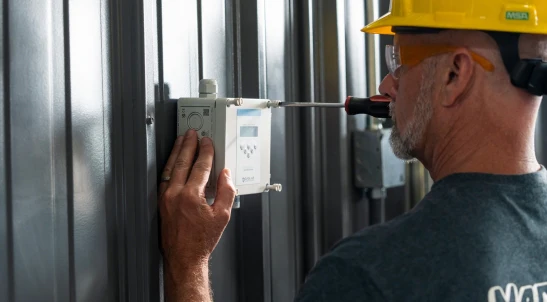
Image Credit: CO2Meter, Inc.
This guide outlines the key advantages of CO2 gas safety monitoring, optimal installation practices, and essential considerations for selecting the correct system for your workplace.
Why CO2 Safety Monitoring is Essential for Workplace Safety & Code Compliance
Carbon dioxide is colorless, odorless, and denser than air, which means it can accumulate near the ground, in basements, coolers, walk-ins, and other confined or poorly ventilated areas. Without ongoing monitoring, CO2 leaks can remain undetected, endangering employees.
Regulatory requirements include:
- OSHA Permissible Exposure Limit: 5000 ppm (8-hour TWA)
- NIOSH STEL: 30,000 ppm (15-minute exposure)
- NFPA 55 & IFC 5307: Monitoring required when storing >100 lb of CO2 or using piped systems
- IFC 901.6.2: Integrated systems must be tested annually
- NFPA 704: CO2 signage requirements for responders
A fixed CO2 monitoring solution, such as the Remote CO2 Storage Safety 3 Alarm (RAD-0102-6-HS2), guarantees gas safety detection in real-time and immediate audible/visual alarms, giving teams time to react safely.
In addition to compliance, CO2 safety systems help prevent:
- Gas wastage and product loss
- Unexpected shutdowns
- Equipment malfunctions
- Worker exposure incidents
- Emergency response calls or fines
Is a CO2 Safety Monitoring System Right for You? (Quick Decision Guide for 2026)
If your facility stores or uses compressed carbon dioxide in an indoor setting, you likely need a fixed CO2 safety monitoring system.
You should consider installing a CO2 safety monitor if your facility:
- Stores over 100 pounds of CO2 (NFPA 55 / IFC 5307 threshold)
- Uses piped CO2 beverage systems
- Contains bulk CO2 tanks, cylinders, or manifolds indoors
- Has below-grade storage rooms, basements, or walk-in coolers
- Requires fire panel integration under local code
- Aims to comply OSHA indoor air exposure limits (5,000 ppm TWA)
Industries that commonly require CO2 monitoring include:
- Restaurants and bars
- Breweries and beverage distributors
- Indoor agriculture and grow rooms
- Laboratories and medical facilities
- Facilities that manufacture food and beverages
2026 Annual CO2 Safety Inspection Checklist
To keep your facility prepared for inspections and ensure your system operates effectively, CO2Meter recommends following this annual CO2 safety verification checklist.
1. Test & Verify All CO2 Monitoring Equipment
Your CO2 alarm system must always function to meet OSHA, NFPA, and IFC requirements.
Annual testing should encompass:
- Verification of sensor placement: ensure sensors are 12 inches from the floor and near CO2 storage or potential leak points. If equipment layouts changed, adjust sensors accordingly.
- Functional gas tests: trigger each sensor to confirm detection accuracy and verify that alarms activate and function properly.
- Horn strobes and alarms: ensure visible and audible alarms are functional, unobstructed, and clearly noticeable.
- Remote displays: confirm displays outside entry points reflect sensor readings and warn staff before entering.
2. Perform Annual Maintenance on Your CO2 Safety System
Though CO2 systems are designed for reliability, maintenance is needed to ensure their compliance and accuracy.
Annual maintenance tasks include:
- Clean sensors and enclosures: remove dust, debris, and condensation to maintain accurate readings.
- Inspect wiring and connections: Look for loose, frayed, or damaged cables and repair when needed.
- Examine tubing, valves, and regulators: for systems with sampling lines or manifolds, make sure no blockages or leaks.
- Clear alarm and signage visibility: ensure horn strobes, remote displays, and safety signs are visible.
- Update service log: inspectors typically request evidence of testing, cleaning, and maintenance.
Note that CO2Meter offers service, installation, and annual certification support for facilities needing documented third-party verification.
3. Review Documentation, Permits, and Expiration Dates
Fire inspections typically fail due to documentation-related issues .
Each year, review:
- Permit renewal dates - (CO2 storage, pressure vessels, boilers, etc.)
- Site plans showing CO2 storage locations, piping runs, and system layout
- Manufacturer specifications and cut sheets for equipment that has been installed
- Records of calibration and maintenance
IFC 5307.4 requires facilities to keep current documentation on storage volume, room conditions, and equipment specifications. Maintaining a complete, updated binder (digital or printed) is essential during inspections.
4. Inspect Ventilation & Exhaust Systems (If Required)
For enclosed or below-grade CO2 storage areas, many jurisdictions require ventilation.
Annual ventilation checks should:
- Test airflow and ensure exhaust systems activate at the correct alarm levels
- Inspect fans, vents, and ductwork for blockages
- Confirm automatic activation functions with alarm triggers
- Ensure that ventilation prevents negative pressure or pooling
Since CO2 sinks, adequate airflow is critical to prevent accumulation in low-lying areas.
5. Refresh CO2 Safety Signage & Emergency Instructions
Clear signage is required by NFPA, OSHA, and local code; it is not optional.
Therefore, each year one should:
- Replace faded or damaged hazard signs
- Make sure warning signage is visible, whether doors are open or closed
- Check zone labels and remote display instructions
- Keep updated emergency shutoff procedures
- Retrain staff on alarm responses and evacuation routes
CO2Meter provides signage in both English and Spanish, NFPA 704 placards, as well as downloadable resources to ensure compliance.
6. Schedule Recertifications, Calibration and Professional Inspections
Several jurisdictions require annual recertification by a qualified technician, particularly when CO2 alarms are integrated into fire systems.
Professional visits should include:
- Verification of system-wide calibrations
- Functional tests of the gas sensor
- Tests of alarm response
- Integrated testing if tied to fire panels
- Updated inspection certificates for your compliance binder
CO2Meter provides professional system audits, installation support, and calibration services across the US.
Best Practices for Installing CO2 Safety Monitoring Systems
CO2 safety monitoring systems are deployed wherever compressed CO2 is stored or used in indoor settings. Depending on the application, they may be required by state or local jurisdictions.
While mounting the CO2 safety sensor 12 inches above the floor is optimal for early warning signaling, it makes it difficult to read the CO2 level on the screen. As a result, this is why most CO2 safety alarms are made of two parts:
- CO2 Sensor - Mounted near the gas 12 inches (32 cm) from the floor
- Remote Display - Mounted outside the door at 60 inches (152 cm).
One should also use CO2 Safety Signs to alert occupants in the event of a leak.
Both devices feature audible and visual alarms, but the remote display and safety signs are crucial as they warn staff before entering an enclosed area with potentially high CO2 levels.
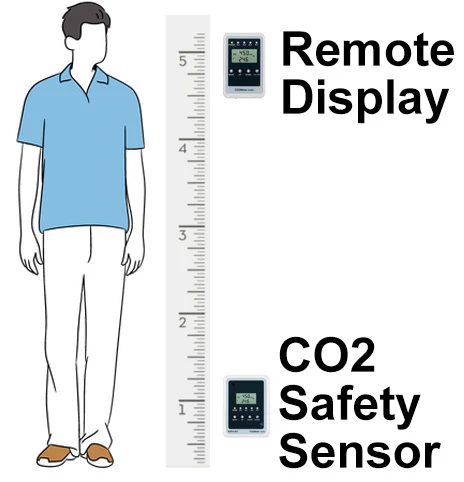
Image Credit: CO2Meter, Inc.
CO2 Sensor Installation
Prior to installation, it is important to understand that proper placement of the CO2 monitoring system is essential for full functionality and employee safety.
Care should be put into planning the system placement, electrical wiring, and protection of the devices as well as training employees about what to do if when the alarm is triggered.
The CO2 sensor should be mounted 12 inches (31 cm) from the floor, whereas the CO2 monitoring system display should be mounted 60 inches (152cm) from the floor.
Note: CO2 (carbon dioxide) monitors and CO (carbon monoxide) monitors are not to be confused. CO alarms should be mounted in residential or commercial spaces to detect CO gas generated by flames or furnaces. On the other hand, CO alarms should be mounted on the ceiling or near the top of a wall.
A site assessment should consider two additional factors before you install a CO2 safety monitoring system.
- You should be aware of the local and state codes that may require additions to your CO2 safety monitoring system. High-visibility strobe lights mounted above doors are the most common additions required.
- Certain jurisdictions also require CO2 safety monitors to be attached to the fire alarm panel to automatically trigger a call to the local fire department to warn of a CO2 leak.
Depending on local inspector or fire codes, meeting these requirements is not an option. One can be fined if these requirements are not met.
Once the approximate location of the sensors is known, the confined space, and how many are required, the next step is to determine how to power the sensors.
CO2 meter CO2 safety monitors operate 110-220 VAC 50/60 Hz converted to 12 VDC power, but a 24 VDC hard-wired power option is available
For situations where standard wall power is inaccessible or for users who prefer the security of a non-unplugged device. It’s crucial that the CO2 sensor be installed so it cannot be damaged when handling nearby kegs, crates, or gas cylinders. Additionally, if you're using a power adapter, make sure the plug is securely fastened to the wall to avoid unintentional disconnection by staff.
Why mount CO2 sensors 12 inches from the floor? Because carbon dioxide gas is heavier than air, it will accumulate on the floor first when a leak first occurs, then slowly rise.
Consider CO2 gas like water. If your building were flooded, where would the water accumulate first? That's the area where CO2 will collect, justifying the position of the CO2 safety monitor.
If there is a basement staircase near a CO2 tank in the facility, cylinder, or CO2 system manifold, the CO2 gas will flow down the stairs and fill the space before it starts to fill the main floor. In this scenario, a safety monitor sensor 12 inches off the basement floor should also be placed.
Remote Display Installation
Though both the CO2 Sensor unit and the remote display unit have audible and visual alarms, the purpose of the remote display is to be placed outside the restricted area to warn personnel of potential gas leaks before entering.
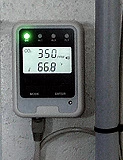
Image Credit: CO2Meter, Inc.
Remote displays should be positioned 60 inches (152 cm) from the floor in proximity to the door frame of any door entering the enclosed area. The displays should be mounted on the same side as the door handle to ensure they are not obstructed when the door opens.
The majority of CO2 safety monitors can connect multiple remote displays to a single CO2 sensor in case there are several entry points.
CO2 Safety Signage
After installing the CO2 safety sensor and remote display(s), it is crucial to install safety signage at every access door. The signage must remain visible whether the door is opened or closed.
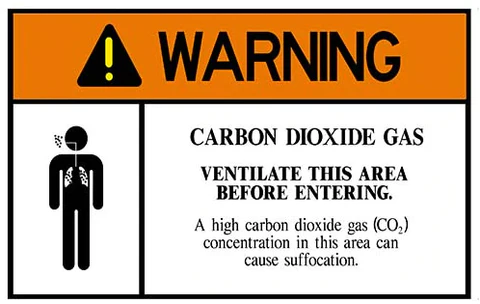
Image Credit: CO2Meter, Inc.
Depending on local regulations, National Fire Prevention Association (NFPA) 704 signs on the outside of your building may also be required in order to warn emergency first responders of stored gases inside your facility.
Bulk CO2 System Area Coverage
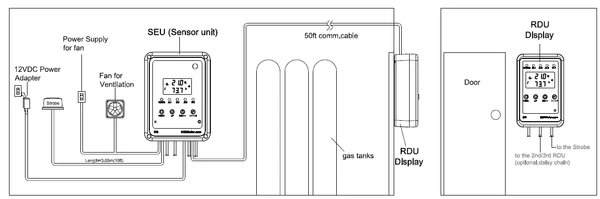
Image Credit: CO2Meter, Inc.
For applications involving bulk CO2 systems, monitors typically cover around 1,500 sq. feet (length x width of the space). It is generally sufficient to place the CO2 sensor within 10 feet of the bulk CO2 storage tank, cylinders, and the BIB rack. Larger facilities or spaces where these components are separated may require additional monitors. Enclosed areas such as closets, offices, bathrooms, and keg coolers may require further monitoring as gas can be trapped in these spaces due to the enclosed space.
How CO2 Safety Monitors Support OSHA, NFPA, and IFC Code Compliance
Understanding CO2 safety codes can be challenging; however, gas safety monitoring systems facilitate compliance and make it more predictable.
OSHA requires employers to maintain safe indoor air quality and guarantee workers are not exposed to CO2 concentrations above established permissible thresholds. CO2 safety alarms also provide a proactive way to remain within OSHA-required CO2 levels and document that safety precautions are in place.
NFPA and IFC codes control the installation of CO2 safety systems used for beverage dispensing, bulk CO2 tanks, and compressed gas storage. Most jurisdictions currently require fixed CO2 safety alarms in storage rooms, basements, and areas where CO2 is piped or stored. Adequately installed gas safety monitoring systems demonstrate compliance during inspections and can prevent costly violations.
Many inspectors also require high-visibility strobes, remote displays outside entrance doors, and integration with the facility's fire panel. A certified CO2 safety system helps satisfy these obligations while enhancing employee and emergency responder safety.

This information has been sourced, reviewed and adapted from materials provided by CO2Meter, Inc.
For more information on this source, please visit CO2Meter, Inc.