Often, the search for compliance begins following a failed inspection, a safety incident, or a fire marshal warning. However, compliance isn’t just about passing inspections, it’s about safeguarding employees from invisible gas hazards like carbon dioxide, all while adhering to OSHA, IFC, NFPA, and local fire code requirements.

Image Credit: chaylek/Shutterstock.com
Air monitoring in the workplace is vital for compliance.
Facilities that store, generate, or use CO2 are increasingly required to install continuous gas monitoring systems, provide appropriate signage, and document procedures for responding to alarms.
Understanding what compliance services entail and how CO2 safety monitoring fits into them helps facilities avoid citations, downtime, and significant safety risks.
What “Compliance Services” Entail for Workplace Air Monitoring
Compliance services extend beyond the initial installation of a CO2 safety system on the wall. Typically, compliance refers to a systematic approach to identifying hazards, monitoring exposure, and responding appropriately when unsafe conditions occur across different environments.
In the context of workplace air monitoring, this typically includes:
- Identifying areas where hazardous gases like CO2 might accumulate
- Employing fixed or portable gas detection devices in code-required locations
- Configuring alarms to adhere to OSHA exposure standards
- Train personnel on alarm response and evacuation protocols
Many facilities mistakenly assume that simply purchasing a gas safety monitor ensures compliance.
Compliance relies on suitable placement, correct alarm thresholds, consistent maintenance, and employee training; all elements highlighted in CO2Meter’s educational resources and safety guides.
Which Codes Trigger CO2 Monitoring Requirements?
Requirements for CO2 safety monitoring are not arbitrary; they are driven by a combination of national codes and local jurisdictional enforcement. Understanding which codes apply to your facility is critical for compliance services.
The most frequent codes that trigger CO2 monitoring consist of:
- OSHA – Requires employers to maintain a safe workplace and limit employee exposure to hazardous gases
- International Fire Code (IFC) – Obligates CO2 safety in areas where compressed gas volumes exceed set limits
- NFPA – Includes stipulations for CO2 storage, monitoring, alarms, and signage
- NBIC – Addresses pressure systems and associated safety controls
Common Compliance Shortcomings Noted by Inspectors
Facilities seldom fail inspections due to inaction. Instead, they fail because an element was incomplete or incorrectly installed. Understanding the most common compliance gaps helps avoid costly re-inspections, fines, and frustration.
Inspectors frequently flag:
- CO2 monitors installed too high (air is lighter than CO2, so monitors need to be set up at least 12 in. above the floor)
- Alarm limits not aligned with OSHA TWA and STEL limits
- Missing or incorrect NFPA placards and warning signage
- The absence of documented employee response procedures
- Lack of records related to calibration or maintenance
Another common issue is relying solely on ventilation rather than continuous monitoring. Although ventilation can lower risk, it is often expensive, unreliable, and does not provide real-time alerts during dangerous conditions.
Fixed versus Portable Monitoring for Compliance
Fixed and portable CO2 monitoring are not mutually exclusive when it comes to compliance, as the most compliant facilities use both as part of a layered safety strategy.
Fixed CO2 monitoring systems are typically required for:
- Enclosed spaces
- CO2 storage rooms
- Beverage gas areas
- Grow rooms and laboratories
These systems facilitate continuous monitoring, visual and audible alarms, and can connect to exhaust fans or fire panels.
Contrastingly, portable CO2 monitors protect:
- Technicians entering enclosed spaces
- Maintenance staff responding to alarms
- Installers working across multiple sites
Portable safety devices are not alternatives to fixed systems but serve as an additional layer of safety during inspections and safety audits.
Facilities seeking compliance services should evaluate multiple product options. A genuine compliance partner helps you understand why monitoring is required, where to install gas safety devices, and how to respond when alarms occur.
When evaluating a compliance provider, inquire about whether they:
- Understand local fire code enforcement practices
- Help with gas safety monitor placement and alarm configuration
- Provide training or SOP guidance
- Support ongoing calibration
How to Choose a Compliance Partner
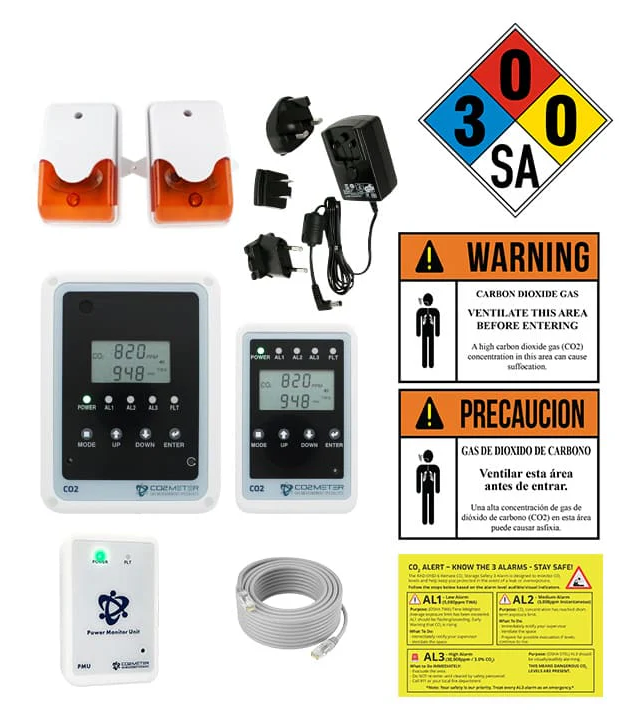
RAD-0102-6-KIT. Image Credit: CO2Meter, Inc.
Use this checklist to determine whether your facility is CO2 safety and inspection-ready:
- CO2 hazards are identified by area
- Fixed gas safety monitors are installed at the correct height (12 in. from the floor)
- Alarms are set to OSHA, TWA, and STEL limits
- NFPA signage and placards are properly displayed
- Employees are trained in alarm responses
- Calibration and maintenance are continually documented
If any item is unchecked, it’s time to review your compliance strategy.
How Gas Equipment Services Supports Long-Term Code Compliance
Installing a CO2 gas safety monitor is only one part of compliance.
Fire codes and workplace safety standards increasingly emphasize how equipment is installed, maintained, and documented over time, not just whether they are present in the facility.
Relying solely on device installation often leads to compliance issues during follow-up inspections. Moreover, recognizing that proper installation, certification, calibration, permitting, and system design ensure CO2 gas safety monitoring systems continue to meet expectations throughout their lifespan.
Partnering with a gas safety provider that offers both gas safety monitoring tools and professional gas equipment services helps facilities close common compliance gaps before they become violations.

This information has been sourced, reviewed and adapted from materials provided by CO2Meter, Inc.
For more information on this source, please visit CO2Meter, Inc.