*Important notice: This news reports on a paper which has been accepted and is awaiting peer review. Communications Biology sometimes publishes preliminary scientific reports that are not peer-reviewed and, therefore, should not be regarded as conclusive or treated as established information.
A luminescent biosensor turns fleeting calcium signals inside cells into a measurable readout, with the potential to make a common class of drug-target assays easier to run at scale.
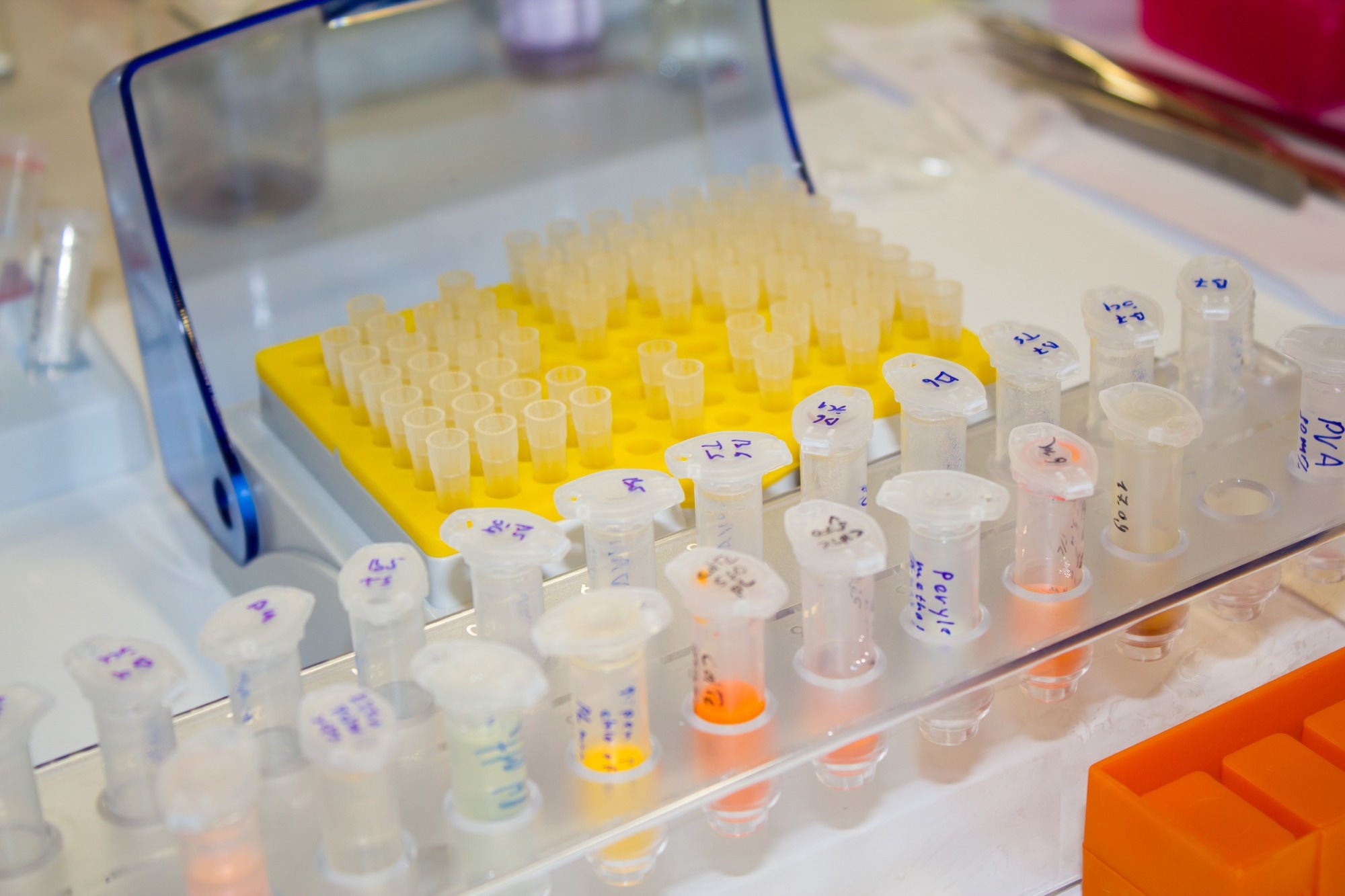 Study: A luminescent calcium biosensor enabling endpoint measurement of GPCR-mediated calcium signaling. Image Credit: Dzmitry Melnikau/Shutterstock.com
A large share of modern medicines act on G-protein-coupled receptors, or GPCRs, a family of cell-surface proteins involved in processes ranging from hormone signaling to muscle contraction. For receptors linked to the Gq/11 pathway, one of the main ways to track activity is to measure changes in intracellular calcium.
That is useful in principle, but practically speaking, not always straightforward.
Calcium spikes are brief, so researchers usually need instantaneous measurements after stimulation. Fluorescence-based assays are most widely used, but they can be affected by autofluorescence from biological samples or by the intrinsic fluorescence of test compounds.
The new study, published in Communications Biology, reports a way around some of those limitations. The researchers developed CalLuc-2.1, a luminescent calcium biosensor that converts a short-lived intracellular Ca2+ rise into a sustained change in light output.
The result is an assay that can be read later using standard luminescence plate readers, without relying on tightly timed detection.
Saving this for later? Download a PDF here.
Designing the Luminescent Sensor
The team built a series of calcium biosensors based on split firefly luciferase. They fused luciferase fragments spanning residues 1-416 and 395-550 to calcium-binding elements derived from calmodulin or troponin C, then altered the component and linker order to improve performance.
These candidate sensors were expressed in HEK293A cells together with GPCRs, including the angiotensin II type 1 receptor, AT1.
After incubation with D-luciferin, the cells were stimulated with ligands, and luminescence was measured over time. The researchers assessed signal size, kinetics, and reproducibility, then tested the best-performing construct in a broader set of receptor assays.
CalLuc-2.1 is the Leading Sensor
Of the eight variants tested, CalLuc-2.1 emerged as the lead candidate. When GPCR activation triggered calcium mobilization, the sensor produced a marked decrease in luminescence that persisted for at least 20 minutes after stimulation.
This is a notable departure from many existing calcium biosensors, which typically produce transient signals lasting only seconds.
The authors suggest the sustained response may reflect the calcium-binding domain remaining in a calcium-bound conformation longer than the cytosolic calcium transient itself, although they also say the structural properties of the split firefly luciferase fragments, and possibly downstream interactions, may contribute.
The signal's direction is also unusual. Instead of increasing as calcium rises, CalLuc-2.1 becomes dimmer. The authors propose that calcium-induced conformational changes reduce complementation between the luciferase fragments and, with it, enzyme activity.
Performance Across Receptors
CalLuc-2.1 detected calcium mobilization across several Gq/11-coupled GPCRs, including orexin, oxytocin, histamine, and angiotensin receptors. Its sensitivity was broadly comparable to that of a commercial fluorescent calcium assay, although not identical across all receptors tested.
The assay also performed well in screening-style formats. In both agonist and antagonist modes, Z′-factor values were above 0.88, supporting its suitability for high-throughput use. The sustained signal also enabled the researchers to assess reversibility after antagonist treatment, adding value to the system for pharmacological studies.
The group further showed that the assay could be extended beyond Gq/11-coupled receptors. By pairing CalLuc-2.1 with chimeric or promiscuous G proteins, they were able to detect signaling from Gi/o-coupled receptors as well. But that performance depended on the receptor-G protein combination, and the kinetic profiles varied across receptors.
Testing with Human Serum
The study also examined whether the sensor could detect endogenous bioactive ligands in biological fluids. Using cells expressing the LPA3 receptor, the researchers estimated levels of lysophosphatidic acid, or LPA, in human serum.
Several controls supported that interpretation. The signal was largely reduced after dextran-coated charcoal treatment, which depletes low-molecular-weight compounds, including LPA, and it was abolished by inhibition of Gq/11 proteins. Estimated serum LPA concentrations were in line with previously reported values.
That makes the work a proof of principle for using the platform to measure bioactive ligands in complex samples, offering a simpler workflow than some immunoassay- or mass spectrometry-based approaches.
What Makes this Biosensor Unique?
The main advantage of CalLuc-2.1 is its practicality. Because the signal remains stable, the assay does not depend on capturing a narrow real-time window immediately after stimulation. In the study, measurements taken around 18 to 20 minutes after stimulation were especially reproducible, with the signal becoming more stable after about 15 minutes.
That could make calcium-based GPCR assays more accessible to laboratories without specialized injector-equipped readers. The system uses routine luminescence plate readers and multichannel pipettes, which may lower the technical barrier for endpoint screening.
However, there are caveats. Because the signal decreases rather than increases, the readout needs careful interpretation. And in biological fluids, nonspecific effects from interfering substances remain a concern, underscoring the need for appropriate controls.
Conclusion
CalLuc-2.1 has the propensity to change the way signaling is measured. By converting a rapid intracellular event into a sustained luminescent readout, it is a more practical endpoint assay for Gq/11-coupled GPCR activity and, in some settings, for Gi/o-coupled receptors through chimeric G proteins.
For drug screening and receptor pharmacology, this could make a technically demanding assay easier to deploy. And for work on biological fluids, the study points to a possible route towards simpler cell-based detection of endogenous ligands.
Journal Reference
Doi K., et al. (2026). A luminescent calcium biosensor enabling endpoint measurement of GPCR-mediated calcium signaling. Communications Biology. DOI: 10.1038/s42003-026-09920-4