Optoelectronic sensor design combines fast GeSe photodetection with CsPbBr3 memory retention, enabling LiDAR tracking, polarization-aware hazard detection, and neuromorphic visual processing for autonomous systems at the edge efficiently in vehicles.
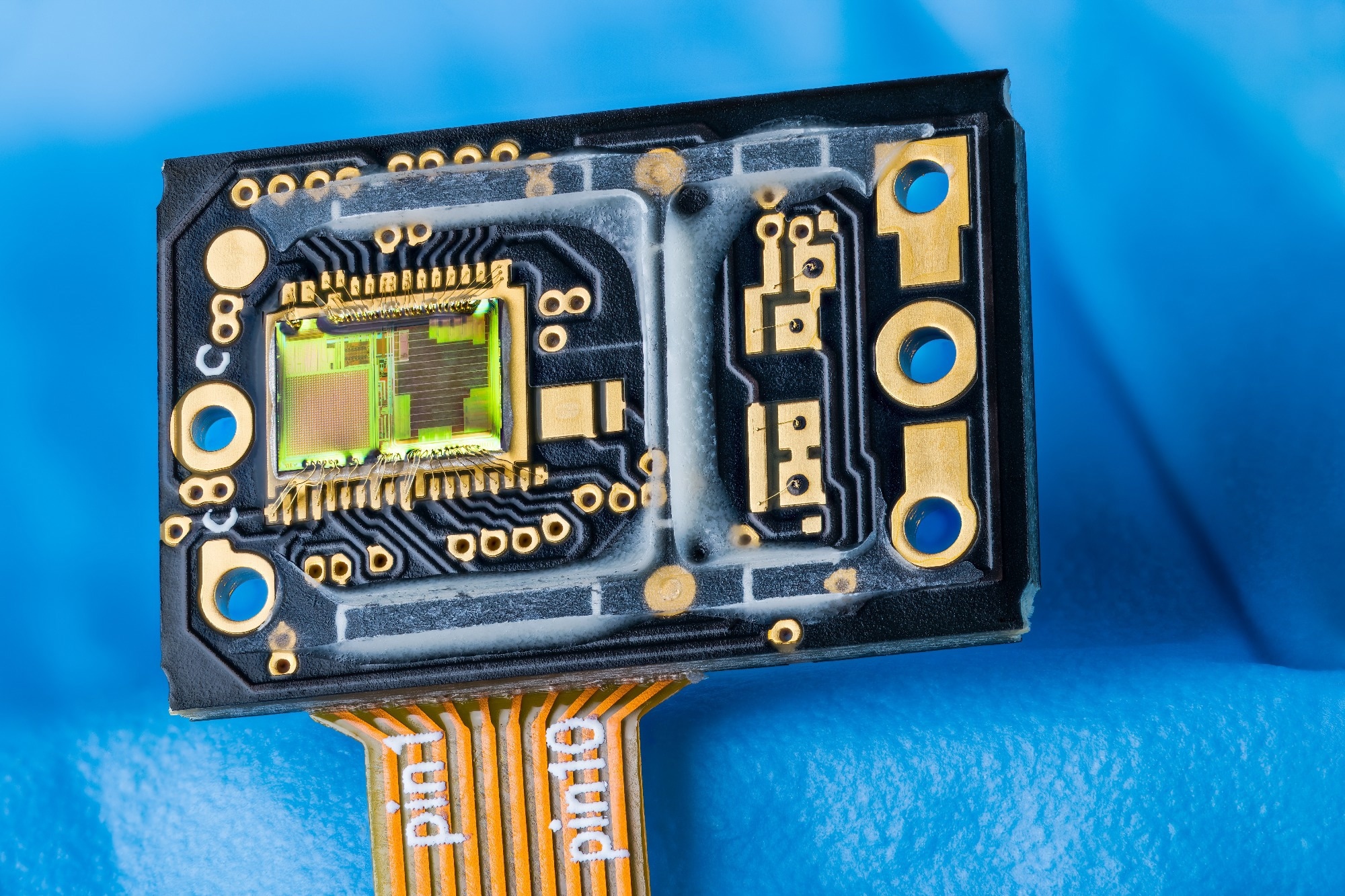 Study: Reconfigurable optoelectronic sensor with seven-order dynamic response time range for photodetection and neuromorphic visual perception within monolithic device. Image Credit: KPixMining/Shutterstock
A recent study published in npj Nanophotonics introduced a monolithic Germanium Selenide (GeSe) and Cesium Lead Bromide (CsPbBr3) heterojunction device that combines ultra-fast light detection with persistent memory retention in a single-chip architecture. By tuning its internal carrier dynamics through minor bias adjustments, the device achieves a temporal response range spanning seven orders of magnitude, enabling rapid light sensing and long-term information retention. This addresses existing limitations of intelligent automation.
Challenges of Traditional Silicon Photodetectors
Modern optical tracking systems, such as LiDAR (light detection and ranging), rely heavily on silicon photodiodes for high-speed photon detection. While these devices rapidly convert incident light into electrical signals, they cannot store visual information. As a result, advanced functions such as feature learning and visual memory require continuous data transfer between sensors and external memory units. This separation creates a von Neumann bottleneck, increasing energy consumption and limiting efficiency.
Although biomimetic optoelectronic synapses have been developed to provide native memory functionality, they often face challenges with long response times. Thus, achieving a single device capable of sensing and long-term information retention remains a challenge.
Fabrication of a Monolithic Heterojunction Sensor
Researchers developed a monolithic heterojunction sensor composed of layered Germanium Selenide and CsPbBr3 perovskite quantum dots. GeSe is an orthorhombic semiconductor with good structural anisotropy, providing intrinsic sensitivity to polarized light. Density functional theory calculations showed that natural selenium vacancies introduce shallow defect states that act as charge trapping centers under an applied electric field.
The device was fabricated by combining GeSe crystals produced through a dual-zone chemical vapor transport process with perovskite quantum dots synthesized via hot injection. The final structure consisted of an Indium Tin Oxide (ITO) substrate, an insulating layer, a GeSe flake, and a perovskite quantum dot film, forming a Type II heterojunction. Furthermore, structural properties were characterized using Raman spectroscopy and X-ray diffraction, while electrical performance was evaluated using a dual-channel source meter.
Performance Metrics of the Heterojunction Device
The experiments showed that the heterojunction device can operate in two modes controlled by low-voltage inputs. At zero bias, it functions as a self-powered photodetector, with carrier drift across the Schottky junction enabling rapid photoresponse. Under these conditions, the device exhibited a rise time of 23 microseconds and a fall time of 20 microseconds.
Saving this for later? Download a PDF here.
The photodetector demonstrated a broad spectral response ranging from 365 nm to 1050 nm. Under 400 nm illumination, it achieved a responsivity of 362.4 mA/W and a detectivity of 2.52 × 10¹³ Jones. Similarly, at 808 nm near-infrared illumination, the responsivity and detectivity were about 1.5 mA/W and 1.04 × 10¹¹ Jones, respectively. The anisotropic structure of GeSe results in the photocurrent depending on the polarization direction of the incident light, thereby producing a dichroic ratio of 2.58 under 808 nm illumination.
Applying a bias of 0.05 V effectively switches the device into a synaptic mode. In this state, selenium vacancies become ionized, and the Type II heterojunction retains photogenerated holes, resulting in persistent photoconductivity lasting over 500 seconds. By varying the duration, intensity, and repetition of light pulses, the device demonstrated a controllable transition from short-term to long-term plasticity, including paired-pulse facilitation behavior.
Implications for Intelligent Systems
The dual-mode functionality of this monolithic sensor makes it suitable for automated applications, particularly in autonomous driving. Operating at zero bias, the device serves as a high-speed optical receiver for pulsed LiDAR, leveraging its microsecond-scale response time. Tests indicated that, at a pulse repetition frequency of 2 kHz, the sensor achieved a tracking error of only 2.5 cm for objects moving at 50 m/s. Its polarization-sensitive response also enables the identification of hazards, such as standing water on road surfaces.
At a bias of 0.05 V, the device operates as a synaptic visual processor. In this mode, it retains information from previous light exposures and generates intensity gradients that encode motion history. This data can be utilized by a two-layer Long Short-Term Memory (LSTM) neural network to predict trajectories while reducing background noise.
Advancements in Edge AI Devices
In summary, this heterojunction device addresses the trade-off between high-speed photodetection and memory retention in optoelectronic systems. Through bias-controlled vacancy ionization, a single monolithic platform can seamlessly switch between rapid carrier transport and persistent charge storage without needing additional circuit components.
The device operates with an energy consumption of approximately 5.65 × 10⁻¹² J per synaptic flash event, supporting compact and efficient in-sensor computing. Its dual-mode functionality also presents opportunities for edge AI (artificial intelligence) systems, robotic perception, and imaging applications that require adaptation to dynamic environments.
Journal Reference
Li, M., & et al. (2026). Reconfigurable optoelectronic sensor with seven-order dynamic response time range for photodetection and neuromorphic visual perception within monolithic device. npj Nanophoton. 3, 33. DOI: 10.1038/s44310-026-00123-7, https://www.nature.com/articles/s44310-026-00123-7
Disclaimer: The views expressed here are those of the author expressed in their private capacity and do not necessarily represent the views of AZoM.com Limited T/A AZoNetwork the owner and operator of this website. This disclaimer forms part of the Terms and conditions of use of this website.