*Important notice: This news reports on an unedited version of an accepted paper and is awaiting final editing. Therefore, the paper should not be regarded as conclusive or treated as established information.
Evaluating the exact ripeness of durian without damaging the fruit has long been a challenge, as traditional methods such as manual tapping and visual inspection are subjective and often lead to inconsistent quality control and post-harvest losses. In a recent study published in the journal Scientific Reports, researchers developed a non-destructive multimodal sensor system powered by artificial intelligence (AI) to classify durian maturity.
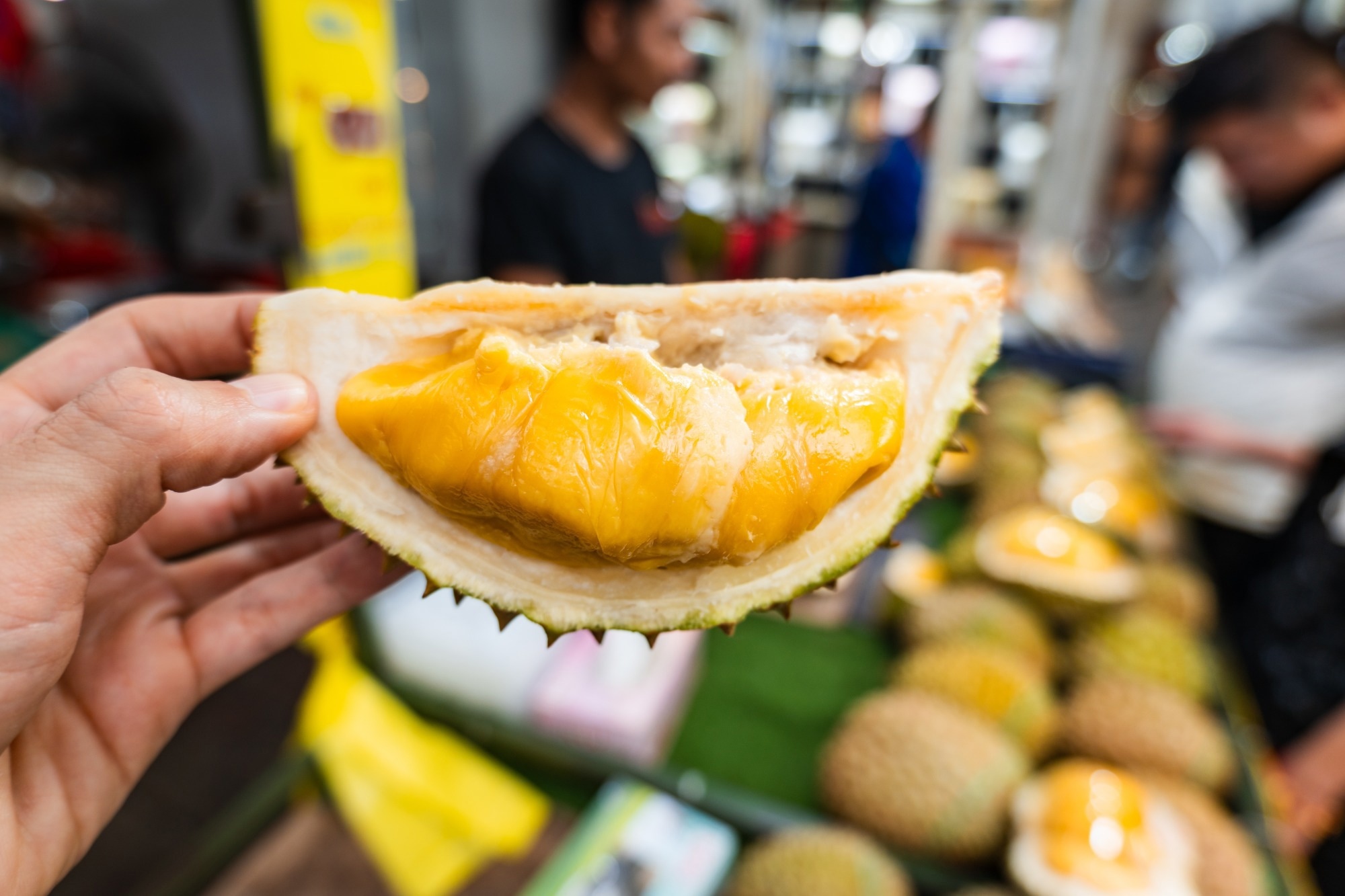 Study: A multimodal IoT sensor platform analyzes durian gas emissions, surface temperature, and tapping sounds to support automated, non-destructive ripeness assessment. Image Credit: Marius Karp/Shutterstock.com
By integrating gas detection, thermal imaging, and acoustic analysis within an Internet of Things (IoT) architecture, the system assesses fruit maturity in real time. Using a neural network, it achieved a classification accuracy of 96.91% with an area under the curve (AUC) of 0.98, providing a reliable alternative to destructive methods such as fruit cracking.
Traditional Limitations in Durian Quality Control
Determining the maturity of climacteric fruits like Durio zibethinus (durian) is challenging due to internal physiological changes beneath a thick, spiky pericarp. Traditionally, post-harvest quality assessments have relied on subjective methods, including visual inspection, manual tapping, and odor evaluation, which often result in inconsistent quality control.
Saving this for later? Download a free PDF copy now.
Agricultural automation addresses these limitations through non-destructive multimodal sensor systems that integrate gas sensors, thermal imaging, and acoustic transducers. These sensors measure volatile chemical emissions, surface temperature distributions, and internal mechanical properties associated with fruit ripening.
Custom Sensor Framework for Durian Evaluation
To evaluate durian maturity non-destructively, researchers developed a custom acrylic chamber controlled by an ESP32 microcontroller for real-time data acquisition and wireless cloud transmission.
The system integrated four gas sensors: an MQ-3 sensor for alcohol detection, a TGS2620 sensor for volatile organic compounds (VOCs), an MG-811 sensor for carbon dioxide, and an oxygen sensor for monitoring oxygen consumption.
An MLX90640 thermal camera captured infrared surface temperature maps, while a servo-driven tapping arm paired with an Analog Sound V2 sensor recorded acoustic responses.
The study evaluated 90 Monthong durians across three maturity stages, measured in days after anthesis: unripe (80–100 days), half-ripe (101–110 days), and ripe (>110 days). Each fruit was measured at five surface locations, generating a total of 450 observations under controlled conditions (25 °C and 60–70% relative humidity).
Destructive testing validated the maturity, showing that flesh firmness decreased from 12.44 N in unripe fruit to 5.47 N in ripe fruit and 8.95 N in half-ripe fruit. Soluble solids concentration increased from 3.84 °Brix to 6.61 and 9.64 °Brix, and alcohol content also rose from 0.80% to 2.27% and 4.43%.
Data was preprocessed using min-max normalization and used to train a multilayer perceptron neural network with three hidden layers, dropout, and early stopping. To avoid data leakage from measurements of the same fruit, researchers applied fruit-level grouped 10-fold cross-validation and compared the model with six machine learning algorithms.
Performance and Contributions of Sensor Modalities
The multilayer perceptron neural network outperformed the six other supervised machine learning models, correctly classifying 157 of 162 validation samples for an overall accuracy of 96.91%.
The unripe fruits were identified with perfect precision, recall, and F1-score (1.00). The half-ripe class achieved precision and recall values of 0.94 and 0.96, respectively, while the ripe class recorded precision and recall values of 0.96 and 0.94. Misclassifications occurred only between adjacent half-ripe and ripe stages.
Ablation analysis revealed that the gas and VOC sensor array was the primary contributor to classification performance, achieving 100% standalone accuracy. The thermal imaging module provided complementary information, reaching 99.41% accuracy.
In contrast, the acoustic sensor achieved only 52.94% accuracy, indicating that sound pressure levels alone cannot reliably detect internal structural changes without frequency-domain analysis.
Applications in Commercial Durian Processing
With further development and real-world validation, this integrated sensor framework has applications in commercial fruit packing, processing, and international distribution. By combining gas, thermal, and acoustic sensors with cloud-connected microcontrollers, processing facilities can automate maturity assessment and sort durians by physiological readiness before packaging.
Real-time quality monitoring enables logistics managers to optimize shipping schedules, cold-chain storage, and long-distance transport. Therefore, this framework could help fruit reach consumers at peak quality while reducing post-harvest losses. Miniaturizing the sensor into portable handheld devices would support field harvesting and quality inspection, potentially allowing agricultural workers to assess tree-bound or freshly harvested fruit without cutting open the thick husk.
Directions for Advanced Agricultural Sensing
This study demonstrates that combining gas, thermal, and acoustic sensors with a neural network provides a scalable approach for non-destructive durian maturity assessment. Future work should focus on expanding the dataset to include additional durian cultivars, validating performance under variable field conditions, and incorporating frequency-domain acoustic features to improve characterization of internal fruit structure.
Overall, scaling this multimodal sensor platform into commercial equipment could help standardize automated quality assurance across the tropical fruit industry.
Journal Reference
Brilliantina, A., et al. (2026). Development of non-destructive durian fruit maturity detection tool based on multi-variable sensor for harvest quality optimisation. Scientific Reports. https://www.nature.com/articles/s41598-026-61395-9
Disclaimer: The views expressed here are those of the author expressed in their private capacity and do not necessarily represent the views of AZoM.com Limited T/A AZoNetwork the owner and operator of this website. This disclaimer forms part of the Terms and conditions of use of this website.