Researchers have developed and validated a wearable inertial measurement unit (IMU) sensor that objectively measures gait quality in individuals with lower-limb amputation. Their study, published in Sensors, introduced a machine learning (ML) framework that analyzes real-time movement data to generate a continuous measure called the gait goodness score (GGS).
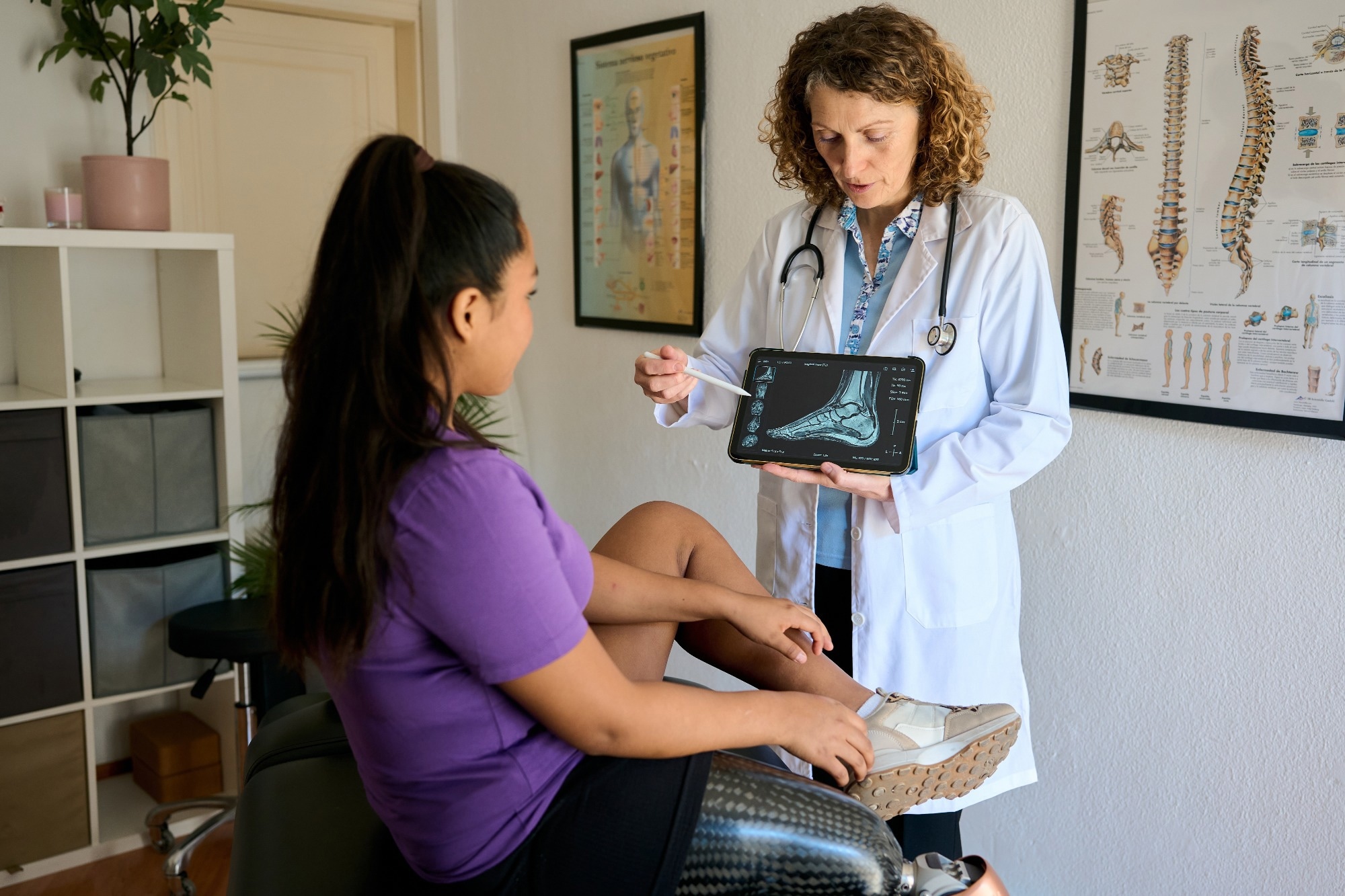 Study: Development and Prospective Validation of Wearable Sensor-Based Gait Metric for Individuals with Lower-Limb Amputation. Image Credit: alvarog1970/Shutterstock.com
Eighty-three participants provided valid sensor data for calculation of the GGS. The score was associated with established physical performance measures, supporting its potential as a portable complement to conventional gait assessment.
Challenges in Traditional Gait Assessment
Limb loss affects more than two million people in the United States, and the number of cases continues to rise because of vascular disease and traumatic injuries. After amputation, many individuals develop uneven walking patterns and movements that increase stress on their joints, raising the risk of osteoarthritis and chronic lower back pain.
Download a free PDF of this news article here!
Assessing prosthetic gait has traditionally relied on specialized motion analysis laboratories equipped with infrared cameras and force plates. While these systems provide accurate measurements, they are expensive and impractical for routine clinical use. Consequently, clinicians often depend on visual gait assessments and simple tests during outpatient visits.
Wearable IMUs, which combine tri-axial accelerometers and gyroscopes, offer a practical alternative. They record detailed movement data in laboratory settings, and with further development, could enable objective gait assessment during daily activities.
Technical Framework of the Wearable System
The wearable gait assessment system uses four IMU sensors positioned above and below both knees, including on the prosthetic limb. These sensors continuously recorded angular velocity and linear acceleration data, transmitting the measurements via Bluetooth Low Energy to an iPad running custom analysis software.
Instead of analyzing raw signals with deep learning, the system employed a feature-based ML approach. It identified heel-strike events and calculated key gait parameters, including single- and double-limb support times, step length, walking speed, gait cycle duration, and peak knee flexion.
These features were analyzed using four decision-tree ensembles to identify gait patterns: non-deviated gait, reduced prosthetic balance, reduced prosthetic toe loading, and reduced prosthetic knee flexion. The model combined these results into a GGS ranging from 0 to 1, where higher scores indicated better gait quality.
The model was trained using data from 71 individuals with unilateral lower-limb amputations and seven non-disabled controls, representing nearly 3000 stride pairs. Five licensed physical therapists provided reference labels based on video-recorded 10-meter walking tests.
The system was validated in an independent group of 120 participants across military and Veterans Affairs outpatient clinics, including the Walter Reed National Military Medical Center and the Miami VA Healthcare System, without retraining the ML model. Of these 120 participants, 83 provided valid instrumented walking data.
Validation Results and Clinical Insights
During the prospective validation phase, the wearable system produced an average GGS of approximately 0.50 during self-selected walking, providing sufficient variation to distinguish different levels of physical function. The sensor successfully differentiated participants across Medicare functional classification levels (K-levels), with those with higher ambulatory capabilities achieving higher gait scores.
Participants with transtibial amputations had a mean GGS of 0.50, higher than the 0.47 recorded for those with transfemoral amputations, reflecting the greater biomechanical challenges associated with above-knee limb loss. Additionally, researchers observed a modest decline in gait quality with advancing age.
The GGS showed strong correlation with established clinical measures. Higher scores correlated with faster walking speeds and better performance on the Amputee Mobility Predictor (AMP) test, while lower scores corresponded to longer Timed Up and Go (TUG) test times. The score also exhibited a moderate positive correlation with the Prosthetic Limb Users Survey of Mobility (PLUS-M).
The system demonstrated high reliability, with intraclass correlation coefficients of 0.85 or above for key spatiotemporal gait measures across repeated walking trials. It remained stable under moderate levels of sensor noise, with noticeable reductions in accuracy occurring only when interference exceeded normal operating conditions.
Implications for Clinical Practice and Rehabilitation
This wearable sensor system has significant implications for clinical physical therapy and prosthetic care. By converting complex multidimensional movement data into a single GGS with specific gait deviation indicators, it could be used to help clinicians quickly identify abnormal walking patterns during routine assessments.
Because the software runs efficiently on standard mobile devices without needing cloud computing, it provides real-time biomechanical feedback in clinical settings. This could help therapists evaluate whether adjustments to prosthetic alignment, socket fit, or knee damping improve gait symmetry, potentially supporting faster and more objective treatment decisions. Future longitudinal studies are required, however.
Future Directions for Continuous Monitoring
This novel wearable sensor system provides a practical solution for gait monitoring that, with future research, could be used beyond the clinic. If such home-based assessment during everyday activities is made possible, this could allow healthcare providers to track changes in mobility and gait quality.
Future work should focus on integrating these portable wearable sensors into closed-loop biofeedback systems. By converting real-time gait measurements into haptic or auditory feedback, smart prosthetic systems could alert users to developing gait asymmetries and encourage immediate corrections. This continuous monitoring could help reduce overuse injuries, support long-term rehabilitation, and optimize prosthetic alignment over time.
Journal Reference
Bennett, C., et al. (2026). Development and Prospective Validation of Wearable Sensor-Based Gait Metric for Individuals with Lower-Limb Amputation. Sensors. 26(14). https://www.mdpi.com/1424-8220/26/14/4613.
Disclaimer: The views expressed here are those of the author expressed in their private capacity and do not necessarily represent the views of AZoM.com Limited T/A AZoNetwork the owner and operator of this website. This disclaimer forms part of the Terms and conditions of use of this website.