A bio-hybrid system connecting three lab-grown human brain organoids, an optical tactile sensor, and a machine-learning classifier has recognized Braille characters with 83% accuracy. The system works by converting tactile signals into electrical pulses that stimulate the organoids, showing the potential of living neural tissue to process sensory information for bio-integrated computing and robotic touch systems. These findings were published in the journal Frontiers in Artificial Intelligence.
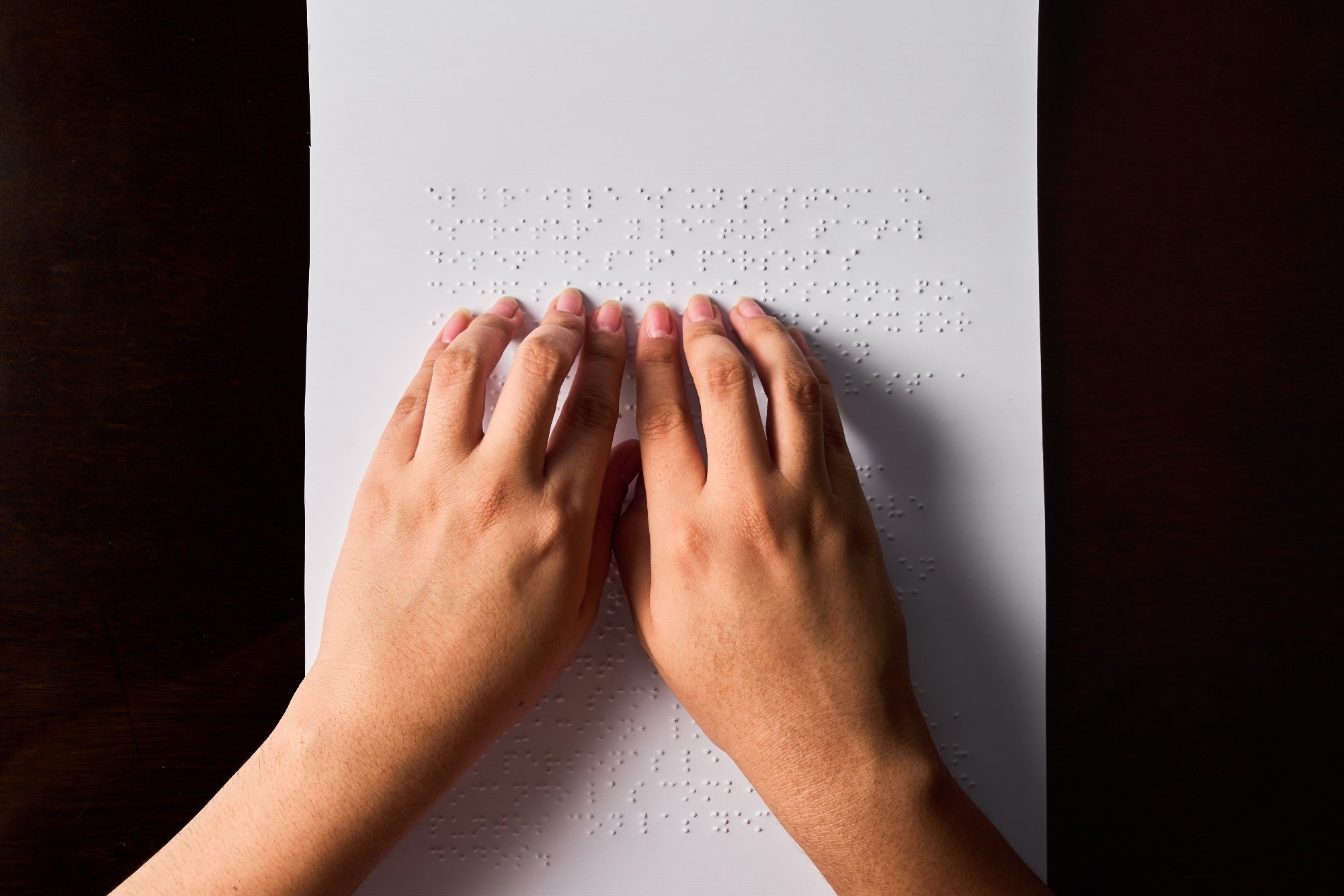 Study: Encoding tactile stimuli for Braille recognition with organoids. Image Credit: Fabian Montano Hernandez/Shutterstock.com
Advancements in Wetware Computing and Tactile Processing
Conventional robots typically use silicon-based artificial neural networks (ANNs), which can consume significant power. Neuromorphic chips can reduce energy consumption, but scaling them to mimic complex human cognition remains challenging. In contrast, the human brain performs sensory processing and motor coordination using approximately 20 watts of power.
Therefore, scientists continue to explore organoid intelligence, or wetware computing, as an alternative. Human pluripotent stem cells can develop into three-dimensional (3D) brain organoids containing neurons and synaptic networks. When connected to microelectrode arrays, these organoids produce spontaneous electrical activity and exhibit synaptic plasticity, making them suitable for real-time sensory signal processing.
Saving this for later? Download a free PDF here.
Designing a Tactile Sensing Interface
Researchers constructed a tactile sensing system using the Evetac optical tactile sensor, mounted on a four-axis Dobot MG400 robotic arm. This sensor includes an event camera, an LED (light-emitting diode) ring, and silicone gel embedded with a tracking grid.
As the sensor moves across a surface, the gel deforms, shifting the grid dots, which the camera records as address-event representation (AER) streams. These streams capture contact pressure, surface vibrations, and slipping at frequencies up to 498 Hz.
The system was comprehensively tested on a 3D-printed board containing all 26 letters of the English Braille alphabet. The robotic arm scanned the board at five contact depths, from 0 to 0.4 mm, producing 1300 tactile trials.
The sensor’s field of view was divided into eight regions. For each region, the study calculated four features, including total event count, event duration, peak activity timing, and the standard deviation of event counts. These features were then converted into electrical pulses, which were sent to human forebrain organoids via the FinalSpark Neuroplatform.
Each organoid was positioned across eight stainless-steel electrodes. The event count controlled the pulse train length (four to 10 pulses), contact duration set each phase to 50–300 µs, the trigger delay was determined by peak activity timing (0–4000 µs), and signal intensity set the phase amplitude to 4–20 µA. The organoids’ neural spikes were recorded over 500-millisecond windows.
Characterizing Neural Responses and Decoding Accuracy
Controlled electrical stimulation showed that forebrain organoids process input signals through nonlinear biological responses. Neural firing required a minimum phase amplitude of 4 µA; above this
threshold, spike counts increased with the number of pulses.
Activity mapping also demonstrated that four or more pulses produced compact, distinct activation clusters. These shifted the center of neural activity by about 20 µm, thereby indicating that different sensor locations triggered distinct patterns of neural activity.
A support vector machine (SVM) classified the 26 Braille characters using responses from individual organoids, achieving 57–67% accuracy, with an average of about 61%. Combining outputs from three organoids into a 24-dimensional feature vector increased accuracy to 83%.
In tests involving artificially corrupted classification data, the combined system handled noisy signals better than direct stimulation-based classification. With clean signals, direct stimulation achieved 82% accuracy, while the organoid ensemble maintained 83%. Under Gaussian noise, accuracy fell to 55% for direct stimulation, whereas the ensemble retained 83%.
For uniform noise, the respective accuracies were 67% and 82%. When data was missing, or outliers were introduced, the ensemble achieved 72% and 68% accuracy, respectively. These findings suggest that combining multiple organoids can enhance the system’s resilience to wrong sensory inputs.
Could Bio-Hybrid Sensors Improve Robotic Touch?
Combining living brain organoids with tactile skin sensors establishes a flexible approach for next-generation robotic touch. Future prosthetics could use this encoding framework to directly convert dynamic changes in grip slip, texture gradients, and temperature into neuro-compatible electrical stimulation patterns that biological neural networks can process.
Industrial robots and manipulators, automated sorting and gripping systems, and inspection drones could also benefit from this approach. Integrating event-based tactile sensing with biological computing may help these systems recognize objects effectively and maintain reliable grasping when sensor signals are disrupted, data is missing, or sensors become worn.
Implications for Scalable Bio-Hybrid Computing
In summary, this study demonstrates that microelectrode arrays can support tactile classification when sensory signals are encoded to match biological neural activity. Combining responses from three organoids preserved information useful for Braille classification and improved the system's tolerance to several forms of artificially introduced data corruption.
Future work should explore high-density electrode arrays and closed-loop systems in which organoid-generated spikes guide robotic grasping in real time. Combining tactile sensors with living neural networks could support adaptive, low-power bio-hybrid computing systems.
Journal Reference
Liu, T., Philamore, H., and Ward-Cherrier, B. (2026) Encoding tactile stimuli for Braille recognition with organoids. Frontiers in Artificial Intelligence. 9:1800219. DOI: 10.3389/frai.2026.1800219, https://www.frontiersin.org/journals/artificial-intelligence/articles/10.3389/frai.2026.1800219/full.
Disclaimer: The views expressed here are those of the author expressed in their private capacity and do not necessarily represent the views of AZoM.com Limited T/A AZoNetwork the owner and operator of this website. This disclaimer forms part of the Terms and conditions of use of this website.