Every year, billions of animals cross oceans, deserts, and mountain ranges on journeys that remain largely invisible to scientists. Ground-based radio trackers and older satellite tags provide scattered glimpses of these movements, mostly for species large enough to carry heavy transmitters. International Cooperation for Animal Research Using Space (ICARUS) closes that gap by tracking animals from space.
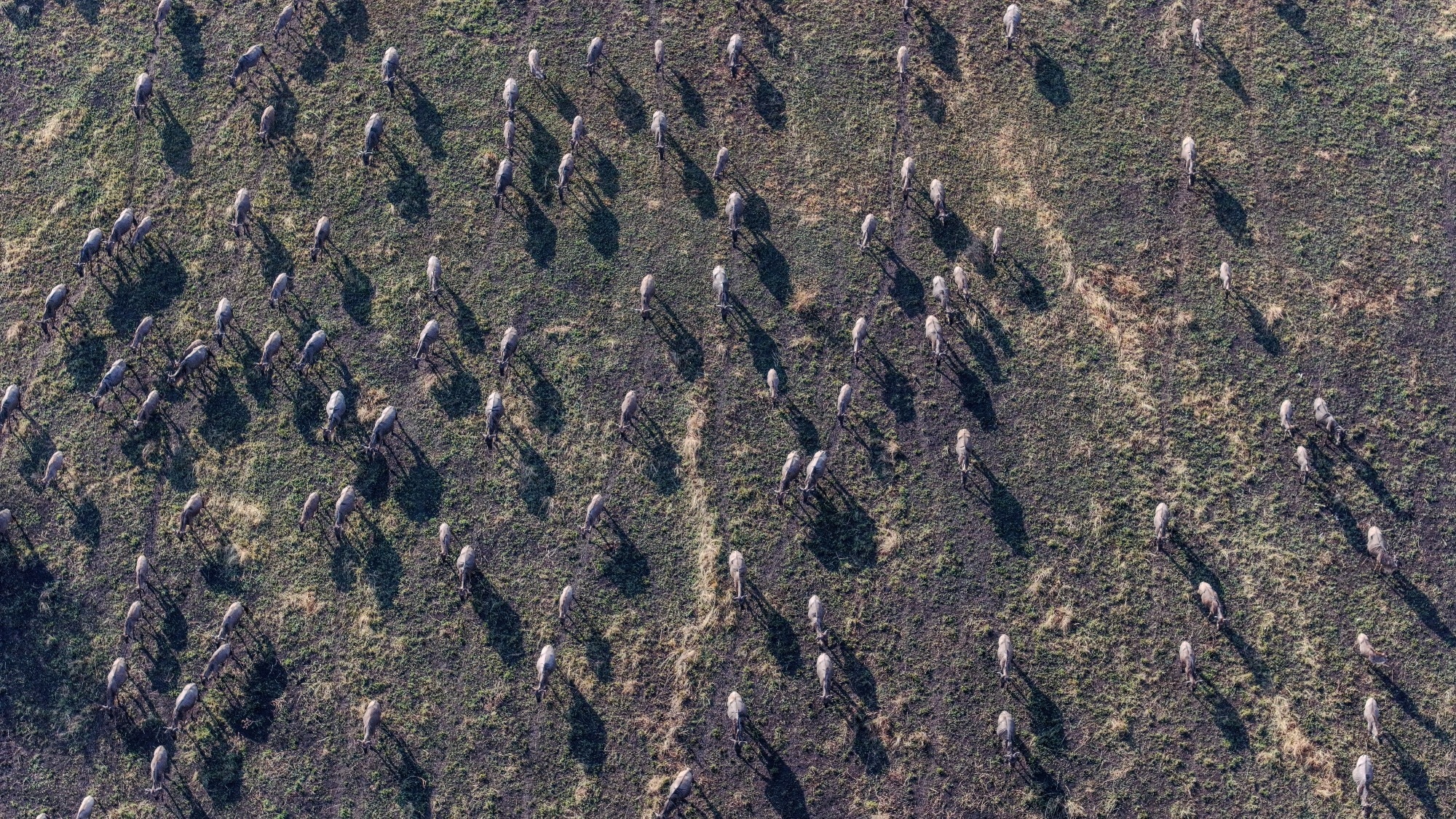 Image Credit: KTdrones/Shutterstock
Scientists have followed animal migration for over a century using leg bands, radio collars, and direct observation from small aircraft, methods that capture only fragments of a full route. Satellite tracking promised a fuller picture, but the equipment was too heavy, expensive, and power-consuming for the small animals that constitute most of the animal kingdom.1,2
A Vision Two Decades in the Making
Martin Wikelski, an ornithologist at the Max Planck Institute of Animal Behavior, first proposed the idea in 2002. He wanted tags light enough for songbirds and bats, cheap enough for researchers worldwide, and linked to a receiver orbiting far above the interference from mountains or the forest canopy. That receiver eventually reached the International Space Station in 2018.3
The project was funded primarily by the Max Planck Society, with the German and Russian space agencies contributing hardware and launch support during the earlier phase. Around €30 million had been invested by the time the antenna reached the space station. The figure illustrates the engineering required to build a workable small-animal tracking system from scratch.4
The German Aerospace Center and Roscosmos partnered with the Max Planck Society to install the antenna on the Russian segment of the station. Commissioning tests started in March 2020, and the pilot phase followed that September. Within 18 months, tags relayed data from mountain plovers, saiga antelope, and migrating cuckoos across 90 research sites worldwide.2
Turning Animals into Sensors
Each ICARUS tag carries a GPS receiver, an accelerometer, a magnetometer, and sensors for temperature, humidity, and air pressure. Solar cells keep the device charged, and its weight has dropped from around 4 g to 1 g, close to the weight of a paperclip. This miniaturization lets researchers tag species once too small or fragile to track.5
Onboard processing flags unusual movement before transmission, so a sudden drop in activity or an odd flight path reaches scientists as a flagged event rather than raw numbers. Wikelski describes this as animals reporting their own condition directly to researchers on the ground.2
Communication runs on a random-access wireless protocol designed for very low power and weak signals, since a tag attached to a bird's back cannot draw much current. This design allows thousands of tags to share limited satellite contact time without needing prior coordination. It draws more from consumer wireless networks than from traditional wildlife telemetry systems.5
A Setback in Orbit
The original antenna's early success ended abruptly in March 2022. Data had flowed from the space station through a ground station in Russia, and when the German and Russian space agencies suspended their partnership following the invasion of Ukraine, that pathway closed. Researchers watched 18 months of steady progress stop within days.4
Rather than abandon the project, engineers redesigned the hardware entirely, replacing the shared station antenna with a lighter, shoebox-sized payload built for its own satellite. The Bulgarian manufacturer EnduroSat assembled the new unit, and the first redesigned satellite reached orbit in November of last year, followed months later by a second craft carrying only ICARUS instruments.1
From the Space Station to Dedicated Satellites
The newest satellite launched aboard a SpaceX Falcon 9 from Vandenberg Space Force Base, carrying ICARUS instruments into low Earth orbit. Unlike the shared antenna on the space station, this satellite dedicates its full capacity to wildlife data, giving engineers more control over signal timing and coverage.1
Saving this for later? Download a PDF here.
During each overhead pass, a receiver has only a brief window, measured in seconds, to reach any given tag before moving out of range. Engineers work around this limit with short data bursts and command updates, while the tag's onboard memory stores fresh readings until the next contact arrives.2
Further satellites are planned, with the team aiming for a small constellation within the next few years. Each addition shortens the wait between passes over a tagged animal, moving the network closer to near-real-time monitoring. Tag prices have also fallen from approximately $300 to $200, easing the path to wider deployment.3
What Thousands of Tagged Animals Can Reveal
Around 3000 tags are ready for deployment, with 3000 more already ordered, building toward a goal of monitoring 100,000 animals at once. Sudden stillness among a group of vultures can signal a poisoned carcass left by poachers, while pigs that stop moving their ears may show early signs of swine fever.1
Beyond these alerts, tagged animals function as roaming environmental sensors. Their movements register temperature shifts, storm patterns, and habitat changes at a resolution fixed weather stations cannot match. Researchers argue this data could sharpen climate forecasts and reveal how species adjust their ranges as local conditions change.3,6
Seed-dispersing birds, migratory fish, and forest mammals also carry information about ecosystem health simply through the paths they choose. Tracking these routes over several years can show which corridors remain viable for migration and which have been cut off by development, informing conservation decisions with evidence drawn directly from the animals themselves.2
Progressing Toward an Internet of Animals
Wikelski and his colleagues describe their long-term goal as an internet of animals, a living network in which tagged wildlife continuously reports on the planet's condition. If the satellite constellation reaches its planned size, researchers could compare movement data across continents, as meteorologists already compare readings from weather stations worldwide. However, dependable satellite coverage and steady funding remain open questions, even as the redesigned hardware performs well in its early months in orbit.4,5
Two decades after the idea began as a proposal from a small research team, Project ICARUS now has working satellites, shrinking tags, and a growing list of scientific partners. Hurdles remain, and yet the project's progress marks a genuine shift in how researchers observe wildlife, and through that wildlife, the planet they share with us.3
References and Further Reading
- Sarah Gibbens. (2026). How to spy on animals - from low-Earth orbit. Nat Geo Science. https://www.nationalgeographic.com/science/article/project-icarus-new-satellite-animal-tagging.
- Belyaev, M. Y. et al. (2023). Animal Migration Studies with the Use of ICARUS Scientific Equipment in the URAGAN Space Experiment aboard the Russian Segment of the ISS. Gyroscopy and Navigation, 13(3), 129. DOI:10.1134/S2075108722030026. https://link.springer.com/article/10.1134/S2075108722030026.
- Elizabeth Pennisi. (2025). Game changer’: System to track small animals from space takes flight - again. Science. DOI:10.1126/science.zw87ucw. https://www.science.org/content/article/game-changer-system-track-small-animals-space-takes-flight-again.
- Elizabeth Pennisi. (2022). War halts project to track wildlife from space. Science. DOI:10.1126/science.abq1948. https://www.science.org/content/article/war-halts-project-track-wildlife-space.
- Krondorf, M. et al. (2022). ICARUS - Very Low Power Satellite-Based IoT. Sensors, 22(17). DOI:10.3390/s22176329. https://www.mdpi.com/1424-8220/22/17/6329.
- Jetz, W. et al. (2022). Biological Earth observation with animal sensors. Trends in Ecology & Evolution, 37(4), 293-298. DOI:10.1016/j.tree.2021.11.011. https://www.sciencedirect.com/science/article/pii/S0169534721003165.
Disclaimer: The views expressed here are those of the author expressed in their private capacity and do not necessarily represent the views of AZoM.com Limited T/A AZoNetwork the owner and operator of this website. This disclaimer forms part of the Terms and conditions of use of this website.