In recent years, crochet-based sensors have advanced from craft workshops to sensor laboratories. This appeal stems from the unique geometry of crocheted fabric, made of interconnected loops. When conductive thread runs through these loops, the contact points can conduct electricity, transforming traditional stitch patterns into functional sensing elements.
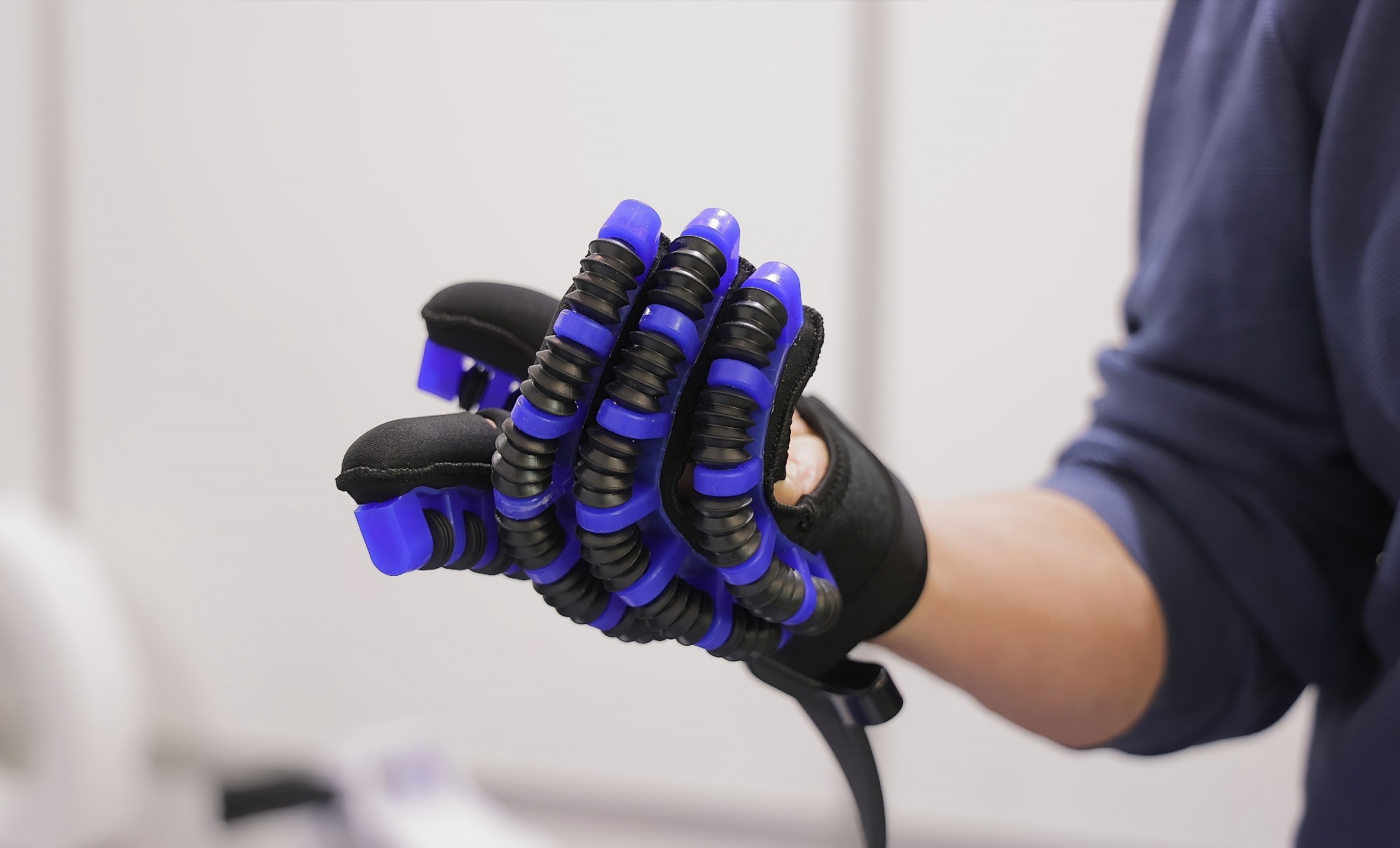 Image Credit: Ira.foto.2024/Shutterstock
Unlike knitting, crochet uses a distinctive double linkage: the working loop passes through both the previous row's stitch and the current row's stitch. That double linkage produces anisotropic fabrics whose stiffness depends on direction, giving designers a wider catalog of producible structures than knitting offers.1
How Soft Textile Structures Turn Motion into Signal
The sensing mechanism in soft textile structures depends on contact resistance. Conductive loops press against one another at heads, legs, and feet. Stretching the fabric separates those contacts and lengthens the electrical path, so measured resistance climbs. Relaxing the fabric restores the contacts and lowers resistance. Motion produces a voltage reading without a rigid component in contact with the skin.2
The direction of integration also matters for signal output. A weft-knitted sensor placed along the course direction responded only below roughly 10% strain and reached a gauge factor of 0.04, while wale-wise placement produced gauge factors between 1.65 and 2.48 and tracked strain up to 50%. Loop count across the width shifted base resistance from 14.69 to 1.61 Ω/cm.2
Loop size and yarn selection are equally important factors. Silver-coated polyamide yarns yield cleaner responses than stainless steel blends, which tend to produce noisy signals and poor reproducibility. Plating a conductive yarn with an elastic-covered yarn compresses the loops when at rest, increases the contact area, and raises sensitivity. These design choices are made during fabrication and cannot be modified later.2
Recent comparisons indicate that crochet is superior for creating strain sensors. Researchers building sensors for soft rehabilitation robots fabricated four low-cost designs using either crocheting or weaving, then measured working range, linearity, hysteresis, sensitivity, and repeatability. Among these, a fully crocheted sensor that combined elastic thread with silver-plated conductive thread achieved the highest performance.3
The numerical data support this ranking. The crocheted design achieved a working range of 49.76%, with a hysteresis of 20.12±19 and a coefficient of determination of 0.7741±0.03 for linearity, demonstrating high repeatability. A working range near half the original length matters for a device that follows elbow or knee flexion, since joints stretch the fabric covering them.3
Durability Under Repeated Wear
Wearable sensors fail through abrasion long before they fail through electronics. A recent Scientific Reports study fabricated 10 crochet elastic band designs on an industrial machine with 9 needles/cm. They integrated silver-coated polyamide yarns at different structural positions and measured dynamic resistance on a breathing simulator that reproduced respiratory motion. Samples were then subjected to controlled abrasion at 0, 5,000, and 10,000 cycles.4
The placement of the conductive yarn was a key factor in the results. Increased abrasion reduced tensile strength and elongation across all samples, as pilling altered surface morphology and stitch regularity. Configurations with balanced warp and weft integration of conductive yarn maintained nearly constant resistance across all abrasion levels, whereas other layouts degraded or failed later. Statistical analysis confirmed the effects of both configuration and cycle count to be below the 0.05 threshold.4
Moisture also poses a separate hazard for silver-based conductors. Spraying a salt solution reduced the baseline resistance of knitted stretch sensors because chloride ions carried electrons and reacted with silver ions to form silver chloride. Energy-dispersive spectroscopy showed the silver content decreased from 27.5% to 1.4% by weight after salt-fog exposure. Sweat, therefore, sets a chemical limit that stitch design alone will not solve.5
Touch Sensing and Fast Prototyping
Strain measurement is also a crucial branch of the field. Another work featured in IEEE Haptics used a surface crochet technique to thread stainless-steel conductive yarn through crocheted acrylic, bamboo, and faux-fur substrates, forming capacitive electrodes read by a 12-electrode touch module. Touch changes electrode capacitance, and a dual-threshold filter converts that shift into a binary state.6
The performance was consistent across all three yarns. Every sensor detected touch with 100% accuracy at loads of 0.25, 0.5, 1.0, and 2.0 N across 50 cycles per force level, and release detection reached at least 98%. The mean signal-to-noise ratios ranged from 9.46 to 9.74 dB. However, participants did report that the added conductive thread made the fabric feel rougher and less pleasant.6
Saving this for later? Download a PDF here.
Reversibility gives the crocheted approach a practical edge during design work. An experienced crocheter installed an 8 X 10 cm sensor in 10 minutes and pulled it out within 30 seconds, since a single continuous thread length can be withdrawn from its free end. Three different electrode geometries were obtained from a single swatch and a 20 cm thread.6
Moving From Bench Tests to Bodies
Bench data must eventually withstand human trials. One knitted stretch sensor was mounted on a stretchable ribbon belt with two microcontroller boards, wireless transmission, and a 75 Hz sampling rate, then tested on fifteen adults breathing at guided rates. Breathing-time measurements fit a linear model with a coefficient of determination of 0.87 across slow and normal protocols. None matched the fastest target rate.5
A second target lies in neurorehabilitation. Functional electrical stimulation helps people with weak foot dorsiflexion due to multiple sclerosis or stroke, and it requires a live knee angle to fire impulses during the correct gait phase. Measurements above the kneecap showed 130 ° of flexion, stretching the fabric by 50%, which sets the range a garment sensor must cover.2
The Production Bottleneck
Manufacturing remains the sharpest constraint on crochet-based sensors. No established machinery produces true crocheted textiles, and equipment sold under the crochet label operates as warp knitting, chaining yarn with weft inlays. A genuine crochet machine was patented in 2019, but it has not yet reached industrial use, leaving handwork that consumed more than 45 minutes per test specimen in one composite study.1
Handwork also introduces dimensional scatter and variable mechanical properties, which block acceptance as a technical textile where repeatability governs qualification. The recent elastic-band work sidestepped that problem by switching to an industrial crochet knitting machine, a signal that some structures already suit factory output.4
What Comes Next?
Two active research directions are currently being explored. The first focuses on calibration and drift, since baseline resistance in loop-based sensors shifts across cycles as the fabric recovers slowly, with gauge factors falling after 1,000 stretch cycles in knitted samples.5
The second direction concerns tactile quality. Conductive filaments alter how a garment feels. Alternative conductive yarns that preserve softness while maintaining electrical performance would widen adoption in rehabilitation robots, assistive devices, and everyday clothing.6
References and Further Reading
- Storck, J. L. et al. (2023). Principle capabilities of crocheted fabrics for composite materials. Journal of Engineered Fibers and Fabrics. DOI:10.1177/15589250231203381. https://journals.sagepub.com/doi/10.1177/15589250231203381
- Fischer, S. et al. (2024). Novel Weft-Knitted Strain Sensors for Motion Capture. Micromachines, 15(2). DOI:10.3390/mi15020222. https://www.mdpi.com/2072-666X/15/2/222
- Newkirk, M. et al. (2025). Fabrication and Evaluation of Woven and Crocheted Strain Sensors for Soft Rehabilitation Robots. 2025 International Conference On Rehabilitation Robotics (ICORR), Chicago. DOI:10.1109/ICORR66766.2025.11062948. https://ieeexplore.ieee.org/document/11062948
- Mustafa, E. et al. (2026). Electrical and mechanical properties of conductive elastic bands as wearable sensors. Scientific Reports, 16(1), 17335. DOI:10.1038/s41598-026-54874-6. https://www.nature.com/articles/s41598-026-54874-6
- Cay, G. et al. (2022). Textile Knitted Stretch Sensors for Wearable Health Monitoring: Design and Performance Evaluation. Biosensors, 13(1). DOI:10.3390/bios13010034. https://www.mdpi.com/2079-6374/13/1/34
- Castro, S. et al. (2026). Crocheted Capacitive Touch Sensors for Rapid Prototyping of Soft Interfaces. IEEE Haptics Symposium: [Proceedings]. IEEE Haptics Symposium. DOI:10.1109/HAPTICS66823.2026.11495498. https://ieeexplore.ieee.org/document/11495498
Disclaimer: The views expressed here are those of the author expressed in their private capacity and do not necessarily represent the views of AZoM.com Limited T/A AZoNetwork the owner and operator of this website. This disclaimer forms part of the Terms and conditions of use of this website.