The Price of Constant Data
How Microneedles Reach Glucose?
Paper as a Sensing Platform
The Problem with Sweat
Hybrid Designs Combine Strengths
Current Technical and Clinical Gaps
Conclusion
References and Further Reading
Continuous glucose monitoring (CGM) has changed daily life for many people with diabetes. A small sensor worn on the body measures glucose levels every few minutes and sends the data to a phone, replacing most finger-prick tests. But the high cost of these systems makes them unaffordable for many around the world, and that gap has driven the search for cheaper materials and simpler designs.
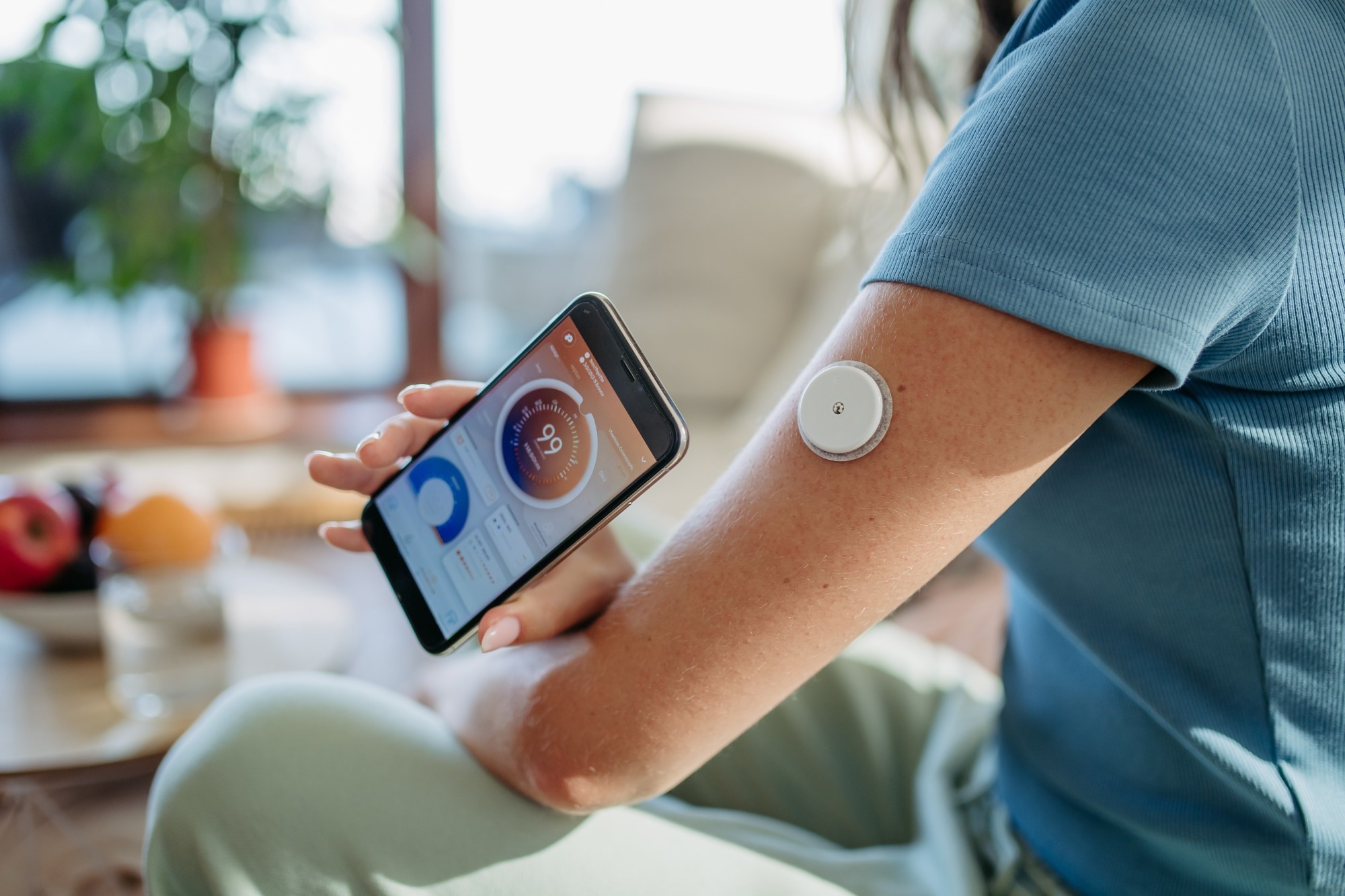 Image Credit: Halfpoint/Shutterstock
The article discusses microneedle patches and paper-based sensors as alternatives for glucose monitoring, addressing cost barriers, challenges in measuring glucose in sweat, and novel design approaches.
The Price of Constant Data
Commercial continuous glucose monitoring (CGM) systems use a sensor that sits under the skin for a short period and must be replaced by the user. This cycle turns the device into a recurring expense. For households with limited incomes, the cost of new sensors is much higher than the one-time cost of a reader. This added financial burden explains why cheap, disposable alternatives attract so much research attention.1
A BMJ Public Health survey conducted across Fiji, Indonesia, Kyrgyzstan, Mali, Peru, and Vietnam found no CGM devices in any sampled public clinic or private pharmacy. Here, the sensors were available only online, for US$88–US$107 per sensor. In Vietnam, a month’s supply of sensors costs the lowest-paid government worker 65 days of wages, far above the benchmark of one day's wage for a monthly supply.1
How Microneedles Reach Glucose?
Microneedles are tiny projections, ranging from a few hundred micrometers to one millimeter in length, arranged in arrays on a small patch. They penetrate the outer layer of the skin and stop in the dermis, making them minimally invasive and largely painless. In this layer, they sample interstitial fluid, the watery fluid surrounding skin cells. Glucose can easily pass from capillaries into this fluid, so its concentration closely matches that of blood plasma.2,3
However, there is a slight delay in this process. Glucose takes about 5 to 10 minutes to move from blood into surrounding tissue, and a protective sensor membrane adds another 1 to 5 minutes. Early results in human trials are promising. A coin-sized microneedle wearable tracked meal-driven glucose swings for more than 6 hours, and its readings differed from finger-prick values by an average of only 8.83% in pilot studies.2
Paper brings a different set of advantages. It is cheap, flexible, biocompatible, and biodegradable. Moreover, its cellulose fibers can move liquid by capillary action, eliminating the need for a pump. Researchers print wax patterns onto paper to guide fluid into separate reaction zones for each test. A paper-based test developed for a different disease shows how low the price can fall, with a reported cost below US$0.50 per test.4,5
Most paper glucose sensors use the enzyme glucose oxidase, which produces hydrogen peroxide that can trigger a color change or an electrical current. In a colorimetric design, the naked eye could separate normal from high glucose within 30 seconds. For more precise results, a team folded wax-printed paper into 5 layers that collected sweat. This design collects sweat, guides it over a printed electrode, and evaporates it to keep the fresh fluid moving.4,5
The Problem with Sweat
Wearable paper sensors primarily measure glucose levels in sweat, a challenging sample matrix. Sweat glucose concentrations typically range from 6 to 300 μM, while blood glucose levels are around 3.6 to 6 mM, a dilution of around 100-fold. Therefore, these sensors require exceptional sensitivity to detect glucose accurately.6
Saving this for later? Download a PDF here.
Furthermore, sweat glucose levels can fluctuate due to factors such as sweat rate, skin temperature, pH, and contamination from residual sweat on the skin. These variables contribute to an inconsistent relationship between sweat and blood glucose levels, leading reviewers to question the reliability of these measurements.6
Exercise is a common method for producing sweat for testing; however, it is often deemed unsuitable for older adults and individuals with pre-existing medical conditions. Additionally, resting sweat flows at sub-nanoliter rates, leaving very little fluid to analyze, and there is currently no standardized method to adjust readings for varying sweat rates.6
Hybrid Designs Combine Strengths
Some of the most interesting prototypes merge the two approaches into a single patch. In a recent design published in Biomaterials Science, grooved polymer microneedles draw fluid onto a paper glucose strip, which changes color about 2 minutes after the patch enters the skin. Polymer needles also suit low-cost production, since porous polymer structures are simpler and cheaper to micromachine than ceramic or metal ones.3
Paper also pairs well with gentler sweat collection. A wearable platform described in Advanced Science used an osmotic hydrogel to extract sweat from inactive skin, a paper channel to transport it, and a self-powered enzymatic sensor to measure it without external power. In tests conducted on the fingertip and forearm, the estimated blood glucose levels differed from the reference values by 10.56% and 13.17%, respectively, with every reading falling within clinically acceptable ranges.7
Current Technical and Clinical Gaps
Microneedle and paper-based CGM sensors face several technical barriers to clinical adoption. Enzymes lose activity over time and react to heat, humidity, and pH, and biological material can contaminate sensor surfaces. Laboratory and animal tests show that microneedle sensor lifetimes range from a few hours to about 20 days. Sweat readings from the fingertip are also delayed, showing blood glucose levels 20 to 40 minutes after the actual values, which makes it difficult to catch dangerous drops quickly.3,7
Furthermore, there is a significant lack of clinical evidence. Few microneedle devices have passed rigorous human trials, and experts call for systematic comparisons against laboratory reference analyzers such as the YSI 2000 series. Historical examples provide a warning for developers. The GlucoWatch, the first FDA-approved noninvasive glucose monitor, was removed from the market because users experienced skin irritation and had to wait 2 to 3 hours for it to warm up. It also required regular calibration with standard blood glucose test strips.2,3
Conclusion
Microneedle patches and paper-based sensors approach the CGM cost problem from two directions. Microneedles reach the interstitial fluid, which tracks blood glucose closely after a delay of several minutes. On the other hand, paper offers pump-free fluid handling, simple chemistry, very low material costs, and easy disposal, although sweat remains a weak and variable signal. Hybrid designs combining these strengths have produced the strongest early accuracy results so far.3
Currently, both methods need to improve in terms of longer wear times, more stable chemistry, and large-scale clinical trials that compare their effectiveness against established laboratory standards. Therefore, the answer to the question is somewhat qualified: these sensors present a viable, lower-cost alternative to traditional CGM systems. They have the potential to reach patients in low- and middle-income countries, provided trial data demonstrate they are as reliable as the more expensive options.1
References and Further Reading
- Ewen, M. et al. (2025). Availability, prices and affordability of self-monitoring blood glucose devices: Surveys in six low-income and middle-income countries. BMJ Public Health, 3(1), e001128. DOI:10.1136/bmjph-2024-001128. https://bmjpublichealth.bmj.com/content/3/1/e001128
- Wu, Z. et al. (2024). Interstitial fluid-based wearable biosensors for minimally invasive healthcare and biomedical applications. Communications Materials, 5(1), 33. DOI:10.1038/s43246-024-00468-6. https://www.nature.com/articles/s43246-024-00468-6
- Wang, Y. et al. (2023). Microneedle-based glucose monitoring: a review from sampling methods to wearable biosensors. Biomater. Sci., 11 (17): 5727–5757. DOI:10.1039/d3bm00409k. https://pubs.rsc.org/bm/article/11/17/5727/796333/Microneedle-based-glucose-monitoring-a-review-from
- Shariati Pour, S. R. et al. (2024). Microfluidic-Based Non-Invasive Wearable Biosensors for Real-Time Monitoring of Sweat Biomarkers. Biosensors, 14(1), 29. DOI:10.3390/bios14010029. https://www.mdpi.com/2079-6374/14/1/29
- Anuj Kumar & Pralay Maiti. (2024). Paper-based sustainable biosensors. Mater. Adv., 5 (9): 3563–3586. DOI:10.1039/d3ma01019h. https://pubs.rsc.org/ma/article/5/9/3563/812730/Paper-based-sustainable-biosensors
- Veronica, A. et al. (2023). Yanan Li, Yue Li, I-Ming Hsing, Hnin Yin Yin Nyein; Dermal-fluid-enabled detection platforms for non-invasive ambulatory monitoring. Sens. Diagn., 2 (6): 1335–1359. DOI:10.1039/d3sd00165b. https://pubs.rsc.org/sd/article/2/6/1335/828408/Dermal-fluid-enabled-detection-platforms-for-non
- Saha, T. et al. (2024). A Passive Perspiration Inspired Wearable Platform for Continuous Glucose Monitoring. Advanced Science, 11(41), 2405518. DOI:10.1002/advs.202405518. https://advanced.onlinelibrary.wiley.com/doi/10.1002/advs.202405518
Disclaimer: The views expressed here are those of the author expressed in their private capacity and do not necessarily represent the views of AZoM.com Limited T/A AZoNetwork the owner and operator of this website. This disclaimer forms part of the Terms and conditions of use of this website.