Fundamentals of Biosensor Operation
Heavy Metals Show the Clearest Progress
Pesticides Challenge Enzyme-Based Sensing
PFAS Remain the Hardest Target
Closing the Gap Between Laboratory and Field
Conclusion
References and Further Reading
Traditional methods of environmental monitoring still follow an established protocol. For example, water samples from rivers or wells are manually collected and sent to laboratories for analysis. This process can take several days, leaving a gap during which contamination events, such as industrial spills or agricultural runoff, may go undetected.
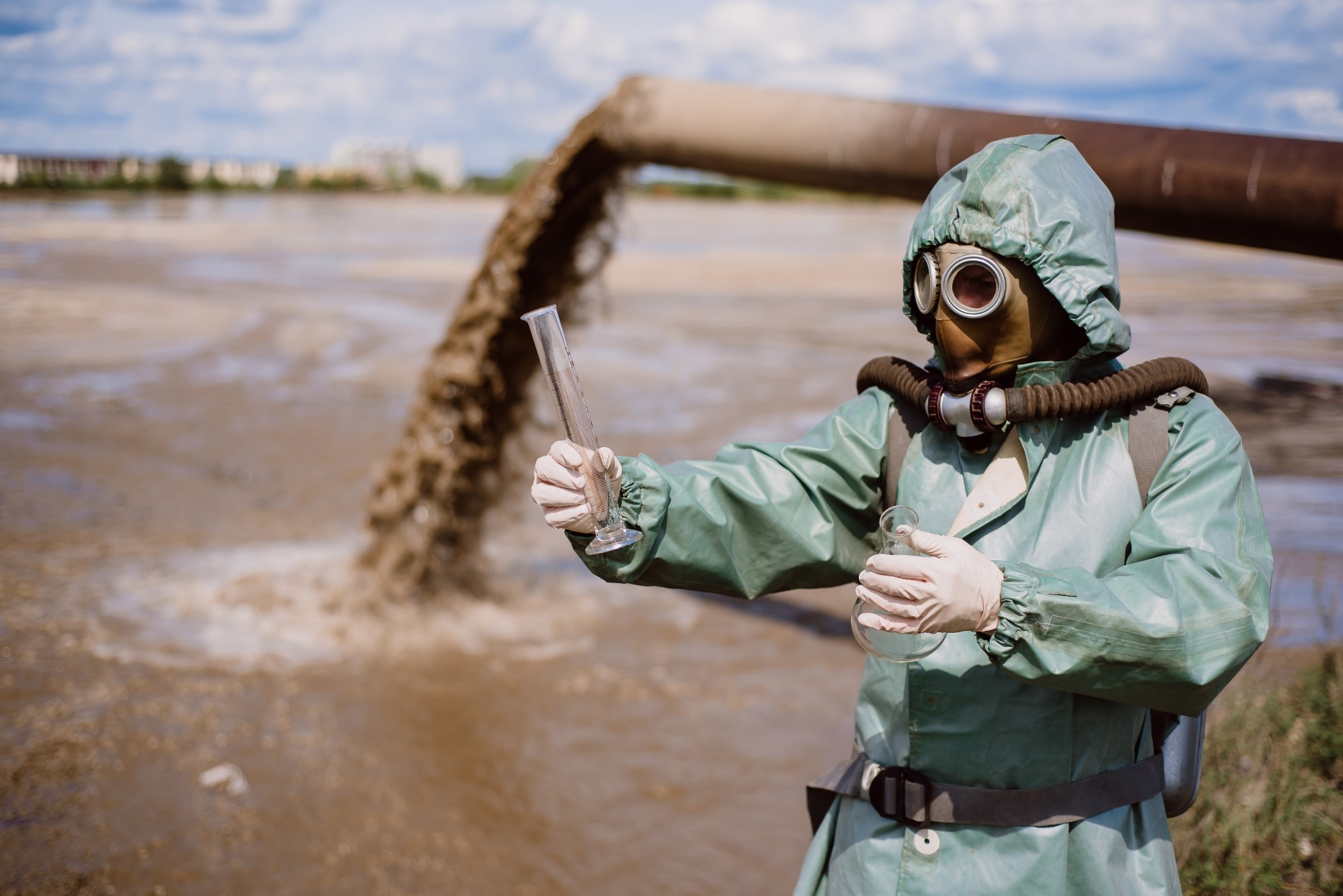 Image Credit: Reshetnikov_art/Shutterstock
To address these challenges, biosensors have emerged as a viable alternative. These devices pair a biological recognition element, like an enzyme or deoxyribonucleic acid (DNA), with a transducer to convert interactions with pollutants into electrical or optical signals. Experts view biosensors as cost-effective and suitable for on-site use. This article examines whether biosensors can detect pollution in real time, explains their function, and compares results for heavy metals, pesticides, and per- and polyfluoroalkyl substances (PFAS).1,2
Fundamentals of Biosensor Operation
Every biosensor is based on the principle of selective binding. The recognition layer is designed to interact with a specific target or a closely related group of targets, and that interaction produces a measurable change. In electrochemical designs, this binding modifies the current or the resistance at the electrode surface. Meanwhile, in optical designs, it influences color, fluorescence, or the propagation of light along a fiber. Researchers usually attach these layers to nanomaterials, thereby providing large surface areas and amplifying weak signals.3
Real-time detection introduces additional challenges to this simple design. A sensor that works once in a clean laboratory beaker must keep working for weeks in turbid, salty, or biologically active water. It also needs a fast response, stable calibration, and a way to transmit results without a technician present. These requirements explain why progress differs so sharply from one pollutant to another, as the following examples show.2
Heavy metals, including mercury, lead, and cadmium, are introduced into aquatic systems through mining, electroplating, and industrial discharge, leading to bioaccumulation in living organisms. Laboratories measure them with atomic absorption spectrometry or inductively coupled plasma mass spectrometry (ICPMS). Both methods are accurate but require sample pretreatment, expensive instrumentation, and skilled personnel. This complexity results in infrequent monitoring, creating significant gaps in environmental data.3
Biosensors for metals benefit from a useful feature of DNA chemistry. For instance, mercury ions can form a stable thymine-mercury-thymine bridge, while lead ions fold guanine-rich strands into compact four-stranded structures. Engineers exploit these shape changes directly to generate a signal. One hairpin DNA probe on a screen-printed gold electrode detected mercury at 0.11 pM and performed well in tap water and groundwater samples.3
The field readiness of metal biosensors is also improving. A lead aptasensor based on porous carbon achieved a detection limit of near 0.1 μg/L in water and soil. Furthermore, innovative smartphone-readable paper strips have successfully quantified mercury at 25 nM without the use of any laboratory instrument. However, challenges such as cumbersome fabrication processes, poor reproducibility, and limited stability continue to hinder widespread deployment.3
Pesticides Challenge Enzyme-Based Sensing
Organophosphate and carbamate pesticides work by inhibiting acetylcholinesterase, an enzyme that regulates nerve signaling in both insects and humans. Biosensors use this toxic mechanism as a measurement tool. When acetylcholinesterase sits on an electrode, pesticide exposure suppresses its activity, and the electrical signal drops in proportion. A sensor reported in Reviews in Agricultural Science detected the insecticide malathion at 2.6 pg/mL in controlled laboratory tests.4
Saving this for later? Download a PDF here.
The same mechanism creates a selectivity problem. Many compounds inhibit acetylcholinesterase, so a falling signal confirms the presence of something toxic without identifying it. In this problem, antibodies and aptamers, which are short DNA or RNA strands selected to bind a specific molecule, provide specificity. A novel fluorescent aptamer assay has been developed that can detect four organophosphates at concentrations below 0.4 μg/L. However, each receptor is still designed to target either a single pesticide or a narrow class of chemicals.4
Researchers are addressing this gap by combining several receptors into arrays and interpreting the output with machine learning. Algorithms such as principal component analysis (PCA) and support vector machines can separate overlapping signals into individual pesticide fingerprints. An electronic tongue built from carbon screen-printed electrodes has already classified pesticides in water this way. Linking such arrays to wireless networks would allow farms and watersheds to report residues continuously.4
PFAS Remain the Hardest Target
PFAS contain carbon-fluorine bonds that resist heat, light, and microbial breakdown. Chemists have synthesized roughly 15,000 variants for nonstick coatings, water-repellent textiles, and firefighting foams. In April 2024, the U.S. Environmental Protection Agency finalized enforceable drinking water limits for 6 PFAS. Many jurisdictions now set guideline values in the parts-per-trillion range, which pushes detection toward extreme sensitivity.2
The inherent lack of optical or electrochemical activity in PFAS presents significant challenges for detection. Therefore, a biosensor must depend entirely on its recognition layer. Teams have tested antibodies, aptamers, engineered bacteria, and the liver receptor peroxisome proliferator-activated receptor alpha (PPARα), which PFAS activate inside the body. In this Sensors & Diagnostics review, an antibody-coated optical fiber detected perfluorooctanesulfonic acid (PFOS) and perfluorooctanoic acid (PFOA) in seawater at about 0.2 ppb.2
The figure shows a clear gap, as drinking water limits are set much lower. Lateral flow tests struggle with complex water samples and with coexisting chemicals that resemble PFAS. Biological receptors can also lose their shape when temperature or acidity shifts. This issue is being addressed by concentrating samples before measurement and by developing synthetic receptors, including molecularly imprinted polymers and metal-organic frameworks, that better tolerate harsh conditions.5
Closing the Gap Between Laboratory and Field
Across all three pollutant groups, the same obstacles recur. Interferences arise from suspended particles, salts, and dissolved organic matter, as well as from the degradation of recognition molecules over time. Very high concentrations can saturate a sensor, causing it to report a misleadingly flat reading until someone dilutes the sample. Such issues compromise the fundamental objective of real-time detection.2
In the near term, the most plausible application for biosensors lies in early warning systems. A network of cost-effective sensors can continuously monitor rivers, wells, and treatment facilities. Laboratories then confirm those alerts with mass spectrometry before regulators act. This tiered approach plays to the strengths of each tool, since biosensors provide frequency and coverage, while laboratory instruments supply legal certainty and detailed chemical identification.1
Conclusion
Biosensors have the potential to advance pollution monitoring toward real-time detection, and their progress depends heavily on the target. Heavy metal sensors already detect trace levels in natural water, while pesticide sensors are improving through sensor arrays and machine learning techniques. However, sensors for PFAS still lag behind regulatory limits. A common challenge for all these sensors is their durability under harsh, fluctuating water conditions. Although periodic sampling will remain necessary, biosensors will increasingly play a crucial role in determining when and where to sample.
References and Further Reading
- Huang, C. W. et al. (2023). A review of biosensor for environmental monitoring: principle, application, and corresponding achievement of sustainable development goals. Bioengineered, 14(1), 58–80. DOI:10.1080/21655979.2022.2095089. https://www.tandfonline.com/doi/full/10.1080/21655979.2022.2095089
- Chugh, V. et al. (2026). Recent progress in current and emerging techniques for the detection of PFAS – the forever chemicals. Senors & Diagnostics, 5 (3): 305–325. DOI:10.1039/d5sd00166h. https://pubs.rsc.org/sd/article/5/3/305/311864/Recent-progress-in-current-and-emerging-techniques
- Wu, B. et al. (2023). Recent Advances in the Application of Bionanosensors for the Analysis of Heavy Metals in Aquatic Environments. Molecules, 29(1), 34. DOI:10.3390/molecules29010034. https://www.mdpi.com/1420-3049/29/1/34
- Chakraborty, A. et al. (2024). Pesticide Biosensors for Multiple Target Detection: Improvement Potential with Advanced Data-processing Methods. Reviews in Agricultural Science, Vol. 12, pp. 128-146. DOI:10.7831/ras.12.0_128. https://www.jstage.jst.go.jp/article/ras/12/0/12_128/_article
- Ahmadi Tabar, F. et al. (2023). An Overview on Recent Advances in Biomimetic Sensors for the Detection of Perfluoroalkyl Substances. Sensors, 24(1), 130. DOI:10.3390/s24010130. https://www.mdpi.com/1424-8220/24/1/130
Disclaimer: The views expressed here are those of the author expressed in their private capacity and do not necessarily represent the views of AZoM.com Limited T/A AZoNetwork the owner and operator of this website. This disclaimer forms part of the Terms and conditions of use of this website.