6-Axis Sensing and Strain Gauges
Calibration for Accurate Readings
Sensor Fusion Combines Touch with Sight
Force-Guided Robotic Assembly
Force Control in Polishing and Machining
Safer Robots Through Collision Detection
Conclusion
References and Further Reading
Industrial robots excel at executing precise, programmed movements, but many tasks require a controlled amount of pressure, such as fitting parts or smoothing surfaces. Force and torque sensors close this gap by giving robots a measurable sense of touch during these jobs. These sensors measure the pushing forces and twisting loads acting on robotic joints, tools, and end effectors, and then feed those readings back to the robot controller in real time.
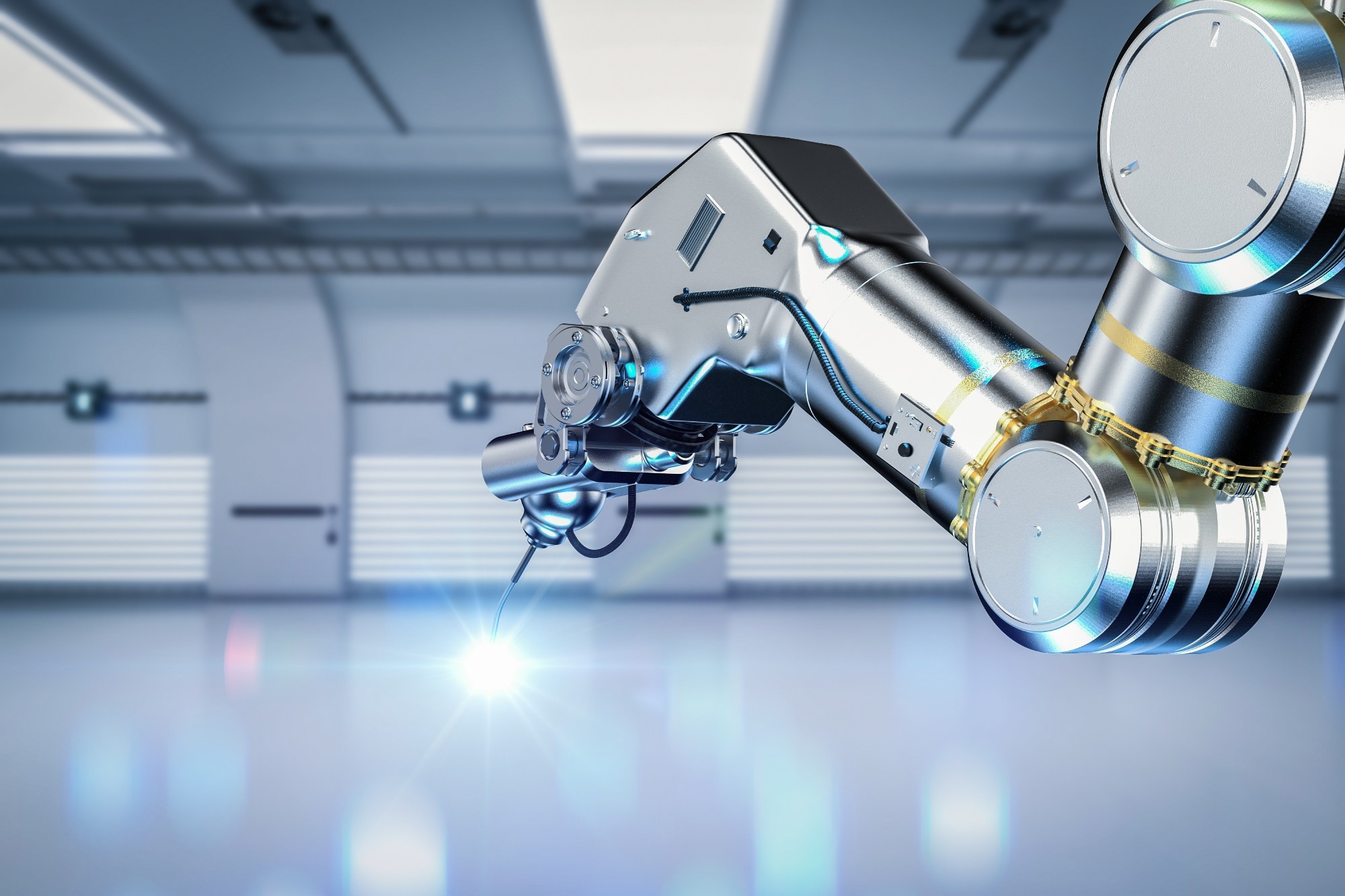 Image Credit: Phonlamai Photo/Shutterstock
This feedback allows robots to adjust their actions while they work. The article talks about how technologies such as six-axis sensing, strain gauges, calibration, and sensor fusion enhance robot performance. It also looks at how these technologies improve the accuracy of industrial robots in tasks such as assembly, polishing, machining, and collision avoidance.1,2
6-Axis Sensing and Strain Gauges
Any contact between a robot tool and a workpiece produces a combination of loads acting in multiple directions simultaneously. A 6-axis force/torque sensor resolves that combination into 3 forces along the x, y, and z directions and 3 torques about the same axes. This complete description is called a wrench, which the controller uses to understand how hard the tool is pushing and in which direction it is tilting or twisting.2
At the core of most 6-axis sensors is a metal elastic body designed to flex slightly when under load. Strain gauges affixed to its surface experience changes in electrical resistance as the metal stretches or compresses, and bridge circuits translate these variations into voltage changes. A study published in the Journal of Robotics and Mechatronics paired semiconductor gauges for low loads with metallic foil gauges for higher loads. As a result, the sensor can resolve forces as small as 0.035 N while tolerating substantial loads.3
Calibration for Accurate Readings
Raw gauge voltages do not directly correspond to individual forces and torques. A load applied along one axis also disturbs gauges intended for other axes, an effect called crosstalk or coupling. Calibration addresses this by applying known loads, recording the outputs, and computing a matrix that converts six raw signals into six clean force and torque values. Errors left in this step carry into every later control decision.2
While linear calibration matrices are effective for many sensors, real-world structures usually behave nonlinearly. In a recent work published in IEEE, a neural network was optimized via particle swarm optimization to decouple the axes. The accuracy improved by about 1%. Calibration on a working robot must also subtract the weight of the attached tool, because gravity acting on a gripper or spindle can be misinterpreted as a false contact force.2
Sensor Fusion Combines Touch with Sight
Force sensors report conditions at the moment of contact, while cameras locate parts and estimate their orientation before contact occurs. Sensor fusion merges these streams so a robot can approach a part using vision and finish the task using touch. Fused data also helps when one sense degrades, such as when a gripper blocks the camera view of a hole during the final millimeters of an insertion.4
Nowadays, machine learning handles much of this data merging. Researchers use both vision and force data to teach a robot to improve its skills over time. It involves a step-by-step approach that makes tasks progressively harder. As a result, the robot can coordinate both senses during contact-rich assembly, a class of tasks in which small misalignments generate large reaction forces that a camera working alone would fail to register.4
Force-Guided Robotic Assembly
Peg-in-hole insertion, in which a pin, shaft, or connector enters a closely matched opening, ranks among the most common and widely studied assembly operations. Studies show that controlling end-effector position alone cannot deliver high-precision, high-efficiency insertion. Tight clearances leave almost no room for error, as parts can jam if the robot misjudges alignment by even a fraction of a millimeter.1
Force feedback allows the robot to respond to the actions of individual parts. For example, when the peg touches the edge of a chamfer, the sensor registers a lateral force and a tilting torque. A compliant controller then adjusts the tool to minimize these issues. This technology has advanced from simple compliance devices to more intelligent systems that correct movements based on real-time force measurements.1
Force Control in Polishing and Machining
The quality of surface finishing depends heavily on the contact force, as the rate of material removal is directly related to the applied pressure. A robot that exerts too much force can overcut the surface, while one that applies insufficient pressure may leave undesirable marks. A study in MDPI Sensors on blade grinding found that constant force and real-time surface tracking are critical. The work also concludes that active force control has largely replaced less stable passive methods in this domain.5
Robotic milling and drilling complicate the situation because robot arms are less stiff than traditional machine tools and can vibrate under cutting loads. This self-excited vibration, known as chatter, damages surfaces and quickly wears tools. Cutting force measurement is one of the primary methods for detecting chatter, since force signals reveal unstable cutting early enough for a controller to reduce spindle speed or depth of cut.6
Safer Robots Through Collision Detection
Force and torque sensing also guards against unplanned contact. A 6-axis sensor mounted at the base of a robot can detect collisions once its readings are corrected for the static and dynamic loads caused by normal motion. When these corrected measurements are combined with feedback from each joint, the system identifies which joint is involved and calculates where on the arm the contact occurred.7
Download the PDF of this page here
This feature supports collaborative robots that share space with workers. A robot that quickly recognizes an impact can stop or retract before the force becomes dangerous. It can also distinguish between intentional human guidance and accidental bumps, allowing workers to teach movements by hand. This sensitivity also protects costly fixtures and tooling from crash damage when a programming error causes the arm to follow an unintended path.7
Conclusion
Force and torque sensors provide industrial robots with a quantitative sense of touch through 6-axis measurement, strain-gauge transduction, careful calibration, and integration with vision systems. With these layers, robots can adjust their motions for various tasks, including assembly, polishing, machining, and collision detection. As manufacturing precision comes to depend on controlling contact as rigorously as position, force feedback will become crucial for ensuring that robots operate accurately and safely on production lines.
References and Further Reading
- Li, S. et al. (2025). Advances in Robotic Peg-in-Hole Assembly: A Comprehensive Review. Chin. J. Mech. Eng. 38, 196. DOI:10.1186/s10033-025-01349-w. https://link.springer.com/article/10.1186/s10033-025-01349-w
- Ren, W. et al. (2024). Development and Application of a Novel High Precision Six-Axis Force/Torque Sensor. IEEE Access. DOI:10.1109/ACCESS.2024.3435467. https://ieeexplore.ieee.org/document/10614162
- Kawahara, T. et al. (2023). Development of High Dynamic Range Six-Axis Force Sensor with Simple Structure. Journal of Robotics and Mechatronics. DOI:10.20965/jrm.2023.p0771. https://www.jstage.jst.go.jp/article/jrobomech/35/3/35_771/_article
- Jin, P. et al. (2023). Vision-force-fused curriculum learning for robotic contact-rich assembly tasks. Frontiers in Neurorobotics, 17, 1280773. DOI:10.3389/fnbot.2023.1280773. https://www.frontiersin.org/journals/neurorobotics/articles/10.3389/fnbot.2023.1280773/full
- Shi, X. et al. (2023). Research on Surface Tracking and Constant Force Control of a Grinding Robot. Sensors, 23(10), 4702. DOI:10.3390/s23104702. https://www.mdpi.com/1424-8220/23/10/4702
- Navarro-Devia, J.H. et al. Chatter detection in milling processes - a review on signal processing and condition classification. Int J Adv Manuf Technol 125, 3943–3980. DOI:10.1007/s00170-023-10969-2. https://link.springer.com/article/10.1007/s00170-023-10969-2
- Wang, Z. et al. (2023). Research on Identifying Robot Collision Points in Human–Robot Collaboration Based on Force Method Principle Solving. Actuators, 12(8), 320. DOI:10.3390/act12080320. https://www.mdpi.com/2076-0825/12/8/320
Disclaimer: The views expressed here are those of the author expressed in their private capacity and do not necessarily represent the views of AZoM.com Limited T/A AZoNetwork the owner and operator of this website. This disclaimer forms part of the Terms and conditions of use of this website.